How to Use Data to Improve Donor Retention in Your Church
In today’s digital world, churches strengthen relationships with their donors by using data insights which helps…
Read More →
Short on time? Let AI do the work. Get the key points.
A silent auction is one of the most effective nonprofit fundraising strategies for raising funds. Such auctions help nonprofits to increase donor engagement, and build community support for a long-term.
Unlike traditional auctions, in silent auctions participants place bids on donated items using paper bid sheets or digital bidding platforms. This creates an interactive and enjoyable experience for every participant involved.
Whether nonprofits are organizing silent auctions as in-person, online, or hybrid events, a well-planned silent auction fundraiser can highly increase fundraising revenue while also improving their relationships with donors, sponsors, and volunteers.
Executing a silent auction successfully requires careful plans, clear fundraising goals, strategic marketing, and strong event management.
Each step from selecting a theme, securing auction items, promoting the event and processing payments efficiently, every step has to be executed properly to achieve the mission of your nonprofit.
Modern fundraising tools like Simplygiv can simplify event registration, donor management, secure payment processing, and reporting, that allow nonprofits to make operations smooth and reduce admin work.
This blog will walk you through every step of planning and execute a silent auction successfully.
Following these best practices helps nonprofits to execute an engaging event, attract more supporters, raise maximum donations, and generate impactful funds to support long-term community impact.
Also Read: Online Fundraising Ideas for Nonprofits to Raise More Donations – Simplygiv
It is a fundraising events where participants place bids on donated items without a traditional auctioneer.
Guests can place their bids using paper bid sheets or digital platforms while contributing to and supporting the mission of nonprofits.
While the funds raised by nonprofits helps them to support programs, services, and community services. A silent auction can be held in person, online, virtually, or as hybrid events.
Such auctions are effective because such events combine fundraising, community engagement, and entertainment all in a single event.
Also Read: Creative Fundraising Virtual Event Ideas for Nonprofits in 2026
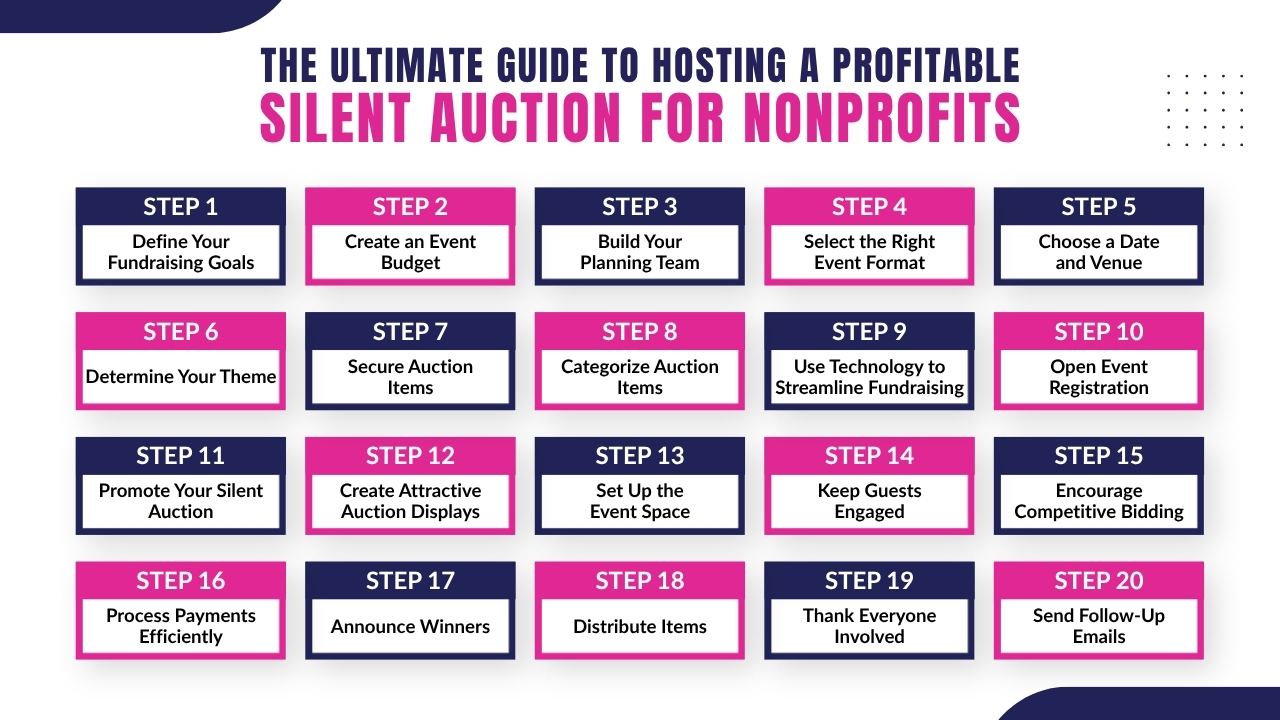
Before planning a silent auction, nonprofits must establish clear fundraising goals. Because setting objectives early helps different teams to remain organized, make informed decisions, and monitor the overall success of the event.
It is essential for nonprofits to have financial and participation goals that creates a strong foundation for your fundraising strategy.
Having clear goals, helps nonprofits with a clear direction, improves team coordination, and ensures that their silent auction achieves meaningful fundraising results.
Also Read: How to Track Event Attendance for Nonprofit Fundraisers and Community Events
While managing a silent auction successfully it is essential for having a realistic budget. Having a detailed budget helps nonprofits to control expenses, predict revenue, and avoid unexpected expenses.
The goal is to raise maximum fundraising revenue while keeping expenses within a manageable range.
Having a well-defined budget helps nonprofits to remain financially organized and allows them to make better decisions throughout the planning process.
Also Read: How to Run a Successful Donation Campaign
To organize auction events successfully needs detailed planning such as forming teams with well-defined responsibilities.
Forming different teams helps nonprofits to assign each event task efficiently, improve communication with attendees, and reduce stressful planning processes.
Nonprofits must ensure that each team member understands their role accurately to ensure that their events run smoothly.
Having a well-defined team lets nonprofits improve efficiency, improve attendee experiences, and execute a fundraising event successfully.
Nonprofits must select the right event format which increases participation and helps to achieve their fundraising goals.
While choosing the event format nonprofits must think about their audience, available resources to decide the event format which is the most suitable.
When nonprofits choose the right event format helps them to improve engagement with audiences and create a better experience for participants.
Choosing the right event format helps nonprofits to engage more with supporters and achieve maximum fundraising success.
Also Read: How to Grow a Church Fast Without Losing Your Mission
Choosing the right date and venue is essential for increasing participation from supporters and creating a silent auction experience successfully.
Nonprofits must select a date which is convenient for their participants. They must avoid scheduling an event on major holidays, local festivals, or competing charity events as it may reduce participation.
While choosing a venue, nonprofits must ensure that they can comfortably accommodate guests and provide a welcoming ambience for the event.
Nonprofits must book their venue in advance so that they can secure the venue on their preferred date without any major challenges.
Nonprofits must select a theme which makes these silent auctions memorable and engaging for participants.
Having a creative theme helps nonprofits to build excitement, improve identity of nonprofits, and gives a good experience to participants through donations, invitations, and entertainment.
They must select a theme which aligns well with the interests of audiences and supports the mission of the organization.
Select a theme that aligns with your audience’s interests and supports your organization’s mission.
With a well-planned theme nonprofits can encourage more participation from donors, improve donor experiences, and establish a memorable fundraising event that participants will enjoy and also remember.
Auction items are the center of executing a silent auction successfully. Nonprofits must select items which attract their audience and encourage competitive bidding.
Providing different types of experiences, services, and products can encourage more participants to participate and increase fundraising opportunities.
Nonprofits must partner with local businesses, restaurants, hotels, sponsors, and supporters.
They must personalize every request and explain their mission, event details, number of participants, marketing benefits, and donor recognition opportunities to encourage more donations.
Also Read: What Is Donor Management Software? A Complete Guide
Organizing auction items clearly into different categories makes it easier for attendees to check auction items and place bids.
Displaying auction items in a well-organized way improves the overall experience of guests and encourages more participation from attendees.
By grouping similar items together helps participants to quickly find items which match with their interests and increase the chances of competitive bidding.
Organizing a clear, well-defined display of auction items makes it easier for participants to attend the event and helps participants to spend more time exploring items, which ultimately increases donor engagement and fundraising opportunities.
Using technology helps nonprofits to manage silent auctions easily and improve overall event efficiency.
Platforms like SimplyGiv helps nonprofits to manage fundraising events even before, after, during the event as it centralizes all crucial tasks at one place. This reduces manual tasks and lets teams prioritize donor engagement.
Rather than using spreadsheets and paper records, nonprofits can manage fundraising operations through a single platform.
Technology helps to improve accuracy, saves time, and improves relationships with donors, which makes it easier for nonprofits to run a silent auction efficiently.
Also Read: Top Online Fundraising Ideas to Grow Donations Fast
Nonprofits must begin their event registration early to help them to predict the number of attendees, plan resources, and build excitement before the silent auction.
Providing an easy registration process makes the guest experience smooth and allows organizers to gather attendee details in advance.
Nonprofits must consider offering early bird pricing to encourage more registration and increase the number of participants. While early registration helps teams to prepare more effectively and provide a smoother experience for guests on the day of the event.
Also Read: Church Donation Kiosks: How Technology Is Modernizing Sunday Giving
Effective marketing is crucial for increasing participation from donors and raising maximum funds. Nonprofits must create a promotional strategy which uses multiple channels to reach attendees, donors, and sponsors.
By consistently promoting auction events helps nonprofits to increase visibility, attract new supporters, and helps to create a silent auction successfully.
Also Read: 50 Short Thank You Messages for Donations
The way nonprofits display auction items can highly affect bidding activity. Organizing attractive displays make items more attractive and encourage more audiences to participate.
They must use professional signage and maintain neat, visually attractive, and easy to navigate displays.
They must use decorations which match with your event themes and avoid overcrowding display areas. By organizing presentations well, nonprofits can improve the guest experience and increase bidding participation.
Also Read: Why Your Church Needs a Mobile Giving Solution This Year
By organizing event space well helps to create a positive experience for attendees and ensures that the silent auction runs smoothly.
Nonprofits must arrange the venue well so guests can move between different spaces without any confusion.
By organizing the venue well allows guests to move easily between different areas of the event, and build a smooth and professional fundraising experience for all participants.
Nonprofits must keep guests engaged throughout the event that allows them to maintain excitement and also encourages them to participate in bidding.
Interactive activities help to create an enjoyable ambience while feeling more connected to the mission of nonprofits and encourage deeper engagement.
When guests feel involved then there are high chances that they may participate and donate more.
When guests remain engaged then they may stay longer, place more bids, and become strong supporters of nonprofit organizations.
Also Read: Church Events Management Best Practices
Nonprofits must encourage competitive bidding as it helps them to increase donor participation and raise maximum funds.
They must create excitement throughout the event by using strategies which encourage attendees to place more bids and stay engaged till the auction closes.
When nonprofits create a sense of urgency encourages attendees to act quickly and increases the chances of higher final bids which helps nonprofits to achieve stronger fundraising results.
Efficient payment processing is essential for creating a smooth checkout experience and improving attendee satisfaction. Providing several payment options allow guests to complete their purchases quickly and conveniently reducing long queues and delays after the auction closes.
Platforms like Simplygiv can simplify donation collection securely and payment tracking by centralizing transactions at a single place.
These tools help nonprofits to reduce admin work, reduce checkout delays, and generate accurate financial records. Having a quick and organized payment process creates a positive impression among attendees and encourages them to participate in future fundraising events.
Also Read: Top Benefits of Using Donation Kiosks for Nonprofits and Charities
Nonprofits must clearly announce winners as it helps them to end the silent auction on a positive note. They must share results promptly so attendees can complete payments and collect their items without any confusion.
It is also a great opportunity to celebrate everyone’s contributions and reinforce the impact of their support.
Not just the winners, nonprofits must congratulate all participants for their support. When nonprofits recognize their donation it creates an unforgettable experience and encourages supporters to participate even in the future.
Also Read: 10 Powerful Thanksgiving Sermons Every Pastor Can Preach
Having a well organized item distribution process helps nonprofits to ensure they end their silent auction smoothly.
A well organized item pickup process reduces delays, mistakes, and ensures a smooth and positive experience for winning bidders.
Nonprofits must pack items carefully to avoid damage and keep the process efficient. Because when some attendees are not able to collect their items in person, consider providing them shipping or delivery options.
A well organized distribution process improves attendee satisfaction and gives a positive final impression of your fundraising event to attendees.
Nonprofits must thank every participant after a silent auction which is essential for building long-term relationships and encourage future support.
They must send thank-you messages promptly to recognize their contributions and show appreciation for their involvement.
Sending personalized thank-you messages help supporters to feel value, improve relationships with donors, and increase the chances of their future involvement with your nonprofit.
Also Read: 100 Best “Thank You for Donation” Quotes for Donor Appreciation
Sending follow-up emails within 48 hours is essential for maintaining good relationships with donors after your silent auction.
With prompt communication with attendees nonprofits can show appreciation, build trust, and keep audiences connected to their mission which also encourages them to participate in future and continued giving.
Transparent communication helps donors see the impact of their support, strengthens relationships, and increases the likelihood of long-term engagement with your organization.
Running a successful silent auction requires good planning, effective communication, and strong teamwork.
Every step like setting fundraising goals, selecting the right event format, securing auction items, and promoting the event, plays a crucial role in achieving objectives of fundraising.
A well-organized silent auction not just helps nonprofits to increase revenue and helps to build stronger relationships with donors, sponsors, volunteers, and community supporters.
Using technology platforms like Simplygiv can further simplify fundraising operations by making event registration simple, secure payment processing, donor management, and reporting.
This lets nonprofits teams spend less time on admin tasks and more time focusing on donor engagement and community impact.
After the event, following up with attendees and being thankful can improve long-term relationships and encourage future support.
Implementing best practices enables nonprofits to create engaging experiences, raise maximum funds, and build a sustainable foundation for future growth and impactful community impact.
If you still have any questions about how a silent auction works, feel free to contact SimplyGiv. Our team is always happy to assist you. Ready to get started? Book a Demo and see how SimplyGiv can help you launch your silent auction with confidence.