Raffle Ideas: 50+ Creative Ideas
Finding the right raffle ideas can make fundraising campaigns engaging, attract participants, and help them to…
Read More →
Short on time? Let AI do the work. Get the key points.
Organizing successful charity galas near me is an impactful way for nonprofits to bring communities together, raise funds, and build long-term support for important causes.
For your charity gala, whether you are planning a formal dinner, a fundraising celebration, or a community gathering, effective charity gala planning begins with clear goals, a realistic budget, and a good understanding of your audience.
Choosing the right charity gala venues and working with experienced charity event organizers can help to simplify the process and create a memorable experience for guests.
Whether selecting creative charity gala themes, arranging event decorations, planning gala entertainment, catering, and guest registration, every small detail leads to the event’s success.
Implementing strong fundraising strategies, attractive ticket sales, and impactful sponsorship opportunities can help nonprofits to maximize donations.
Before the event, organizers should promote the event through social media marketing, email campaigns, and local partnerships that can attract more attendees and supporters to attend the event.
Further using technology can also make giving easier for supporters. SimplyGiv offers online fundraising tools that support online donation, recurring giving, peer-to-peer fundraising, and donation management, based on the selected features and setup.
All these options can help nonprofits to raise donations and engage supporters more than the event itself.
This blog will walk you through charity gala ideas and planning tips to help you organize an engaging event, improve relationships with donors, and raise funds for your mission.
Also Read: Charity Event: Planning Guide
Organizing a charity gala is a nice opportunity for nonprofits to bring donors, volunteers, businesses, and community members together for an important cause.
Whether nonprofits are planning to organize fundraising dinners, cultural celebrations, nonprofit benefit evenings, all these events can help nonprofits to raise funds, build relationships with customers and increase awareness of their missions.
For planning a charity gala effectively, organizers must search for local venues, experienced event planners, catering services, entertainment, or fundraising opportunities.
Organizing a successful gala involves planning several aspects effectively which includes the event budget, guest list, theme, sponsorships, program, and donation process.
Platforms like Simplygiv can support event-based giving by offering campaign pages, and convenient donation options based on the nonprofit’s setup.
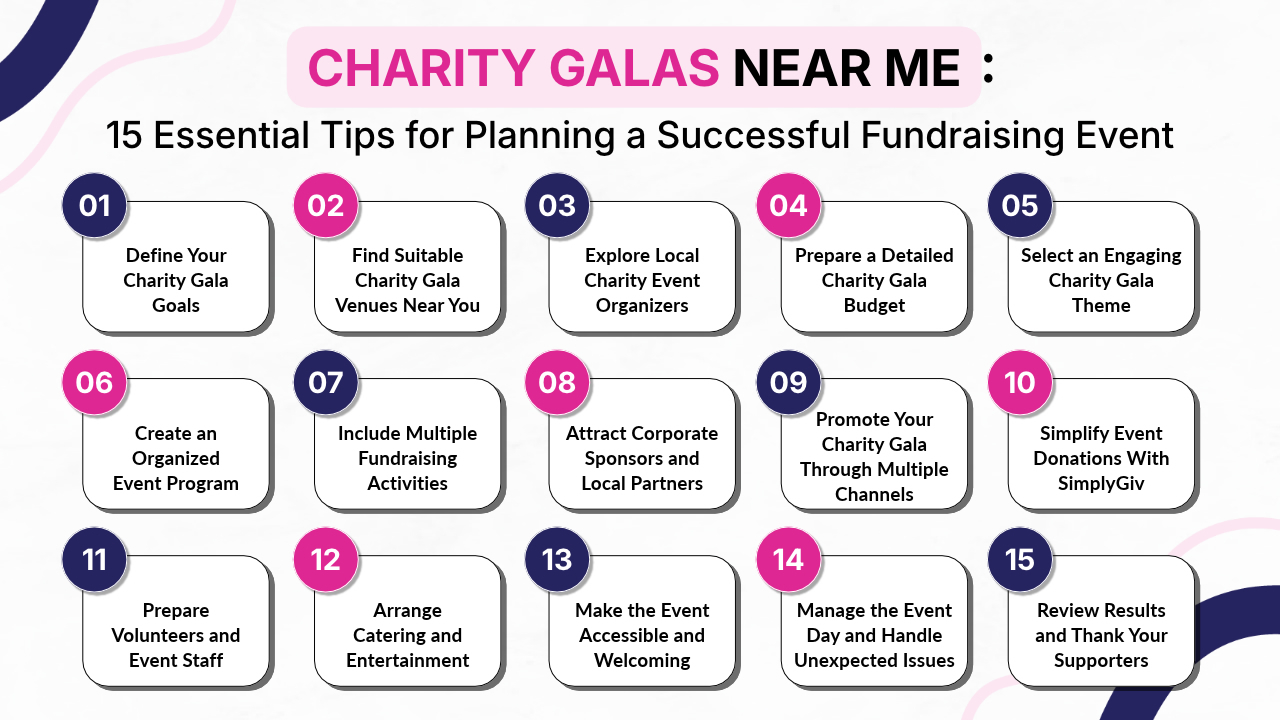
Below are the steps to plan a charity gala, attract supporters, manage event activities, and make the most of your fundraising efforts.
The first step towards planning a fundraising event successfully begins by deciding your goals that you want to achieve. When nonprofits have a clear purpose, it guides them to choose the venue, audience, plan ticket prices, sponsors, and fundraising activities.
Nonprofits might be organizing this charity gala to fund a community project, support nonprofit programs, purchase essential supplies, provide educational opportunities, or increase awareness for a particular cause.
They must set a measurable fundraising target and determine the fund amount that they may need to raise after expenses. For instance, if your nonprofit aims to generate USD 5000 in net proceeds, estimate the amount of funds that can be raised from ticket sales, sponsorships, auctions, and direct donations. This gives a financial target for your planning team and helps you to decide the fundraising activities that should be prioritized for raising maximum funds.
Nonprofits must also set secondary goals such as attracting new donors, finding volunteers, or building relationships with local businesses. Consider whether they want to encourage recurring donations or introduce supporters to other ways of supporting your nonprofits.
Organizers must document their fundraising objectives and share them with everyone involved. Because when committee members, volunteers, sponsors, and event partners clearly understand the purpose, then they can make decisions which support the same goals. A clear mission also helps nonprofits to convey the importance of the event to potential guests.
The venue has an important role for maintaining the ambience and guest experience during fundraising. Depending on expected attendance and budget, organizers must consider hotels, banquet halls, conference centers, heritage properties, and community halls for organizing charity galas.
While comparing different charity gala venues, they must evaluate capacity, location, accessibility, parking, catering facilities. Also check if the venue provides tables, chairs, lighting, microphones, projectors, and staging. They should also confirm if the venue allows external caterers, decorators, entertainers, and fundraising activities.
While comparing venues, organizers must request written quotations from several venues. They must compare rental fees, deposits, service charges, setup time, cancellation policies, cleaning charges, and additional expenses. Organizers must also visit the venue to check the entrance, registration area, dining area, stage, and restrooms.
Finally, select a venue that is convenient for your guests and is suitable for all types of events. They must confirm all important arrangements in documentation before finalizing and paying for the venue.
Also Read: Donate Button Best Practices for Websites
Professional event organizers help organizers with venue arrangements, decorations, catering, entertainment, registration, and event-day operations. Any assistance that event organizers provide may be essential if your nonprofits have less volunteers or if they are planning to arrange a large fundraising event.
For instance, if organizers are planning an event at a place, then they can begin exploring local charity event organizers. Nonprofits may use directories for finding providers rather than considering the providers ensuring service quality.
Before hiring an organizer, it is essential for nonprofits to review their experience with organizing nonprofit events, fundraising dinners, and corporate gatherings.
Request service providers details about their past event work, client references, service details, and a complete quotation. During the event, nonprofits must assign the staff well for each role, where roles include managing vendors, supervising setup, coordinating performers, and handling unexpected problems.
Before the event, nonprofits must discuss their fundraising objectives with the organizer rather than focusing only on decorations. Selecting the best event organizer for your event involves choosing the organizer who understands your budget, audience, schedule, and expectations.
The next step for organizers is to prepare a detailed budget for the charity gala. It helps them to manage event expenses and determine the amount of money remaining for your charitable cause.
Planning the budget involves listing every expected expense and comparing it with available funds before booking suppliers or purchasing materials.
Common charity gala expenses include:
Expenses for the event can be reduced by approaching local businesses for sponsorships. For instance, local businesses may provide drinks, printed services, flowers, or photography support during the event.
Nonprofits must track all estimated and estimated expenses throughout the event planning. They must record invoices, deposits, payments, and outstanding balances.
Finally, nonprofits must calculate the expected net proceeds after deducting costs to understand the amount of funds can be raised for your cause.
Nonprofits must choose an engaging charity gala theme that helps organizers to create a memorable experience for guests. Having a gala theme helps organizers to decide the invitation format, decorations, entertainment, catering, and promotional materials.
Organizers must ensure to choose a gala theme that is the fundraising mission of your organization and must also attract your target audience.
Consider these charity gala theme ideas:
Before finalizing the theme, nonprofits and organizers must consider guests, budget, venue, and event purpose before finalizing the theme. Organizing a formal dinner may be attractive to corporate sponsors while a cultural celebration may attract a wider community.
Ensure that every theme-based event supports your fundraising message and creates a welcoming experience.
Also Read: 25 Online Fundraising Ideas for Nonprofits to Raise More Donations
Creating an organized event program lets guests understand the event programs and lets nonprofits explain its mission and encourage more donations.
Fundraising events must have a proper schedule because without a clear schedule, speeches, dinner service, entertainment, and fundraising activities become disorganized.
A typical charity gala schedule might include:
Organizers must keep the speeches during the event short so that they get enough time for dinner, conversations, and fundraising activities. Sharing a personal story or short presentation can help guests to understand the difference their donations may make. But it is also essential for nonprofits to obtain supporters’ consent before sharing their personal story or images.
Before the event, the event schedule must be shared with speakers, performers, volunteers, caterers, and technical staff before the event. They must rehearse important parts of the program and must be flexible for unexpected delays.
Ticket sales are one of the best ways for nonprofits to generate income. But ticket sales along with different fundraising methods can provide additional opportunities for support.
Nonprofits must choose activities based on your audience, available resources, and local requirements.
Popular charity gala fundraising activities include:
While organizers must explain the rules and terms of each activity to guests before they participate. For auctions, provide right item descriptions, inform participants about bidding deadlines, payment instructions, and collection arrangements. Organizers must check local requirements before organizing raffles, prize draws, or other chance based fundraising activities.
Sponsors can help nonprofits to cover costs while increasing the funds available for charitable programs. Organizers must approach local businesses, restaurants, hotels, retailers, and professional service providers whose interests align with your mission.
Organizers must prepare sponsorship packages that explain the donation amount requested and the way donors will be recognized. Sponsors may receive benefits such as having logos displayed on approved event materials, public recognition during the gala,
requested and the recognition offered. Sponsors may receive benefits like having their logos displayed on approved event materials, receiving public recognition during the gala, being featured on the organization’s website, enjoying reserved seating, or appearing in post-event thank-you messages.
Offer different sponsorship packages at different price points which is suitable for businesses of various sizes. Where top-tier sponsors may receive more visibility and smaller donors recognized in the event program or on a shared sponsor display.
Nonprofits must clearly outline their mission, the gala’s purpose, the intended use of funds, and the expected audience in every sponsorship proposal.
They must document all agreed donations, payment schedules, donated services, and recognition benefits and then send sponsors a post-event summary showing the results and how their support makes an impact.
Also Read: Giving Tuesday 2026: Complete Guide to Giving & Fundraising
Promoting your charity gala through multiple channels helps nonprofits to reach potential attendees, donors, sponsors, and volunteers. Nonprofits must promote the event early so guests and organizers get enough time for making arrangements.
Organizers can create a marketing calendar so that organizers can decide when to invite attendees, announce the event, and when the final updates will be shared.
Use a combination of marketing channels:
Organizers and nonprofits must ensure that the details of the event are shared consistently on every channel. They must ensure that ticket prices, donation instructions, dress code, and registration deadlines are easy to understand.
Use photographs and short updates to communicate the cause behind the gala. Even during promotions, it is essential for nonprofits to track registrations and inquiries so that they can adjust their promotional efforts if needed.
Donors must be able to donate as per their convenience whether they attend donation events in person or support the campaign remotely. Simplygiv offers fundraising and online giving tools that organizations can evaluate for their event requirements.
Some of the features provided by Simplygiv includes campaign pages, customizable donation forms, one-time and recurring donations, peer-to-peer fundraising, and QR-based giving. Availability of features is based on the organization’s chosen setup.
Here are practical ways to consider using SimplyGiv:
Before the event, organizers must test donation forms and payment workflows. Confirm applicable fees, payment methods, data practices, and reporting options.
Train volunteers to guide guests who need assistance. Offering online giving can make donations more convenient, but personal conversations are also important. Organizers must explain donations that they will support and thank contributors for their generosity.
For organizing a charity gala successfully, it is essential for volunteers and event staff to understand their responsibilities. Each staff member must be assigned roles before the event and provide clear instructions to everyone involved. Organizers must not leave important tasks to be decided at the last minute.
Your team may need volunteers for:
Planning for the event begins with preparing a contact list which includes vendor details, staff responsibilities, and important event timing. Organizers must give a short briefing to guests before they arrive so that everyone understands the schedule and knows whom to contact if a problem happens.
They must provide clear procedures for handling payments, cash, donor records, and guest information. While team members must have limited access to sensitive customer information. Efficient volunteers must be recognized during and after the event to show that their donation is valued.
Also Read: How to Set Up Multiple Funds and Split Giving Online
Even the food and entertainment influence the overall experience of guests. Organizers must choose catering options that suit their event format, audience, and budget. A formal dinner may require a different service arrangement than a community arrangement or a shorter fundraising reception.
During the fundraising event, attendees may be served with a plated dinner, buffet, light drinks, or a selection of locally prepared dishes. Before deciding the meal, it is essential for organizers to discuss diet requirements of supporters with the caterer, whether preferred vegetarian, vegan. Confirm serving times, staffing, food safety arrangements, and final guest numbers.
For entertainment, organizers must consider organizing live music, cultural performances, a professional host, or a short presentation connected to your mission. While organizers must keep the entertainment appropriate for the audience while avoiding making the event unnecessarily long.
Organizers must confirm technical requirements with performers and venue staff in advance. They must check microphones, speakers, lighting, and presentation equipment before guests arrive.
Make the event accessible and welcoming for guests with different requirements. While choosing the venue, organizers must consider accessibility while selecting the venue, and planning seating, registration, food service, and entertainment.
Organizers must check if the venue has accessible entrances, lifts, restrooms, and seating before finalizing the venue. Attendees must be clearly instructed about parking and transportation.
Organizers must be inquired about the dietary or accessibility requirements during registration, while collecting only the information required to accommodate them.
Nonprofits must make donation options convenient for supporters who prefer not to use cash. If they provide online giving, attendees must be provided with clear instructions and assistance whenever required. Ensure that the registration and donation processes are easy for guests with different technical experience.
Organizers must use welcoming language in invitations and announcements. Nonprofits must not make guests feel pressured to donate beyond their means.
They must consider seating, clear signage, appropriate lighting, and good sound levels. Planning the event can help organizers to make the guests feel included and allow them to focus on the event and its mission.
For managing the event day well, organizers can prepare an event-day checklist which includes venue access, decorations, equipment, registration, catering, entertainment, and fundraising activities. They must assign a coordinator who can oversee the schedule and convey it to the vendors.
Organizers must check the seating, microphones, lighting, presentation equipment, donation links, and payment arrangements before the guests arrive.
Keep printed or digital copies of the program schedule to the relevant staff. Confirm that the volunteers know their roles and that suppliers understand the setup and service timings.
Prepare backup arrangements if any problems like technical failures, delayed vendors, unexpected attendance changes, or unavailable supplies. Organizers must decide the staff members who can make decisions and how problems should be escalated. While keeping essential contact numbers accessible to the event coordinator.
Each schedule of the event must be tracked and any changes must be communicated clearly. Organizers must keep emergency exits and walkways clear, and ensure that staff knows the safety procedures of the venue. A calm, organized team can respond more effectively when plans change.
Also Read: How to Increase Church Donations with Online Giving Tools
After the gala, organizers must review results and thank your supporters to check its financial performance and maintain relationships with everyone who donated.
Calculate income from tickets, sponsorships, donations, auctions, and other activities. Deduct event expenses to find the net amount raised.
Then complete important follow-up tasks:
Whenever appropriate, use SimplyGiv’s available reporting and donor-management features to help organize campaign results and give records. Handle personal information responsibly and respect donor privacy preferences.
They must consider sending a post-event report that summarizes the fundraising outcome, recognizes sponsors, and explains the next steps for the supported project.
Having a transparent follow-up process helps supporters to understand the impact of their donation and encourages continuous involvement in your organization’s work.
Organizing successful charity galas near you requires thoughtful planning, clear goals, and a strong understanding of your fundraising objectives. Whether choosing the right venue and creating an engaging theme to arranging entertainment, securing sponsors, and promoting ticket sales, every decision contributes to the overall guest experience.
A well-planned gala can do more than raise funds as it can strengthen community relationships, introduce new supporters to your mission, and encourage supporters for continuous improvement.
Begin by setting a realistic fundraising target and preparing a detailed budget. Choose a venue that suits your audience, coordinate reliable vendors, and provide activities that encourage guests to participate.
Start by setting a realistic fundraising target and preparing a detailed budget. Choose a venue that suits your audience, coordinate reliable vendors, and provide activities that encourage guests to participate.
Combining ticket sales, sponsorships, auctions, and direct donations can create multiple opportunities to generate contributions. Consistent communication before and after the event also helps build trust and maintain donor relationships.
Digital fundraising tools can further simplify the process. SimplyGiv can support online donation campaigns, recurring giving, peer-to-peer fundraising, and donor management, depending on the features available in your setup. Sharing convenient donation options allows supporters to contribute even if they cannot attend the gala.
Ultimately, the success of your charity gala should be measured not only by the funds raised but also by the connections created and the impact achieved. With careful preparation, effective teamwork, and transparent communication, your event can make a meaningful difference for the cause you support.
If you still have any query about Charity galas near me and planning then you may schedule a call at SimplyGiv and we are more than happy to assist you.