
Text-to-give vs Text-to-donate
Choosing between text-to-give and text-to-donate can feel confusing because both begin with an SMS keyword and…
Read More →
Short on time? Let AI do the work. Get the key points.
Planning a charity event successfully requires more than selecting a venue and inviting guests. A well-executed fundraising event requires a clear purpose, measurable goals, careful budgeting, effective promotion, and a powerful strategy for engaging donors and supporters.
Whether you are planning to organize a charity gala, community fundraiser, walkathon, auction, or virtual campaign, every aspect should support the mission of your organization and also create a meaningful experience for attendees.
Effective charity event planning starts by defining a fundraising goal, identifying their target audience, preparing event budget, and building a capable planning team.
Organizations must also develop a sponsorship strategy, recruit volunteers, select the right venue, and create an event marketing plan.
By letting supporters donate conveniently through online donations, digital fundraising, and recurring giving options can make it easier for supporters to donate before, during, and after the event.
Implementing advanced technology can simplify donor management, event registration, payment collection, and fundraising analytics. Platforms like SimplyGiv provide online giving, fundraising tools that support online donations, QR-based giving, recurring donations, events, donor records, and reporting.
Every aspect of charity event planning whether setting objectives, securing sponsors, promoting the event, managing logistics, collecting donations, measuring results, requires thoughtful preparation.
This blog will walk you through the important steps while planning a successful charity event, increasing fundraising opportunities, improving engagement with donors, and building long-term relationships with supporters, sponsors, volunteers, and the community.
Also Read: Bootstrapped Fundraising Strategy for Startups
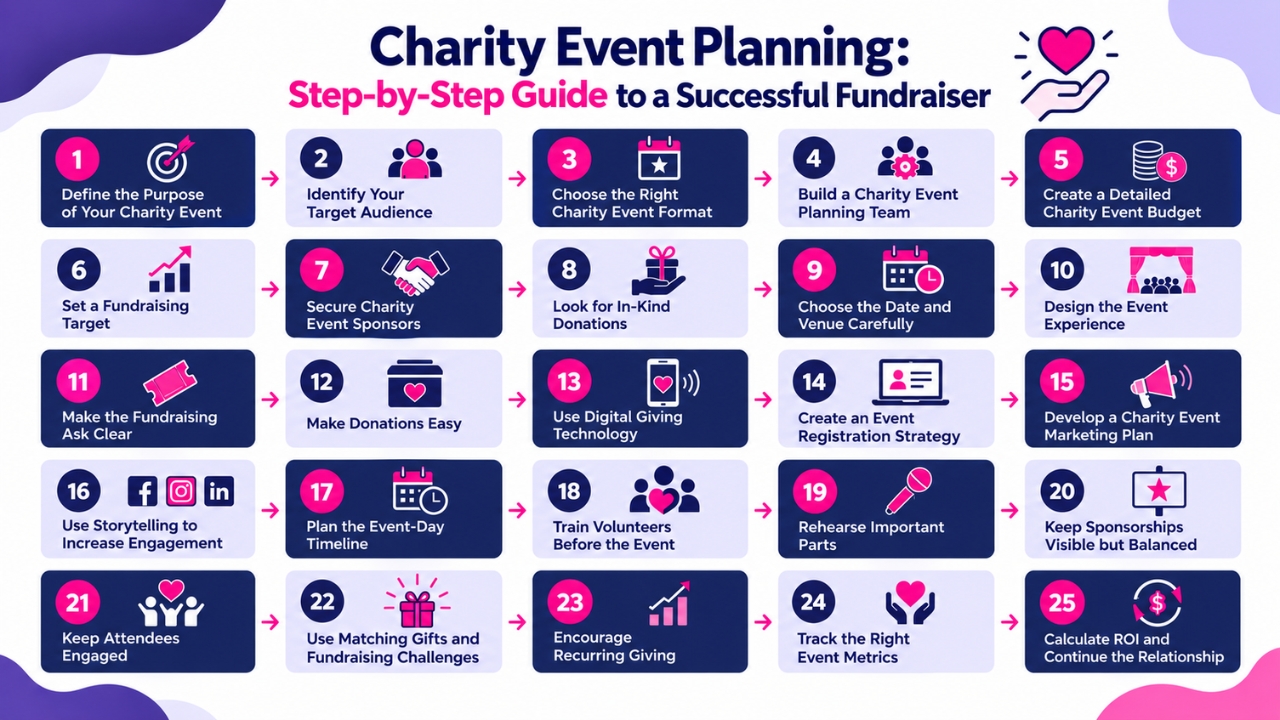
Planning a charity event successfully goes beyond choosing a venue and inviting guests. It requires clear objectives, a defined audience, realistic financial planning, effective promotion, event-day operations smoothly, and thoughtful after event follow-up.
Below are the 25 steps that offer a structured approach for planning an event to raise funds while improving relationships with donors and community engagement.
For organizing an event successfully, nonprofits must first have a clearly defined purpose. Because it is essential for nonprofits to find the cause that they want to support, the donation amount that they want to raise, and the cause for which these funds will be used.
Having a clear purpose helps to share your event format, messaging, audience, and fundraising activities. They must set trackable objectives instead of relying on general goals. These goals make it easier to track progress and analyze results after the event.
Your objectives may include:
When nonprofits have clear goals, the planning team remains focused and gives measurable criteria for detecting whether the event achieved their purpose.
The next step is to find their target audience. Because different audience groups respond differently to different event formats, messages, and fundraising.
While it is essential for nonprofits to understand the donors that they want to attract and understand the areas that encourage supporters to attend, participate, or donate. As the target audiences can influence the venue, ticket prices, entertainment, promotional content, and overall event experience.
Potential audiences may include:
For instance, some supporters may enjoy a formal gala, while other supporters may enjoy a community festival or walkathon. Understanding preferences of audiences helps to choose the most effective marketing channels.
Also Read: Donation Kiosk Software for Nonprofits and Churches
There is no such universal charity event format that works well for every nonprofits.
Some of the charity event formats are charity galas, fundraising dinners, silent auctions, live auctions, concerts, community festivals, fun runs, golf tournaments, trivia nights, sports events, online fundraisers, virtual auctions, hybrid events, networking events, and awareness campaigns.
As per their fundraising goal, audience, budget, resources, and cause, nonprofits must choose the event format.
A gala event or auctions work well during major fundraising but a festival can support community awareness. While a virtual fundraiser can be useful while the nonprofits want to reach supporters and increase community awareness.
A charity event should not depend on one person handling every responsibility. Create a planning committee and assign clear ownership or major tasks.
Major roles in the event planning team are event coordinator, finance manager, marketing manager, volunteer coordinator, venue and logistics manager, ticketing manager, donor relations coordinator, technology lead, and auction or entertainment coordinator.
When responsibilities of every role is clearly defined, then there are less chances of duplicate work and makes it easier for nonprofits to assign tasks. Every important aspect of event planning like venue selection, budgeting, registration, sponsorships, donations, and technology should have appropriate team members.
Also Read: Donor Management Software Guide: Everything Nonprofits Need to Know
A fundraising events should generate impactful funds for the cause instead of consuming most of its revenue through unnecessary expenses. It is essential to create a detailed budget before committing to important purchases or contracts.
Consider costs such as:
By separating fixed expenses from variable expenses and estimating potential revenue from tickets, sponsorships, donations, auctions, merchandise, matching gifts, corporate contributions, and in-kind support. While the crucial metric is the projected net fundraising outcome rather than the total gross revenue generated.
Having a clear fundraising goal enables the team to have a measurable target. They must begin by estimating total event expenses and deciding the desired net proceeds.
For instance, if projected expenses are $20,000 and the goal is to raise $50,000 net, then the event should generate at least $70,000 in total revenue to achieve the target.
It is also essential to create several revenue streams rather than depending fully on ticket sales. Crucial sources of revenue streams are tickets, sponsors, auctions, direct donations, and matching contributions.
Throughout the campaign, nonprofits must effectively track tickets sold, sponsorship revenue, donations, auction commitments, net funds raised, donor numbers, average donation size, and recurring donors.
Also Read: Text To Give Vs Text To Donate
Sponsors also support charity events through cash contributions, products, services, or promotional assistance. Sponsors can be local businesses, restaurants, banks, technology companies, healthcare organizations, retailers, professional service firms, and corporate foundations.
Having a well-planned sponsorship strategy can reduce event expenses, improve available resources, and increase the overall chances for achieving fundraising success.
They must create sponsorship packages with clearly defined benefits for each contribution level. For instance, a Gold Sponsor can receive premium branding, VIP access, website promotion, and social media recognition, while Silver and Community Sponsors can receive progressively customized promotional benefits.
Also focus on the value that sponsors receive, that includes brand exposure, community recognition, networking opportunities, and good association with the charitable cause. By clearly communicating these benefits to supporters can make sponsorship opportunities more attractive to potential partners.
Not every sponsor requires financial support. Businesses may donate catering, printing, venue space, photography, entertainment, auction items, transportation, equipment, gift certificates, or advertising.
In-kind contributions can highly reduce event expenses and allow more of the money raised to support the nonprofit’s mission. For instance, donated catering can remove a substantial event expertise while providing the contributing business with appropriate sponsor recognition.
Track all donated products and services along with their estimated monetary values. Proper documentation supports accurate financial reporting and provides a complete picture of the savings created through community partnerships.
Also Read: How to Track Donor Engagement for Nonprofits and Churches
The event date can directly influence the number of people who attend the event. So before choosing an event date, it is essential to consider major holidays, school holidays, community events, competing nonprofit fundraisers, sporting events, local festivals, weather patterns, and the availability of crucial speakers or sponsors.
Begin planning early whenever possible. While choosing venues, consider venue capacity, accessibility, parking, public transportation, restrooms, catering restrictions, audiovisual equipment, Wi-Fi, accessibility requirements, registration areas, donation areas, and emergency procedures.
Just choosing a beautiful venue location is not necessarily the best choice if the venue has logistical difficulties or is very expensive. The venue should support the attendee experience without compromising financial objectives.
Fundraising should remain central, but attendees should also have an enjoyable and impactful experience. Think through the complete journey from invitation and registration to arrival, check-in, programming, fundraising, donation, closing, and follow-up.
Use activities that create an emotional connection with the mission like beneficiary stories, videos, guest speakers, performances, interactive experiences, auctions, photographs, mission displays, and impact presentations that demonstrate the organization’s work.
They must keep the program clear and well-paced to maintain guest engagement. Having a focused schedule ensures important fundraising messages receive proper attention without making the event feel too long, crowded, or overwhelming.
Also Read: Why Your Church Needs a Mobile Giving Solution This Year
A charity event can be entertaining and professionally organized but still fail to raise enough donations if the fundraising request is not clear.
Attendees should understand what the organization does, what problem they address, what the event will fund, and how much support is required, and how they can contribute.
Through specific examples nonprofits can explain the impact that donations will make on other’s lives. Rather than making a general request for support, they must explain how donations contribute to specific, measurable outcomes that the organization can actually demonstrate.
When nonprofits clearly explain the impact that donations will make in other’s lives, it helps donors to understand why their donation matters and what the fundraiser is designed to accomplish.
They must reduce donation challenges by providing convenient donation options like online forms, QR codes, mobile, and text-to-give, card payments, online wallets, recurring donations, and dedicated event pages that make donations quick and accessible for supporters.
For in-person events, they must keep QR codes where attendees can easily see them, that includes tables, program materials, screens, registration areas, auction spaces, and exits. The objective is to make giving possible without needing guests to search manually for a donation page.
The easier the donation process is, the less likely technical or procedural barriers are to interrupt a donor’s willingness to contribute.
Also Read: What Is Donor Management Software? A Complete Guide
Digital fundraising tools can support several aspects of the event workflow. SimplyGiv provides online giving, text-to-give, QR giving, recurring gifts, event giving, donor records, receipts, reporting, and engagement capabilities.
For an event, digital giving technology helps nonprofits to collect donations, support QR-based giving, maintain donor information, provide receipts, monitor event activity, and review fundraising reports.
The value of digital tools goes beyond accepting payments. Connecting giving activity with donor records can help organizations to understand engagement and identify opportunities for appropriate follow-up after the event.
Registration should collect the information the planning team genuinely needs without creating unnecessary steps or complicated forms. Based on the event, it could include a participant’s name, email address, phone number, ticket type, guest information, dietary requirements, accessibility requirements, sponsorship information, and donation preferences.
Avoid asking for excessive information. Long registration forms can make the process frustrating and may increase cart abandonment.
Also establish an efficient check-in system. QR-code check-in, digital ticket scanning, guest lists, mobile registration, and printed backup lists can help staff manage arrivals. A simple registration process creates a better first impression and reduces congestion when guests arrive.
Also Read: 20 Creative Fundraising Virtual Event Ideas for Nonprofits in 2026
A successful fundraiser still needs strong visibility. They must develop a promotional calendar covering the entire campaign, using consistent communication across email, social media, websites, community partners, and other relevant channels to attract attendees.
Early promotion can include save-the-date announcements, email campaigns, sponsor announcements, social media teasers, and a website event page.
Mid-campaign promotion can highlight speakers, auction items, beneficiary stories, volunteers, sponsors, and ticket reminders. In the final promotional stage, share countdown updates, ticket availability, event schedules, parking details, important instructions, and timely donation reminders to keep attendees informed and encourage participation.
Use multiple channels, including email, social media, your website, local media, community groups, partner organizations, sponsors, volunteers, and board members. A coordinated approach gives the fundraiser more opportunities to reach potential supporters.
Statistics can show the magnitude of a problem, but using authentic stories help supporters to understand the impact that donations make on other’s lives. Effective storytelling follows a simple approach:
Problem -> Action -> Impact
It is essential to explain the challenges faced by a beneficiary, describe the way nonprofit organizations responded, and then show the impact of donations.
Depending on the organizations, storytelling can use short videos, photographs, testimonials, speaker presentation, and before and after impact data.
They must also use personal stories responsibly by obtaining consent before sharing images, names, or any details. Authentic storytelling should connect supporters with the mission while they protect the privacy, dignity, safety, and personal comfortness of everyone whose experiences are being shared.
Also Read: Church Donation Kiosks: How Technology Is Modernizing Sunday Giving
Planning a detailed event-day timeline keeps the planning team organized and ensures that each activity happens at the same time. They must schedule setup, staff briefings, registration, presentation, fundraising appeals, auctions, sponsor, recognition, and closing remarks. They must share the timeline with crucial team members before the event.
Include essential details such as:
While scheduling charity events, it is also essential to include buffer time for unexpected delays while maintaining a clear schedule. This helps team members to understand responsibilities, coordinate transitions, avoid activity overlaps, and resolve potential time issues before guests arrive.
Volunteers mostly interact directly with attendees that makes training volunteers an important part of the event experience. They must be trained on check-in, registration, donation procedures, guest questions, venue layout, accessibility, emergency procedures, sponsor recognition, auction processes.
It is essential to provide volunteers with proper training instead of assuming that they themselves understand their roles. They must conduct an orientation session and give them written instructions which they can easily refer to.
Involving well-trained volunteers provide an organized and welcoming experience, they must be trained to answer routine queries efficiently, assist attendees, and allow the core planning to focus on important event responsibilities.
Also Read: Easy Christmas Fundraising Ideas You Can Start Today
Rehearsing the complete charity events may not always be practical, but important event aspects should be tested before the fundraising starts. It is also essential to review the event schedule with the core team and identify potential technical or operational issues.
Before the event, testing important systems helps the team to act confidently if something goes wrong.
Important areas to check include:
They must also be ready with backup options such as a spare laptop, printed guest list, mobile hotspot, backup microphone, alternative payment method, and offline donation instructions. Testing these systems beforehand helps to prevent minor problems from turning into major disruptions during the event.
Sponsors should also receive recognition but the main focus should be on the charitable mission. They must set recognition levels based on donation amounts and offer enough visibility to each sponsor.
Recognition can include:
While they must avoid doing excessive branding that could distract attendees from the cause. Through thoughtful sponsor recognition shows thankfulness, builds long-term partnerships, and preserves a professional setting while keeping the charity’s mission and fundraising goals at the core of the event.
Also Read: What Is a Donation Kiosk?
A successful charity event should maintain a slow pace and allow attendees reasons to stay engaged in charity events. Activities must be planned in such a way that creates interaction while keeping the charitable mission at the core.
Engagement ideas include:
Programs should be organized at the right place by reducing any long gaps and excessive entertainment. This helps nonprofits to maintain attendees interest throughout the event, encourage them to donate, and strengthen impactful connections with supporters throughout the event.
Using matching gifts and fundraising challenges creates a sense of urgency and encourages people to donate. A sponsor might agree to make donations up to a defined amount during the event, providing a good opportunity for attendees to increase the impact of their donations.
Other approaches include first-donation challenges, hourly challenges, team fundraising, peer-to-peer challenges, and sponsor-funded milestones.
Supporters should be clearly conveyed about the rules, matching limit, and deadline. Showing fundraising progress can encourage more people to participate by helping supporters to see the way their contributions move closer to its goals and achieving impactful campaign milestones.
Also Read: Church Events Management Best Practices
The fundraising relationship with donors should continue even after the event ends. Although a single contribution is valuable, recurring giving can give more consistent long-term support.
They must offer monthly, quarterly, annual, or membership-style options and clearly explain their impact. Make enrollment simple and convenient for supporters.
Encouraging attendees to become monthly donors can convert a single event donation into an ongoing relationship, that helps nonprofits to build a more stable funding base while maintaining regular communication and engagement with supporters.
The number of supporters who attended charity events does not determine whether a charity event was successful. Organizations should analyze financial, audience, engagement, and operational metrics to understand the overall performance of charity events.
Important financial measures include total donations, ticket, and sponsorship revenue, auction, expenses, net funds raised, and average donation.
Audience metrics can include attendance, registration rates, new donors, and returning donors, while engagement can cover recurring gifts, volunteer sign-ups, social interactions, email activity, and website traffic.
Operational measurements like registration time, donation completion rates, payment problems, volunteer coverage, and schedule performance can reveal aspects for improvement. Reviewing these results helps nonprofits to refine future fundraising strategies.
Also Read: How to Start a Church: Step-by-Step Guide for New Pastors
A large event does not automatically mean a successful fundraiser. Rather they must evaluate revenue, expenses, net funds raised, and the resources invested to determine its overall value. Consider both instant financial results and longer-term benefits.
Important outcomes to review include:
After the event, thank donors, sponsors, volunteers, speakers, vendors, partners, and attendees. Share impactful results and future plans. Follow up with new supporters, review what worked, and document lessons learned. This helps turn one fundraiser into lasting donor relationships and stronger future events.
A successful charity event is built through careful planning rather than a single fundraising idea. The strongest events begin with a measurable purpose, understand their audience, establish realistic budgets, assign responsibilities, secure sponsors, create an engaging experience, and make donating simple.
Digital fundraising should also be considered part of the event strategy rather than an afterthought. Tools such as SimplyGiv can connect online giving, Qr code for donations , recurring gifts, event activity, donor records, receipts, and reporting within a broader fundraising workflow.
Most importantly, the event should be viewed as more than a one-day fundraising activity. The registration, donation, attendance, and engagement data can help organizations understand supporters and build relationships after the event.
By combining strong event planning, fundraising, marketing, donor engagement, technology, and post-event follow-up, nonprofits can create events that not only raise money but also strengthen long-term support for their mission.
The best charity events leave attendees with three clear impressions: the cause matters, their contribution makes a difference, and they want to stay involved.
If you still have any query about charity event planning guides then you may Schedule a Call at SimplyGiv and we are more than happy to assist you.