50+ Raffle Basket Ideas That Actually Raise Money
Raffle basket ideas are one of the most effective ways for nonprofits, churches, to increase donations…
Read More →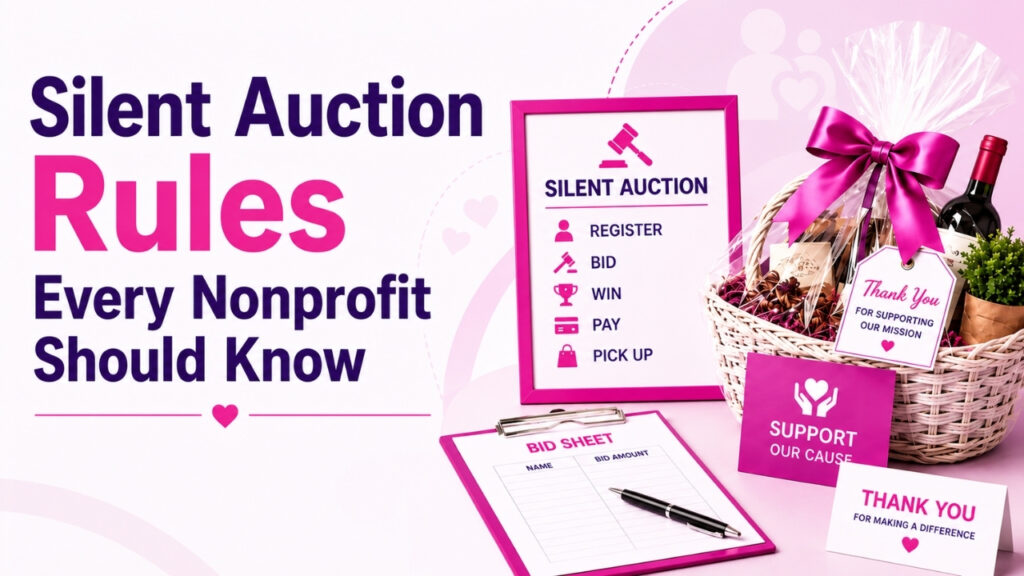
Short on time? Let AI do the work. Get the key points.
Silent auctions are one of the most successful nonprofit fundraising events. Such auctions help nonprofits to raise funds, increase donor engagement, and establish long-lasting relationships with the community.
Whether nonprofits organize silent auctions as in-person, online, or hybrid events, it is essential to establish clear silent auction rules for creating a seamless, transparent, and successful fundraising experience.
Nonprofits by establishing well-defined rules help participants to understand the bidding process, reduce confusion, avoid disputes, and encourage every participant to fairly participate throughout the event.
While organizing silent auction fundraising successfully requires careful planning and organization.
Every phase of silent auction fundraising follows a structured set of guidelines such as bidder registration, item displays, payment collection, and item distribution.
Having clear rules allow participants to bid confidently while helping volunteers and event staff manage operations efficiently.
Because when participants know exactly how the auction works, then they are more likely to stay engaged and place additional bids, which increases fundraising revenue.
Nonprofits should establish policies for bid increments, starting bids, auction closing times, winner selection, payment processing, and checkout procedures before even the event begins.
Establishing proper communication helps to build stronger trust between organizations and their supporters, creating a positive donor experience that encourages ongoing donor engagement and long-term support.
Technology can further improve event management. Platforms like Simplygiv help nonprofits to make smooth event registration, donor management, secure payment processing, and fundraising reporting through a centralized system.
This helps nonprofits to reduce admin tasks of the staff and allow teams to focus more on building relationships with supporters.
This blog will walk you through the most crucial silent auction rules that every nonprofit should know.
By following these best practices, nonprofits can improve event efficiency, raise maximum funds, improve donor satisfaction levels, and create a memorable fundraising experience that supports long-term community impact.
Also Read: How to Run a Silent Auction: Complete Guide for Nonprofits
Nonprofits must establish clear auction rules for executing a well-organized, fair and transparent fundraising event.
Because without having proper guidelines, participants may become confused about the way they place bids, when bidding ends, or how winners are selected.
When nonprofits establish clear auction rules help participants to feel more confident and encourage them to engage actively throughout the event.
Establishing well-defined rules help volunteers and staff to manage rules efficiently while minimizing any misunderstandings and disputes.
Strong auction rules contribute highly to the overall success of a nonprofit fundraiser and create a positive experience for everyone involved.
Establishing clear communication is one of the crucial factors for creating a fundraising event successfully and maximizing nonprofit fundraising results.
Also Read: Creative Fundraising Virtual Event Ideas for Nonprofits in 2026
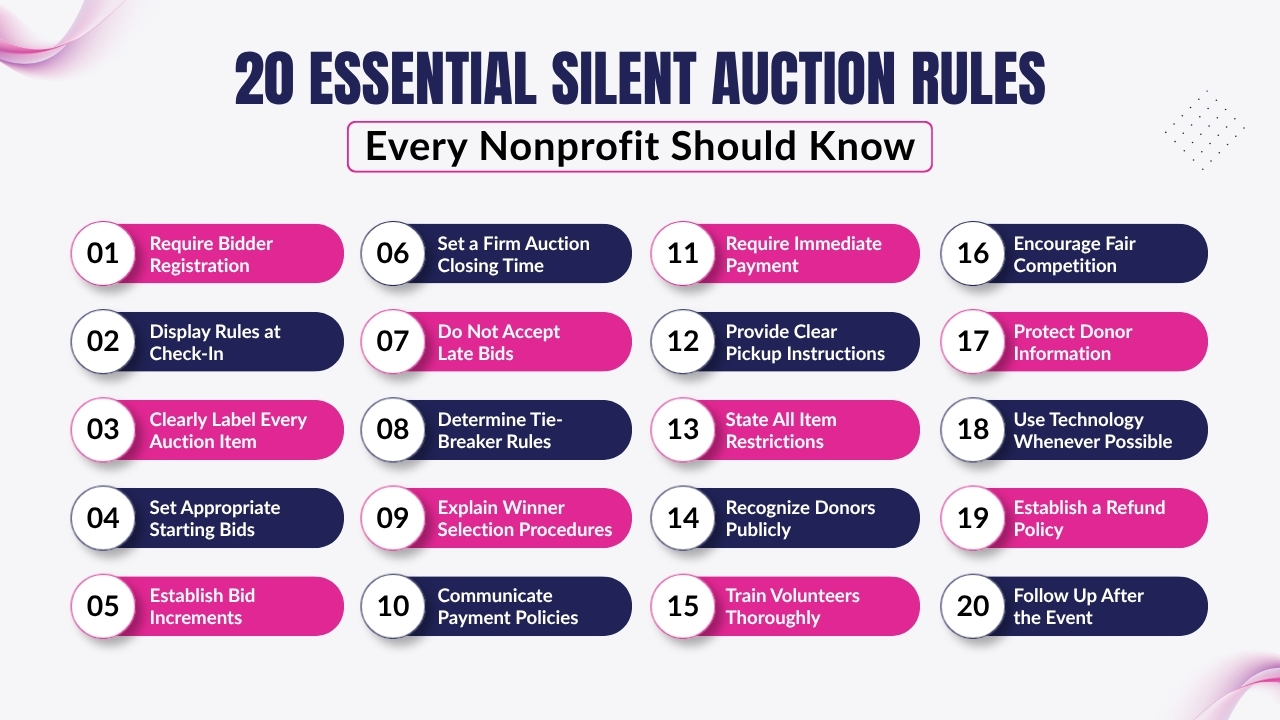
Registering bidders is an important step for running a silent auction successfully. Every attendee must complete the registration process before participating that ensures accurate tracking and managing events smoothly.
Collecting participant information helps organizers to announce winners, verify payments, and reduce admin mistakes throughout the event.
By implementing a well-organized registration process, improves accountability, reduces confusion, and helps volunteers to manage the event more effectively that ensures a smooth experience for all participants.
Also Read: Church Donation Kiosks: How Technology Is Modernizing Sunday Giving
Displaying auction rules at check-in helps attendees to understand the bidding process. This creates a fair and well-organized event experience.
Nonprofits must ensure participants should have easy access to essential information before they start bidding. When nonprofits display clear rules, it helps to reduce confusion, avoids misunderstanding, and helps volunteers to answer queries of participants more efficiently.
Having visible and well-communicated rules help nonprofits to seem transparent, increase the trust of attendees, and ensures a smooth fundraising experience for everyone.
Also Read: Why Your Church Needs a Mobile Giving Solution This Year
Nonprofits have to clearly label every auction item as it helps attendees to understand what they are bidding on and encourages more supporters to participate.
Providing detailed and accurate descriptions helps nonprofits to make the auction seem professional, reduce confusion, and allow attendees to make informed decisions.
Attractive presentations can increase interest and encourage competitive bidding throughout the event.
Providing well-organized item descriptions further improves the experience of participants and also helps to raise maximum revenue funds.
It is essential for nonprofits to set appropriate starting bids because it directly affects bidder participation and overall fundraising success.
When opening bids are too high then it may discourage attendees from participating in such auctions. While reasonable starting bid prices may encourage more people to join the competition.
A common recommendation for nonprofits to set the opening bid between 30% to 50% of an auction item’s retail value which creates a balance between affordability and fundraising potential.
A common recommendation is to set the opening bid between 30% and 50% of an item’s retail value to create a balance between affordability and fundraising potential.
Providing reasonable starting bids helps nonprofits to increase donor engagement, create excitement, and maximize fundraising revenue.
Also Read: Top Benefits of Using Donation Kiosks for Nonprofits and Charities in 2026
Nonprofits must set consistent bid increments that help to create a fair and organized bidding process. Bid increments establish the minimum amount by which participants must raise their bids while competing for an auction item.
Consistent bid increments reduce confusion, encourage steady bidding activity, and make it easier for guests to participate throughout the event.
Establishing clear bid increments makes the auction process simple, helps to create fair competition among participants, and helps nonprofits to raise maximum revenue while providing a positive bidding experience.
Also Read: How to Run a Successful Donation Campaign
Setting a firm auction closing time helps nonprofits to keep the event organized and also ensures fair treatment for all participants.
Nonprofits must clearly communicate about the auction opening and closing times even before the event begins. Sending regular reminders encourages participants to place their final bids and minimizes confusion.
Every participant should have equal auction closing time. Applying consistent rules helps nonprofits to avoid disputes, maintain transparency, and create a fair and professional fundraising experience.
Nonprofits must establish a strict policy against late bids which is essential for maintaining fairness and transparency during a silent auction.
Accepting bids after the official closing time can create confusion among participants, cause disputes, and reduce participant trust.
Once the auction ends, all bidding activities should stop immediately to ensure that every attendee is treated equally.
Following these procedures helps nonprofits to build trust, fairness, and creates professional fundraising experiences for all participants.
Also Read: How to Set Up Multiple Funds and Split Giving Online
Ties can rarely happen during a silent auction, so it is crucial for nonprofits to establish tie-breaker rules even before the event begins.
Implementing clear procedures helps nonprofits to avoid confusion so it is essential to establish tie-breaker rules even before the event begins. It helps to avoid confusion and ensure all participants are fairly treated.
Nonprofits must communicate these rules to attendees in advance so everyone understands how a winner will be selected.
Having well-defined tie-breaker rules helps nonprofits to create transparency and maintain a smooth auction process.
Nonprofits must clearly explain the way winners are selected to provide a transparent and trustworthy auction experience. Participants should understand that the highest bid wins once the auction officially closes
When nonprofits are transparent about winner selection procedures, it increases the trust of participants and improves the overall event experience.
Also Read: Text-to-Give for Churches: What It Is & How to Implement It
Nonprofits must clearly communicate about payment policies as it helps to create a smooth and efficient checkout experience for participants.
Participants must be informed about the accepted payment methods before the event begins so they can prepare in advance. Offering several payment options to participants makes the process more convenient and reduces delays at payment stations.
Offering clear payment instructions helps to speed up the checkout process, improves attendee satisfaction, and helps nonprofits to complete transactions accurately and efficiently.
Nonprofits are required to implement immediate payment to provide a smooth checkout process and ensure that winners receive their items without delays.
Instant payments allow volunteers to manage item distribution more efficiently and keep the event organized. Nonprofits must also clearly communicate payment deadlines before the auction starts so participants know what they can expect.
Offering a fast and convenient payment process improves participant satisfaction and encourages future support for your fundraising events.
Also Read: What Is a Donation Kiosk? How Nonprofits Can Accept Digital Donations Anywhere
Providing clear pickup instructions helps to create a smooth and organized item distribution process. Nonprofits must inform participants about where and when they can collect their auction items after completing their payments.
Providing clear instructions helps nonprofits to reduce confusion, reduce delays, and ensure a positive experience for winning bidders.
Having an organized pickup process improves efficiency and leaves participants with a positive impression of your event.
Some auction items may have specific conditions that participants should know before placing a bid. By clearly informing all restrictions helps to avoid misunderstanding and ensures participants can make informed decisions.
Being transparent helps to protect nonprofits from disputes after the event.
Nonprofits must also display these details on bid sheets, provide item descriptions, and digital platforms to create a fair and transparent auction experience.
Nonprofits must publicly recognize donors which is an effective way for building long-term relationships and encourage future support.
By showing appreciation to participants helps to strengthen partnerships with businesses, sponsors, and community members while showing that your nonprofit values their donations.
Recognizing donors helps nonprofits to encourage others to support your organization.
Publicly appreciating donors helps to strengthen relationships with donors and encourages participants to continuously involve in future fundraising initiatives.
Also Read: How to Track Donor Engagement for Nonprofits and Churches
Volunteers have an important role in executing a silent auction smoothly and efficiently. Before the event, nonprofits must provide training sessions so volunteers clearly understand their responsibilities.
Providing proper training to volunteers helps to reduce stress, reduces errors, and helps to create a positive experience for guests.
Providing volunteer handbooks or quick-reference guides can further improve efficiency and ensure smooth event operations.
Also Read: Digital Church Growth Strategies: How to Reach More People Online
Silent auctions must provide a fair, enjoyable, and transparent experience for every participant. Nonprofits must establish clear rules that help to avoid unethical practices like bid tampering, bid manipulation, or unauthorized changes to bid sheets.
Staff and volunteers should track bidding activity to find any issues and ensure that all participants follow the same auction rules.
Maintaining fair rules for all participants helps nonprofits to build credibility, increases donor trust, and encourages supporters to participate in future fundraising events.
It is essential for nonprofits to protect donor information to maintain trust of participants and ensure data security during fundraising events.
Nonprofits must gather sensitive details which include contact information, payment records, and donation history.
Using secure systems and giving limited access to authorized people helps nonprofits to prevent data breaches and protects supporter privacy.
Focusing on data security shows professionalism and strengthens trust of donors.
Also Read: What Is Donor Management Software? A Complete Guide
Using technology can highly improve management of silent auctions by reducing admin work and increasing event efficiency. While digital tools help nonprofits to automate tasks, improve communication, and provide a smoother experience for attendees.
Technology helps organizations to spend more time focusing on donor engagement and their mission.
Technology helps nonprofits to manage operations smoothly and helps nonprofits to create a more organized and successful fundraising event.
Also Read: Why Churches Need a CRM & How to Get Started
Creating a clear refund policy helps nonprofits to avoid misunderstandings and secures your nonprofits from disputes after the event. As silent auctions directly support charitable programs and community initiatives, most purchases are considered final sales.
Nonprofits must communicate the refund policy to participants before bidding starts so that everyone understands the terms and conditions.
A clear refund policy increases transparency and creates a professional fundraising experience.
Nonprofits must follow up within 48 hours after the event which helps to improve relationships with donors and maintain long-term engagement with donors.
Sending personalized thank-you emails to attendees and sharing updates about the event’s success. Showing supporters how their donations made and impact encourages future participation from donors and builds trust in your organization.
Also Read: 100 Best “Thank You for Donation” Quotes for Donor Appreciation
Consistent follow-up with participants increases donor loyalty and encourages continuous support.
Understanding and implementing silent auction rules is essential for running a successful, fair, and well-organized fundraising event.
Having clear guidelines helps nonprofits to reduce confusion, avoid bidding disputes, improve donor confidence, and create a positive experience for attendees, volunteers, sponsors, and supporters.
Whether bidder registration, item labeling, payment processing, and post-event follow-up, every rule helps nonprofits to execute a smooth and efficient fundraising process.
Technology can further simplify event management by automating registration, payment collection, donor communication, and reporting tasks.
Platforms such as Simplygiv help nonprofits centralize fundraising activities, reduce administrative workloads, and improve donor engagement.
Establishing transparent procedures and communication expectations clearly, helps nonprofits to build stronger relationships with their supporters and encourage long-term participation.
A well-managed silent auction not just increases fundraising revenue but also strengthens community connections, improves donor loyalty, and creates a lasting impact which supports the mission of nonprofit mission and future growth.
If you still have any questions about how a silent auction works, don’t hesitate to contact SimplyGiv. You can also Schedule Call with one of our experts for personalized guidance—we’re always happy to help.