
Church Donation Kiosks: How Technology Is Modernizing Sunday Giving
In today’s digital world, church donation kiosks are changing the way churchgoers donate, making Sunday giving…
Read More →
Short on time? Let AI do the work. Get the key points.
For nonprofits, developing reliable funding is essential for sustaining their programs and to achieve their long-term goals. Monthly giving is an effective way for nonprofits to generate predictable revenue and also to build long-term relationships with supporters.
When nonprofits have a well-planned monthly giving program, it allows donors to make convenient recurring donations that provide consistent financial support throughout the year.
With a strong recurring giving strategy nonprofits can improve donor retention, increase donor lifetime value, increase fundraising revenue, and make financial planning more predictable.
However, successful monthly fundraising goes beyond adding a monthly recurring option to a donation form.
Organizations require clear fundraising strategies, convenient online donations, secure payment processing, effective donor engagement, and consistent donor stewardship.
Technology helps to simplify these processes. Platforms like SimplyGiv offer nonprofit fundraising solutions that can support recurring donations, online giving, donor management, campaigns, and reporting.
Using simple giving tools and well-organized donor data, helps nonprofits to improve the giving process and build stronger, long-term relationships with supporters.
Through this Complete Guide to Monthly Giving for Nonprofits, you will find practical ways to launch and promote a recurring giving program, attract committed supporters, reduce donor churn, communicate impact, and measurable performance.
Whether you are starting your nonprofit organization from scratch or improving an existing funding program, these strategies help nonprofits to convert one-time contributors into long-term loyal supporters.
Also Read: 100 Best “Thank You for Donation” Quotes for Donor Appreciation
Traditional fundraising relies on campaigns, events, annual appeals, grants, and major donations that can create unpredictable revenue. While monthly giving gives more financial consistency by offering recurring income that nonprofits can use for ongoing programs and planning.
Monthly giving can help nonprofits:
For instance, if 100 donors donate $30 monthly can generate $3,000 each month or $36,000 annually, before cancellations or failed payments. However, nonprofits should evaluate their own donor retention, average gift size, acquisition expenses, and payment success rates to measure actual program performance.
One of the biggest mistakes that nonprofits make is hiding monthly giving behind a small checkbox that says “Make this recurring”. That option may technically work, but it does little to explain why donors should participate. Rather build a recognizable program around recurring support.
A strong program should have:
A clearly named recurring giving program can foster a stronger sense of community and connection than a simple donation option. This approach gives the fundraising team something meaningful to promote throughout the year.
Also Read: 50 Short Thank You Messages for Donations
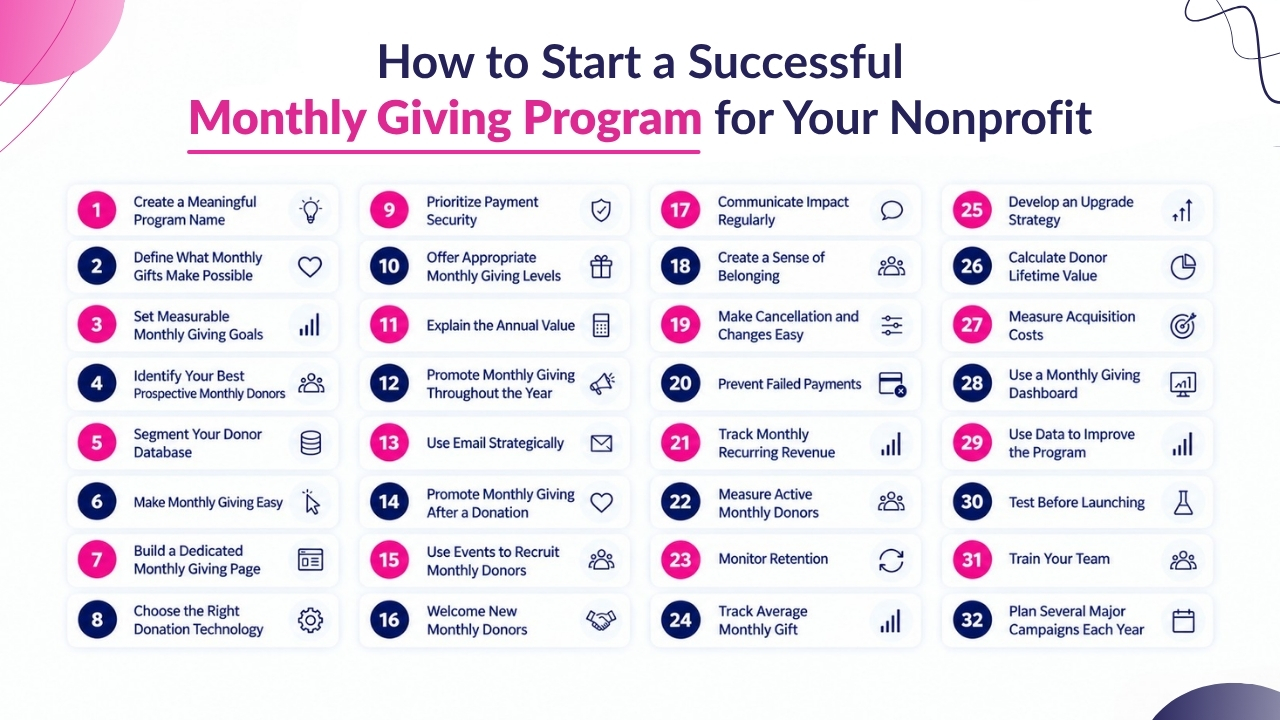
Monthly Giving Programs means recurring donations, but such donation programs cannot create a strong emotional connection with supporters. Hence, it is essential for nonprofits to choose a memorable program name that shows the mission of the organization and make supporters feel that they are joining a program that is impactful.
Name Ideas:
For instance, “Become a member of our Impact Circle” can feel more personal and engaging than “Enroll in recurring billing”.
A meaningful name also strengthens marketing by giving the organization consistent phrases to use across its website, emails, events, social media, and printed materials, that helps supporters recognize and remember the program.
Donors are more likely to participate when they understand how monthly giving supports the ongoing work of an organization. Instead of simply asking supporters to donate every month, they must explain the way donations affect other’s lives.
Monthly gifts can help nonprofits:
Use specific impact statements whenever reliable organizational data supports their mission and causes. For instance, if a $25 monthly donation genuinely funds a specific service or resource, they must explain that clearly.
They must avoid using exaggerated claims, because transparent and accurate information helps to build donor trust while encouraging long-term support.
Also Read: 10 Powerful Thanksgiving Sermons Every Pastor Can Preach
Before launching a monthly giving program, define clear goals that define how you will measure its success. Trackable goals lets nonprofits track results, uncover areas for improvement, and refine their fundraising efforts over time.
Important metrics may include:
For instance, acquiring 50 monthly donors contributing an average of $20 would generate $1,000 in monthly recurring revenue. If all donors remain active and payments succeed, this could produce approximately $12,000 over twelve months. It is essential to have realistic goals and align with the nonprofit’s donor base and fundraising capacity.
Your existing supporters are often the strongest candidates for a monthly giving program as they already understand and value the mission of the organization. Analyze donor records to find supporters with a strong history of engagement and ongoing donations.
Look for supporters who:
These supporters already feel connected to the nonprofit’s mission, so inviting them to make recurring donations is a natural step. Segment donors based on their giving history and engagement so outreach can be more relevant, personal, and effective.
Also Read: 50+ Raffle Basket Ideas That Actually Raise Money
Sending the same monthly-giving message to every supporter can reduce engagement. Rather than segmenting your donor database based on giving history, engagement, interests, and communication preferences. Different groups may require different messages and approaches.
A simple donor experience can improve monthly-giving conversions. Make the donation process quick, mobile-friendly, secure, transparent, and easy to understand. Make sure donors understand the terms and details of their recurring donation before submitting their donation.
Also Read: Pastor Appreciation Day: Ideas & Gift Guide
Having a dedicated monthly giving page allows nonprofits to explain the program and encourage recurring support. They must keep the page clear, persuasive, and donor-focused.
The right donation technology can simplify recurring giving for both donors and nonprofit teams. Choose a platform that supports essential payment, reporting, and donor-management needs while fitting to your organization’s budget and workflow.
They must evaluate security, usability, integrations, costs, and required features before choosing a platform.
Also Read: How to Start a Church: Step-by-Step Guide for New Pastors
Security is essential while managing recurring donations because payment information is processed repeatedly. Before launching your program, evaluate the platform’s security practices and compliance responsibilities.
Choose trusted payment infrastructure and assess security practices based on your specific requirements of organizations.
Offering clear monthly giving options can help donors to choose an amount that feels comfortable and impactful. Present a few suggested donations while allowing flexibility for different financial circumstances.
They must keep three or four options prominent, but always provide a custom donation choice. Emphasize that every recurring gift can contribute meaningful support over time.
Also Read: Church Events Management Best Practices
Some donors naturally think in monthly amounts, while others prefer understanding their total annual commitment. Showing both figures makes recurring donations easier to evaluate and keeps the financial commitment transparent.
For example:
Displaying annual values helps donors to compare recurring contributions with one-time gifts and understand their potential long-term impact. Clearly state that the donation will continue automatically as per the selected schedule.
They must avoid hiding recurring payment details or using unclear language. Transparency helps donors to make informed decisions, builds trust, and strengthens trust in the nonprofit.
A recurring giving program needs consistent promotion to attract new supporters and maintain visibility. Instead of depending on one launch campaign, nonprofits should convey monthly giving throughout the year across multiple channels.
Also: Bootstrapped Fundraising Strategy for Startups
Emails help nonprofits to convert existing donors into monthly supporters. A structured campaign should balance fundraising appeals with useful information, stories, and appreciation.
They must avoid sending constant fundraising requests. They must combine appeals with mission updates, donor recognition, success stories, and measurable results.
Such a balanced approach can strengthen trust, maintain engagement, and encourage supporters to develop longer-term relationships with the nonprofit and its mission.
A donation confirmation page can encourage one-time donors to consider joining monthly giving support after completing their contribution. So nonprofits must send a gentle, optional invitation that explains the benefits of becoming a monthly supporter.
Also Read: Monthly Donation Programs: Grow Recurring Giving
Nonprofits must use events to effectively introduce attendees to monthly giving and show how recurring support goes beyond a single occasion. They must keep the message short, relevant, and easy to act on.
The first 90 days are essential for nonprofits to build long-term relationships with donors. Having a well organized welcoming lets supporters to feel appreciated, informed, and feel connected to the organization.
Also Read: Easy Christmas Fundraising Ideas You Can Start Today
Nonprofits must regularly share updates to supporters that help monthly donors to know how their monthly donations support the mission of the nonprofits.
So they must share impactful results through clear, engaging communications.
Not every message should request another donation.Nonprofits should clearly show how their recurring monthly donations create impactful results, that helps to build trust of donors, gain appreciation, and long-term engagement.
Monthly donors make a commitment to your mission, so it is essential for nonprofits to create a strong feel of community that can deepen the connection of supporters with your nonprofit organization. They must give the program an identity and recognize supporters consistently.
Such simple benefits can increase donor relationships by helping supporters feel appreciated, informed, and closely connected to the mission of the nonprofit organization.
Also Read: What Is a Donation Kiosk?
A trustworthy monthly-giving program should give donors control over their recurring donations. Easy account controls give donors more confidence and support stronger, more positive relationships.
A simple and respectful account experience can maintain donor goodwill, even when supporters decide to end their recurring contributions.
Recurring payments may fail if the cards of the supporters expire, banks decline transactions, or when payment details become invalid. Having a proactive recovery process helps nonprofits to retain donors.
Promptly addressing payment issues can protect recurring revenue and help retain monthly donors.
Also Read: How to Run a Successful Donation Campaign
It involves measuring the recurring income scheduled for each month. For instance, if 100 donors donate $25 monthly then nonprofits can generate $2,500 in MRR which indicates a projected annual value of $30,000.
Nonprofits by regularly tracking MRR can understand recurring revenue performance and find opportunities for sustainable program growth.
Monitoring active monthly donors helps nonprofit organizations to understand the size of their recurring giving program. Nonprofits must regularly track changes in the donor base regularly to find growth and potential retention problems.
A growing donor base is encouraging, but nonprofits should also track retention and revenue raised because count of new acquisitions may mask losses among existing supporters.
Also Read: Silent Auction Rules Every Nonprofit Should Know
Retention helps nonprofits to evaluate the health of their monthly-giving program. They must establish an internal baseline and track changes regularly.
If retention rate declines, then they must review these factors to identify problems and strengthen long-term donor relationships.
It involves measuring the usual recurring donation from each active donor. It can be calculated by dividing total monthly recurring revenue by the number of active donors.
Example:
$5,000 MRR ÷ 200 active donors = $25 average monthly gift
Tracking this metric helps nonprofits to understand donor behavior and increase recurring revenue.
Monthly donors may become comfortable increasing their donations over time. So nonprofits must offer upgrade opportunities during impactful moments without creating pressure.
Even a small increase in donation can significantly strengthen recurring revenue across a large donor community. Keep every upgrade request optional and donor-centered.
Also Read: 12 Ways to Grow Church Membership in 2026
Donor lifetime value estimates the total donation a supporter may provide throughout their relationship with a nonprofit.
Example: $25/month × 36 months = $900
This simple calculation does not account for cancellations, upgrades, failed payments, or acquisition costs.
Donor acquisition expenses show how efficiently fundraising campaign attract new monthly supporters. Nonprofits can calculate this metric by dividing total campaign expenses by the number of new recurring donors acquired.
Example:
$1,500 campaign cost ÷ 75 new donors = $20 acquisition cost per donor
This analysis helps nonprofits to allocate resources smartly and achieve sustainable growth in monthly donations.
A monthly giving dashboard displays important performance metrics at one place, which makes it easier for nonprofits to track the success of recurring programs and identify giving patterns of their supporters.
When nonprofits regularly analyze, the dashboard helps them to make quick, data-informed decisions and improve recurring-giving performance over time.
Also Read: Welcome to Church: First-Time Visitor Guide
Nonprofits can use performance data of recurring giving programs to make informed decisions, identify challenges, and resolve recurring problems before they affect monthly-giving programs.
With this data nonprofits can address weaknesses in their programs early, improve donor experiences, and build a more sustainable recurring giving program.
Before promoting your monthly giving program, it is essential to test every part of the donor journey to ensure a smooth experience. Check donation form template for desktop and mobile devices, verify recurring payments and payment updates, and confirm receipts, welcome emails, and other communications.
Test CRM records, reporting, and failed-payment processes. Review QR codes and landing pages for broken links. Finally, conduct a soft launch with existing supporters to identify and fix issues.
A successful monthly-giving program requires every team member to understand their responsibilities and donor processes. Provide training on enrollment, payment updates, failed payments, cancellation, refunds, receipts, donor questions, reporting, and stewardship.
Define team roles and create clear processes for handling common donor problems. It helps staff to respond efficiently, avoid misunderstandings, and deliver reliable support throughout the donor journey.
Also Read: Top Benefits of Using Donation Kiosks for Nonprofits and Charities
Nonprofits should plan several focused monthly-giving campaigns throughout the year along with regular promotion. Such campaigns can increase visibility, create a sense of urgency, and encourage supporters to become recurring donors.
Strategic campaigns maintain momentum without overwhelming donors.
Monthly giving can help nonprofits create predictable revenue while building stronger, long-term relationships with supporters. A successful program requires more than adding a recurring donation option. Organizations should make giving simple, secure, transparent, and mobile-friendly while clearly showing donors how their ongoing support creates impact.
Consistent promotion through email, websites, social media, events, and fundraising campaigns can attract new recurring supporters. Strong onboarding, regular communication, appreciation, and flexible account management can improve donor retention and trust.
Nonprofits should also track key metrics, including monthly recurring revenue, active donors, retention, average gift size, failed payments, lifetime value, and acquisition costs. Reviewing these results helps organizations identify challenges and improve their strategies.
With thoughtful planning, effective technology, and donor-centered stewardship, monthly giving can become a sustainable funding source that supports long-term organizational growth and mission success.
If you still have any query about Monthly Giving then you may Book a Demo at SimplyGiv and we are more than happy to assist you.