How to Track Donor Engagement for Nonprofits and Churches
With online giving, text-to-give activity, and social media continuously influencing donor behavior, it has become essential…
Read More →
Short on time? Let AI do the work. Get the key points.
Growing a church in 2026 involves not just increasing Sunday attendance. Rather it requires implementing strategies around church membership growth, community engagement, digital outreach, discipleship, and meaningful relationships.
Today, people seek more than weekly church attendance. Rather they need connection, purpose, spiritual support, and a church which understands their real-life requirements. That is why churches have to rethink how they will implement strategies around membership growth, visitor retention, and long-term involvement.
In a quickly changing environment, successful churches focus more on spiritual depth and practical accessibility. A strong church growth strategy involves providing a welcoming first-time guest experience, having a clear mission, powerful preaching, active small groups, and a strong online presence.
From church websites, social media ministry, in-person hospitality, and follow-up systems, every interaction shapes the overall experience. Churches that grow make it easy for people to connect, belong, and take their next step in faith.
Today churches will have to prioritize young adults, young families, and local community outreach. People want to feel a sense of authenticity, care, and a sense of belonging.
People are drawn to churches that offer clear biblical teaching, genuine friendships, and also opportunities to serve. With strong leadership development, volunteer engagement, and intentional follow-up can convert casual attendees into committed members.
Through this blog we will walk you through 12 ways to grow church membership in 2026 which will help your church to build a healthy and more sustainable path to growth.
Rather than focusing only on numbers, these strategies involve real discipleship, stronger relationships, and a church culture that welcomes people into lasting spiritual communities. When your church offers truth, compassion, and wise strategy, then the church growth becomes natural, impactful, and lasting.
Also Read: How to Grow a Church Fast Without Losing Your Mission
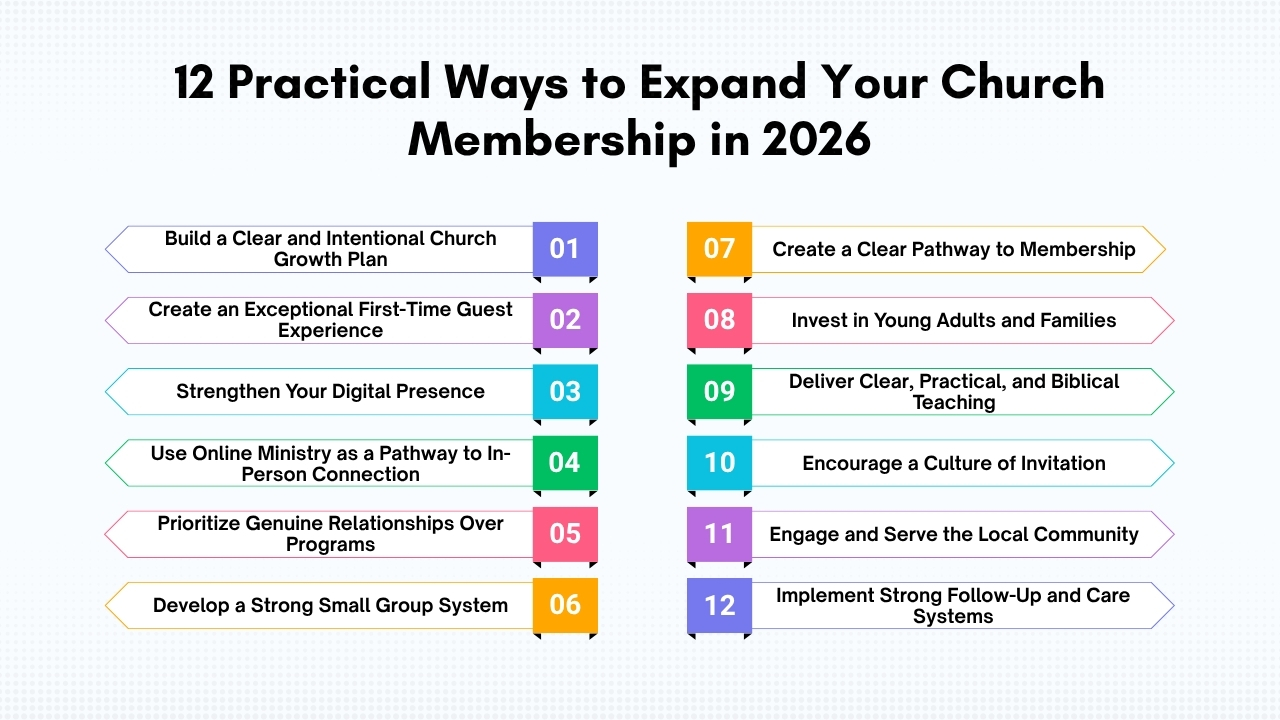
Building a clear and intentional church growth plan is essential for long-term and sustainable membership growth. Churches which grow consistently do not depend on chance or randomly.
Rather, they move ahead with clarity, purpose, and a deep understanding of their mission. When a church has a clear direction, every ministry effort will move toward a common goal that develops a sense of unity rather than confusion.
Rather than launching several unwanted programs, it is essential for churches to develop a clear and intentional church growth plan which guides from their first visit to becoming committed members.
The journey from first visit to becoming committed members can include phases like visitor, returning guest, engaged participant, volunteer, and active member. A clear pathway helps leaders and attendees to understand the next step that makes it easier for people to stay connected and grow.
A church growth plan helps leaders to establish better and more intentional decisions. It is essential for churches to focus on strategies which actually matter and support the mission of the church. This helps churches to align these strategies across teams and build momentum over time.
Without having a clear plan, even active churches may feel stagnant and directionless. But with intentional planning, church growth becomes more focused, measurable, and impactful, which causes a stronger and more connected church community.
Also Read: Digital Church Growth Strategies
Creating an exceptional first-time guest experience is one of the effective ways to grow church membership. First impression forms instantly, as many visitors decide within minutes whether they will return. It means churches must ensure to provide every detail of their visit to be impactful and welcoming.
From the time guests arrive, the church atmosphere should feel simple and easy to navigate. Clear signage, accessible parking, and a friendly welcome team helps to remove confusion and create comfort.
Small efforts of churches like greeting people warmly, offering them help, and making them feel noticed can leave a strong and positive impression to members.
Churches have to ensure that their services themselves should be easy to understand. It is essential for churches to avoid using insider language or to assume that every church member is familiar with traditions.
Churches must ensure to clearly explain the mission, values, and activities, so newcomers feel included and confident throughout their experience with the church.
For families, the children’s ministries are also essential. Parents have to trust that their children are safe, engaged, and cared for in these ministries. When churches provide an organized, clean, and welcoming kids atmosphere, it can strongly influence member’s decision to return.
Offering a good guest experience is not about providing a perfect church experience but it involves offering intentional care. When visitors feel valued and comfortable from the beginning, then there are high chances that they may return and take the next step of establishing a connection with the church.
Also Read: How to Use Data to Improve Donor Retention in Your Church
Strengthening your digital presence is essential for church growth in 2026 because it is mostly the first interaction that people have with your church. Because today most people, even before attending your services in person, will visit your website, check your social media, or watch a sermon online. Due to which it is essential for your online platforms to provide a strong, clear, and welcoming first impression.
Your website should provide all the crucial information which can be explored in a simple and easy way. Ensure that all important details like service times, location, what to expect, and ways to get involved are clearly visible on your website.
It is also essential for churches to offer a fast-loading, mobile-friendly website design which ensures that visitors can access everything smoothly.
Social media should show the authentic life of your church and not just share announcements. By sharing testimonies, community outreach, events, and encouraging messages help people to connect emotionally and also understand the culture of your church.
Online sermons and videos are also essential. These videos allow your potential visitors to experience your teaching style that builds trust and familiarity before they attend your services in person.
A strong digital presence helps churches to convert their initial interest into real engagement and impactful connection. With a strong digital presence, people may feel confident, informed, and ready to take their initial step toward becoming part of your church community.
Also Read: Why Your Church Needs a Mobile Giving Solution
Using online ministry as a pathway to in-person connection is essential for church growth in 2026. Online engagement is often the first step that people take while exploring your church, but people will not stop by exploring the church.
The actual purpose of online ministry is to guide people toward deeper, real-life relationships within the church community. Many begin their journey with your church online as it feels more comfortable.
People may feel curious about faith, searching for answers, or simply wanting to know about church activities before committing. So it is essential for churches to intentionally design an online journey that helps viewers to transition into in-person participation.
Providing simple and clear calls to action to people are essential. Churches must also encourage viewers to attend a service, join a small group, sign up for a welcome event, or connect with a leader.
Every online interaction should point toward a next step which brings them closer to community.
When churches provide a high-quality livestream helps to build in-person connections. Having good audio, clear visuals, and communication helps churches to build trust and keep them interested in your ministry services.
However, just a high-quality livestream is not enough because establishing connection is what truly matters for churches.
Churches must consider online ministry to be an initial step instead of separate experience that becomes a powerful connection which takes people through impactful relationships and establishes lasting involvement in the church.
Also Read: SimplyGiv Launches its All in One Platform for Giving Engagement and Church Management
Churches must prioritize genuine relationships over programs is essential for churches to build a healthy and growing church. Though church programs and events may attract people and build initial interest, these programs are rarely the reason that people stay long term with your church.
Individuals stay connected with the church when people feel known, valued, and genuinely cared for. In today’s high-paced and disconnected world, people search for real, impactful relationships.
Churches that focus only on their events may witness temporary attendance, but without establishing strong relationships, people often shift away quietly.
This is why churches must intentionally establish environments where connections happen naturally. Provided spaces for conversation, shared experiences, and honest interaction helps them to build trust and deepen relationships with members.
Leaders play an important role by knowing newcomers, introducing them to others, and helping those new members to feel included from the beginning.
One powerful question can reveal the strength of your church community:
Would anyone notice if someone stopped attending? If the answer is no, it indicates a real need for stronger relationships, deeper care, and impactful connection.
For churches, if building relationships with people becomes the priority, then the church transforms from a place people attend into a community where they feel to be well known, supported, and connected.
Also Read: How to Run a Successful Donation Campaign
It is essential for churches to develop a strong small group system which helps to build deeper relationships and sustainable long-term church growth.
Though large gatherings may encourage and bring people together, small groups establish a more personal environment where real connection and spiritual growth can take place.
In small group systems, people feel known, heard, and supported in ways that are often not possible in larger services.
An effective small group system must be simple, accessible, and flexible. People must be able to join such small group systems easily without any lengthy processes.
These groups should meet regularly and encourage open, honest conversations where members can share experiences, ask questions, and grow together rather than just passively listening.
Leaders also have a crucial role in the success of small groups. They should be trained to not just guide discussions but also to care for each member personally. A strong leader builds member trust, develops a welcoming atmosphere and helps people to grow in their faith.
It is also essential for churches to offer a variety of groups. Such as groups for young adults, families, men, women, and new believers help people to connect with others who are in similar life phases or experiences.
When individuals actively participate in small groups, then there are high chances that they may stay engaged, develop impactful relationships, grow spiritually, and become committed members of the church community.
Also Read: How to Grow a Church Fast Without Losing Your Mission
Churches must create a clear pathway to membership which helps to convert regular attendees into committed or engaged members. Most churches unintentionally lose people as they do not clearly communicate how people can shift from simply attending church events to truly belonging to the church.
As a result, though people may visit consistently but they may not take an impactful step forward. A well-defined pathway helps churches to remove any confusion and provide direction to members.
This pathway helps people to understand exactly about their next step and how they can become part of the church community. This journey of church members should be simple, structured, and easy to follow, so that anyone irrespective of their background can navigate it confidently.
An effective pathway includes steps such as attending a welcome or newcomers event, joining a small group, serving in a ministry, and also participating in a membership class.
Every step should lead to the next naturally that creates a smooth progression. It is essential for churches to establish clear and consistent communication.
Churches must regularly talk about these next steps during services, highlight them on their website, and reinforce them through follow-up messages. Ensure that the members are not uncertain about how to get involved or about their next step.
When people clearly understand how much they belong, then they are more likely to take action. It increases engagement and helps to build a stronger, more connected church community where individuals not just passively attend church events but become active members and have long-term commitment to the church.
Also Read: Church Event Management Best Practices With Tools
Investing in young adults and families is one of the crucial strategies which ensures sustainable church growth. Younger adults not just help for church growth but also are the foundation for the church’s future. Reaching young adults and families requires a thoughtful, intentional, and relevant approach for churches.
Because young adults look for authenticity, purpose, and for genuine connection. They are not much interested in surface level experiences rather they are attracted to environments where they can ask questions, explore faith, and apply biblical truth to real-life challenges.
Churches which offer open conversations, relatable teaching, and strong community are far more likely to connect with them. Families value safety, consistency and support.
Offering a well-organized children’s ministry is often the most crucial factor in their decision to stay. Because parents have to be assured that their children are in a secure, caring, and impactful environment while they participate in the service.
Churches should also provide many opportunities for young adults to feel seen and valued. Offering them mentorship programs, leadership roles, and involvement in ministry help young adults build ownership and deeper connection. When younger individuals are trusted and empowered, they are more likely to stay engaged.
By investing in young adults and families ensures not just short-term growth for churches rather it builds a strong, lasting foundation for a growing church.
Also Read: 100 Best Thank You Donation Quotes
For churches it is essential to deliver clear, practical, and biblical teaching for ensuring sustainable church growth. Though you may feel connected to your church initially, it is the quality of teaching that finally helps your members to stay, grow, and remain committed to your church.
People feel connected to messages that not just encourage them spiritually but also feel connected with their everyday lives.
Effective biblical teaching should always be rooted in Scripture and also address real-life challenges such as relationships, purpose, stress, and purpose growth.
When people clearly witness the way that biblical principles can be applied to their daily experiences, then the message becomes impactful and relevant. Churches must ensure that their teaching is engaging, easy to follow, and organized in a way which first-time visitors and long-time members can easily understand.
Churches must avoid using complex language, jargons, or abstract ideas which new visitors may feel confused and cannot connect with. Instead of focusing on clarity, simplicity, and reliability helps to ensure that everyone can connect with your message and take something valuable from your teaching.
It is also essential for churches to teach biblical scriptures consistently. When people know they can expect thoughtful, valid, and biblically sound messages every week, it helps to build trust and encourages members to regularly attend church events.
Strong teaching helps churches to not just attract people but also helps them to grow deeply in their faith that causes stronger commitment and a lasting connection with the church community.
Also Read: 10 Powerful Thanks Giving Sermons
It is essential for churches to encourage a culture of invitation which will be one of the simplest and effective ways to grow a church. Personal invitations continue to have more impact on people because there are high chances that they will attend a church when they are invited by someone they know and trust.
When people receive a warm invitation from a friend, family member, coworker, or neighbor it often removes their fear which makes them feel visiting the church more comfortable.
Churches must intentionally encourage members to invite others regularly. This can be done by reminding them from the stage, through social media, or during ministry gatherings.
When people are provided with simple language then they can make inviting others feel easier.
Special events, sermon series, holiday services, and community outreach programs offer many opportunities to invite people. These moments often feel accessible for first-time visitors and help members to encourage others confidently.
It is essential to share stories of people who came to church because someone invited them. Such testimonies may encourage others to show how a simple invitation can cause life change.
When invitation becomes part of the church culture, then the growth of the church is not just carried by pastors or leaders. Rather it becomes a shared mission, and the whole church takes part in reaching people.
Also Read: Top Benefits of Using Donation Kiosks for NonProfits and Charities
Engaging and serving the local community is an essential way to build trust and grow church membership. A church which actively cares for people then the church becomes more than just a place of worship instead it becomes a meaningful part of the community. When people feel genuine care in action, then they are more open to build a connection with the church.
Community engagement may have many practical forms. Churches may support local schools, organize food drives, offer help to families in need, or partner with local organizations. These efforts show that the church is not just focused on their own growth but is committed to making an impact in people’s lives.
When churches consistently engage and serve the local community, this approach is effective. Though one-time events can be helpful, ongoing services create lasting impact and build stronger relationships over time. When people repeatedly witness the church helping, caring for their members, it helps to build credibility and trust.
Serving the community also benefits church members. As it gives members opportunities to live out their faith in practical ways and connect with others outside the church environment. It strengthens both individual growth and community relationships.
When churches become well known for its positive impact and consistent presence, it naturally attracts people who are looking for hope, support, and a place where they actually belong.
It is essential for churches to implement strong follow-up and care systems for converting visitors into active, long-term members. One of the biggest reasons churches lose members is not just due to poor services but also because of lack of feeling connected after the visit. Without intentional follow-up, many people may shift away and never return.
Timely and personal follow-up of churches will have a powerful impact on members. When churches reach out within 24 to 48 hours through a message, call, or email shows that the church truly cares.
It helps visitors to feel noticed and valued instead of being forgotten. As it is the initial connection, it should be warm, simple, and focused on building a relationship rather than just sharing information.
Follow-up with members should always feel genuine, and not feel automated or generic. Mentioning their visit, or asking how you can support them, make the interaction more impactful.
It is essential for churches to guide them toward clear next steps like attending a welcome event or joining a small group.
Not just the first contact, but ongoing care is also crucial. Churches should support members during difficult times and celebrate important moments in their lives. When people feel consistently cared for, they develop trust and deeper connection.
Strong follow-up and care systems help create a church culture where people feel seen, supported, and encouraged to stay and grow.
Growing church membership in 2026 is not about following trends or increasing church attendance rather it is about building a healthy people ministry.
Churches which experience real and lasting growth understand that the impact on members happens when they combine clear strategies with genuine relationships and a willingness to adapt to changing needs and expectations.
A growing church or most effective churches remain focused on strategies that actually matter. They plan with purpose, create welcoming and accessible environments, and help people to move from casually attending to truly belonging to the church.
These churches invest in impactful relationships, use digital tools wisely to expand their reach, and offer clear next steps which guide individuals toward deeper involvement with the church. Above all, it is essential for churches to consistently care for people in personal and authentic ways.
Sustainable church growth does not come from doing more, rather it comes from doing the right things well such as implementing a Church Donation Software. When churches focus on building trust, developing connection, and supporting spiritual growth, people feel seen, valued, and encouraged to stay. It leads to stronger engagement and more willingness to invite others.
Ultimately, church growth is not just about the number of church members or filled seats. It is about life transformation. A truly growing church is one where faith deepens, relationships become stronger, and people find purpose and belonging.
When a church commits to serving people with clarity, consistency, and compassion, growth becomes more than possible rather it becomes meaningful, lasting, and aligned with its true mission.
If you still have any query about 12 ways to grow church membership in 2026 then you may write to us at simplygiv and we are more than happy to assist you.