Easy Christmas Fundraising Ideas You Can Start Today
Christmas giving season is the perfect time to bring your community together, encourage generosity among them,…
Read More →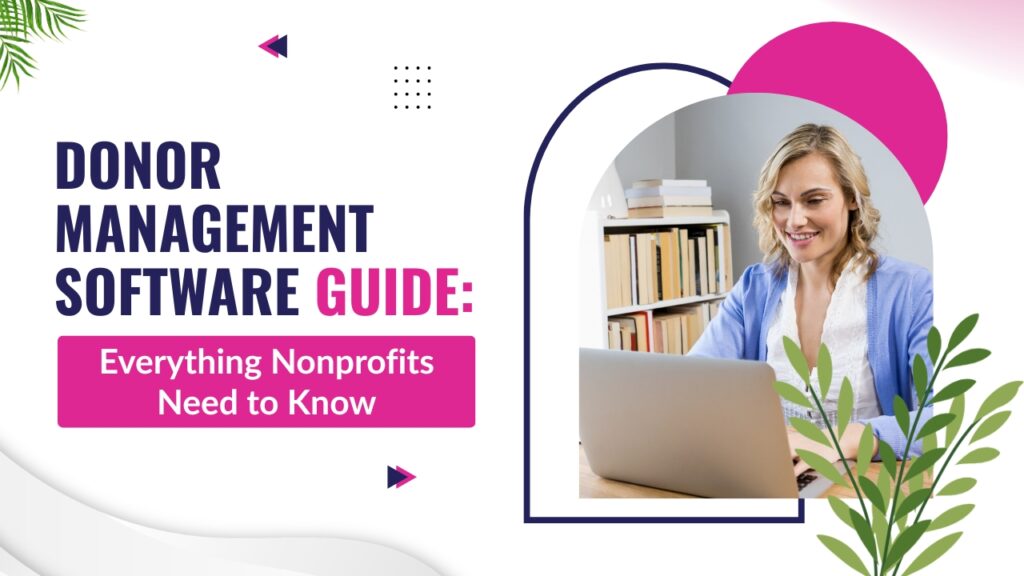
Short on time? Let AI do the work. Get the key points.
Strong donor relationship management is essential for every nonprofit who aims to gain donor trust, increase donations, and achieve long-term fundraising success.
When nonprofits grow, managing donor data, donations, consistent communication with donors, and organizing fundraising campaigns becomes difficult if they manage these tasks manually or through spreadsheets.
This is where Donor Management Software is essential for managing nonprofit organizations. Because modern Donor Management Software helps nonprofits to centralize donor data, automate admin tasks, monitor fundraising, and improve donor engagement through a single centralized platform.
This Donor Management Software Guide will walk you through everything nonprofits should evaluate before selecting, implementing, managing, and achieving maximum benefits of a donor management system.
Even if you are a small charity, community organization, educational institution, faith-based organization, or large nonprofit, implementing the right fundraising software helps them to make operations smooth and improve donor retention.
Integrating many features such as donor database, donor tracking, online fundraising, recurring donations, donor engagement, nonprofit CRM, fundraising analytics, and campaign management, helps nonprofits to make data-driven decisions and provide more experience to donors.
Platforms like SimplyGiv helps nonprofits to improve fundraising through secure online donations, peer-to-peer fundraising, donor management, and campaign tools into a single centralized platform.
Throughout this blog, we will walk you through the essential features, important advantages, implementation strategies, and best practices to consider while selecting the right donor management software.
With the right technology, nonprofits can save valuable time, improve fundraising efficiency, build stronger donor relationships, and create more impact in the communities that they serve.
Also Read: How to Track Donor Engagement for Nonprofits and Churches
Unlike before, nonprofits are more competitive than ever. It is essential for nonprofits to be transparent, gain donor trust, and maintain long-term relationships with donors.
Donor management software helps nonprofit organizations to achieve their fundraising goals by making everyday operations smooth and providing insights about fundraising activities.
Without a centralized platform, nonprofits may struggle to manage donor data that is scattered across different platforms, inconsistent communication with donors, missed follow-ups, and manual reporting.
All these challenges can lead to dissatisfied donors and negatively impact fundraising performance.
A donor management platform helps organizations answer important questions such as:
Having access to accurate, real-time data, helps nonprofit leaders to make informed decisions rather than just assumptions. With the right nonprofit data helps nonprofits to establish stronger fundraising strategies, improve engagement with donors, and effectively allocate their resources.
For nonprofits that are growing, donor management software reduces admin burdens by automating repetitive tasks like donation acknowledgements, tax receipt generation, recurring gift processing, and donor segmentation.
This software collects donor data from different fundraising activities and then stores it in a secure, centralized database. Donor management software automatically records each donation, event registrations, volunteer activities, and supplier interactions, so that every donor profile remains accurate and is up to date.
Donor management software collects information from different fundraising activities and stores it in a secure, centralized database. This software automatically records donations, event registrations, volunteer activities, and supplier interactions, ensuring that every donor profile remains accurate and up to date. Such automation of activities reduces manual work and helps nonprofits to manage donor data more accurately.
The software commonly integrates with:
With access to real-time dashboards and reports, nonprofit staff can easily track their fundraising performance and donor engagement levels.
Users can track:
While cloud-based donor management systems also provide secure remote access, which allow organizations to manage donor relationships while focusing on their fundraising goals.
Also Read: Top Online Fundraising Ideas to Grow Donations Fast
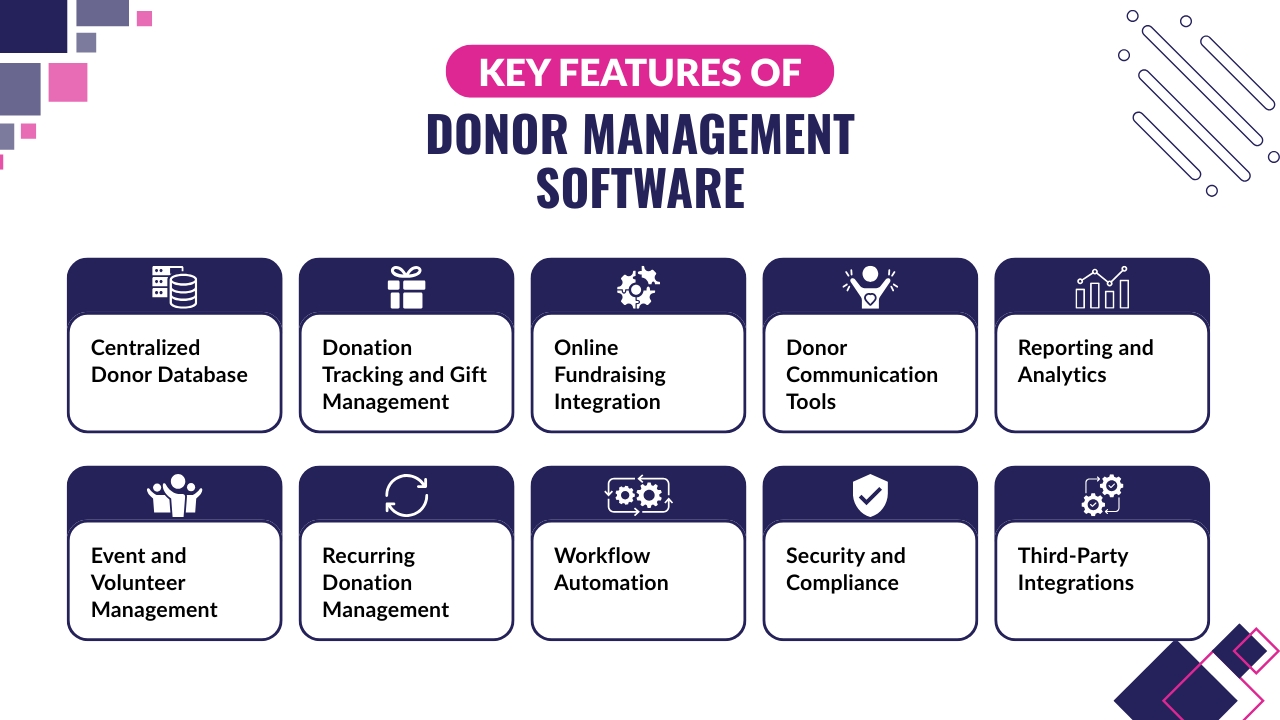
The right donor management software goes beyond storing donor names and donation amounts. This software should also help nonprofits to improve relationships with donors, improve fundraising performance, automate repetitive tasks, and give insights for future campaigns.
Below are the essential features every organization should look for.
It is the foundation of any donor management system. Such a database prevents staff from managing multiple spreadsheets or paper records, and stores all supporter data in one secure location.
The database typically includes:
With all donor data in one place makes it easier for nonprofits to personalize communication, track donor relationships, and improve donor retention.
Monitoring donations accurately is essential for every nonprofits. Donor management software instantly records every donation and organizes donation data for easy reporting.
Most platforms support:
This software helps nonprofits to easily access donation history, find top donors, generate tax receipts accurately, track donations, and manage donor data efficiently, and reduces admin work for staff increasing fundraising performance and supporter engagement.
Also Read: Church Events Management Best Practices (with Tools)
Modern donor management software integrates with online fundraising platforms. Such integrations with online platforms makes it easy for nonprofits to gather donations from multiple digital channels.
If donations made through websites, social media, and fundraising campaigns are instantly recorded, it reduces admin work for staff and also helps them to manage donor profiles up to date.
Common online fundraising features include:
These integrations with online platforms make donation management simple, increase fundraising efficiency and reach of donors, and give supporters a secure and convenient way to donate from anywhere at any time.
Effective donor communication tools help nonprofits to build good relationships with donors. It helps nonprofits to encourage donors to support their causes for the long-term.
Modern donor management software has built-in communication tools which makes it easy for nonprofits to send personalized messages, campaign updates, and acknowledging donations.
Segment donors based on past giving data, interests, or engagement levels to send more relevant and targeted communications.
Common communication features include:
With these communication tools nonprofits can increase donor engagement, improve donor relationships, and help nonprofits to maintain consistent communication with donors.
Also Read: How to Set Up Multiple Funds and Split Giving Online
Reporting and analytics tools help nonprofits to track fundraising campaigns that were successful and make informed decisions. This software provides dashboards and customizable reports which provide real-time insights regarding donation activity, campaign performance, and donor behavior.
These reports help nonprofits to identify fundraising patterns, analyze fundraising strategies, and improve future fundraising campaigns.
Common reports include:
With access to accurate reporting and analytics tools helps nonprofits to track fundraising progress, and make data-driven decisions to improve outcomes of fundraising.
Many nonprofits rely on fundraising events and volunteers to achieve their fundraising goals. Donor management software simplifies event planning and volunteer coordination by centralizing all data at one place.
All these features help nonprofits to manage registrations, schedules, event attendance, and follow-up communication more effectively.
Common event and volunteer management features include:
When donor and volunteer data is combined in a single system, nonprofits will gain a complete view of donor engagement, improve management of events, improve relationships with volunteers, and fundraising efforts in the future.
Also Read: Why Churches Need a CRM & How to Get Started
Recurring donations gives nonprofits a stable and predictable source of donations which improve financial stability for the long-term.
Donor management software automates recurring giving programs which makes it easier for nonprofits to manage donations while reducing admin tasks.
This software also helps nonprofit organizations to maintain strong relationships with recurring donors through reminders and right payment tracking.
Common recurring donation features include:
When nonprofits automate recurring donations, it helps nonprofits to increase donor retention, lifetime of donors, reduce admin work, and build a more reliable way of fundraising income.
Automating workflow helps nonprofits to save staff as this software handles repetitive tasks automatically. Rather than staff sending emails or generating donor receipts, this software enables staff to complete these tasks instantly and accurately.
Such automation of tasks improves efficiency, reduces errors, and ensures supporters to receive timely communication throughout their donor journey.
Common automated workflows include:
Automating routine processes helps nonprofit teams to reduce admin workload, improve donor communication, and focus more on building meaningful relationships, planning successful fundraising campaigns, and advancing their organization’s mission.
Also Read: How to Increase Church Donations with Online Giving Tools
Nonprofit organizations handle sensitive donor and financial data, due to which it is essential to data secure and regulatory compliance.
A reliable donor management software includes advanced security features which helps nonprofits to secure personal data of donors, avoid unauthorized access, and ensure safe payment processing.
All these security and compliance measures help nonprofits to gain more donors while meeting industry standards and legal requirements.
Common security and compliance features include:
All these security features protect donor data, reduce the risk of data breaches, simplify compliance with financial regulations, and let nonprofit organizations confidence that their fundraising data remains secure and well-managed.
Integrating with third-party tools helps donor management software to connect with other tools that nonprofits use every day. When data is shared between systems automatically, it reduces admin work, improves accuracy, and makes daily operations of the nonprofit smooth.
Such third-party integration enables donor management software to connect with other tools that nonprofits use everyday. As the data is shared between systems automatically, these integrations reduce the need to manually enter donor data, improve accuracy, and make daily operations smooth.
This allows staff to manage fundraising, donor communication, and financial records more efficiently through connected platforms.
Common third-party integrations include:
Such integrations with third party tools save time, improve workflow efficiency, keep donor data synchronized across platforms, and help nonprofits to deliver an organized and effective fundraising experience.
Also Read: Text-to-Give for Churches: What It Is & How to Implement It
Implementing donor management software provides important advantages for nonprofits of every size.
This software stores complete donor profiles such as their past giving history, communication records, and event participation. All this donor data helps nonprofits to personalize their emails, thank-you messages, and fundraising campaigns.
Implementing these strategies helps nonprofits to build stronger relationships with supporters as it increases trust of supporters and long-term engagement with donors.
With right access to accurate donor data, nonprofits can identify giving patterns, segment donors, and create targeted fundraising campaigns.
Sending personalized appeals and timely follow-ups often cause more donations, more recurring gifts, and increased overall fundraising revenue.
Automation simplifies everyday admin tasks like donation tracking, receipt generation, recurring gift management, and donor acknowledgments. This reduces manual work, reduces errors, and allows nonprofit staff to spend more time focusing on fundraising and community outreach.
Also Read: How to Start a Church: Step-by-Step Guide for New Pastors
Real-time dashboards and customizable reports deliver insights into fundraising performance. Nonprofit leaders track campaign results, donor retention, donation patterns, and financial performance, which helps them to make informed decisions and improve future fundraising strategies.
It is essential for nonprofits to maintain regular communication with supporters ensuring fundraising success for the long term. With this software nonprofits can send personalized updates, thank-you messages, event invitations, and recurring donation reminders which encourage donors to consistently support the mission of the nonprofit organization.
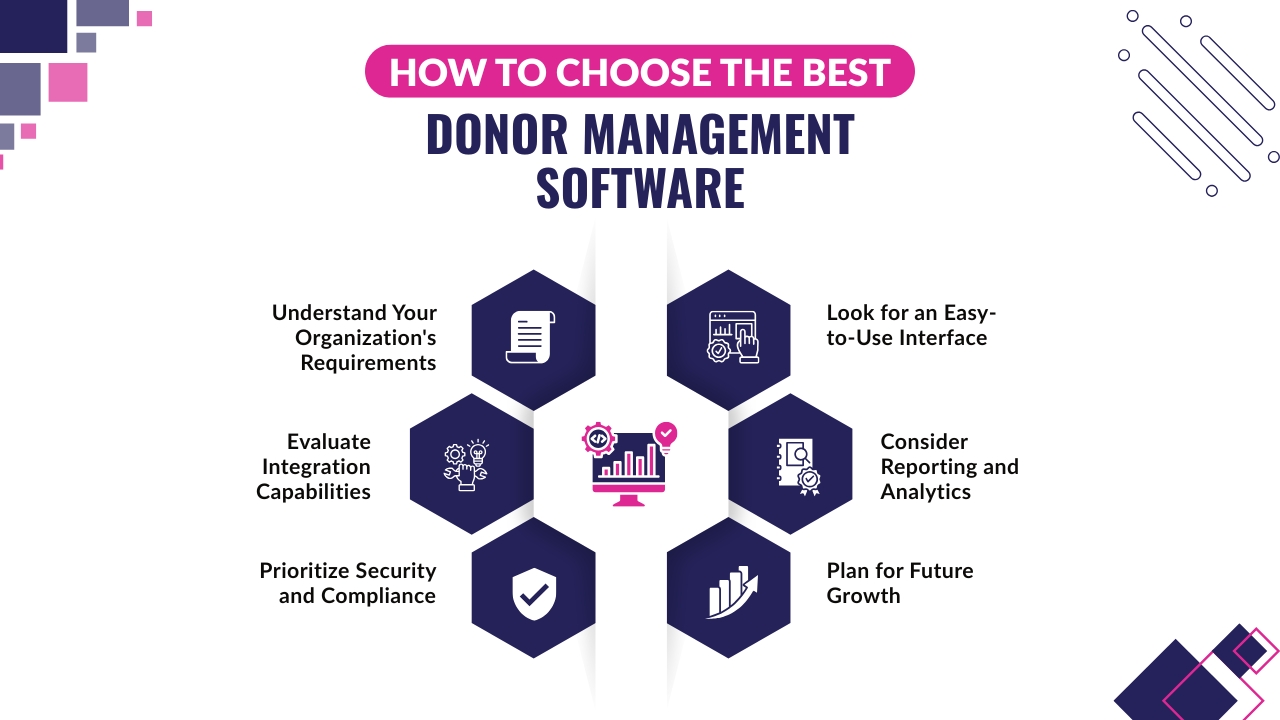
For nonprofits choosing the right donor management software is an investment which helps nonprofits to improve fundraising efficiency and improves relationships with donors.
Before selecting donor management software, nonprofits must evaluate the current needs of them, their future growth plans, and fundraising goals.
Every nonprofit has unique fundraising goals, so it is essential for nonprofits to select a donor management software which aligns with requirements of the organization.
Smaller nonprofits may only require basic donor tracking, while larger organizations often need basic donor tracking, while larger organizations need advanced features such as event management, volunteer tracking, and detailed reporting.
Before comparing other options, identify the features which are essential for your operations.
Consider whether you need:
When nonprofits choose software that is well suited for their fundraising objectives then it helps to improve fundraising efficiency and prevents them from paying for unnecessary features.
The software should be easy for staff and volunteers to learn and use. A simple interface reduces training time, improves productivity, and reduces errors.
This software must have easy navigation, easily searchable donor records, and dashboards which make crucial information easy to access.
Your donor management software should integrate with the tools that nonprofits already use. These powerful integrations reduce duplicate data entry, keep donor records accurate, and improve workflow efficiency.
Look for integrations with:
Also Read: How to Use Data to Improve Donor Retention in Your Church
Reporting tools help nonprofits to track fundraising success and make informed decisions. Choose software that provides real-time dashboards, customizable reports, and performance insights.
Useful reports include:
With these insights nonprofits can improve fundraising strategies and also find new strategies for increasing fundraising.
Making donor data secure is essential for nonprofits. A reliable donor management software includes advanced security features which protect personal and financial data while ensuring that they are compliant with industry standards.
Look for features such as:
Strong security measures help to gain trust from donors and protect your nonprofit organizations from risks.
Choose software that can expand with your nonprofit organizations. When nonprofit organizations expand, your fundraising needs will change. Having a scalable software solution should support larger donor databases, more staff members, more fundraising campaigns, increased online donations, and advanced reporting.
Investing in flexible software today helps nonprofits to avoid costly system upgrades in the future and ensures your nonprofit is prepared for long-term growth.
Also Read: How to Run a Successful Donation Campaign (Step by Step)
Installing software is just the beginning. Successful implementation requires planning, accurate data, and staff adoption.
Every nonprofit has unique fundraising goals, so it is essential to choose software which aligns with your organization’s needs. Smaller nonprofits may only need basic donor tracking, while larger organizations often require advanced features like event management, volunteer tracking, and detailed reporting. Before comparing solutions, identify the features that are essential for your operations.
Consider whether you need:
Choosing software that aligns with your fundraising objectives helps improve efficiency and avoids paying for unnecessary features.
Staff and volunteers should be able to use donor management software easily. If the donor management software has an easy-to-use interface, reduces staff training duration, increases staff productivity, and reduces mistakes.
This software must have easy navigation, searchable donor records, and dashboards which makes crucial donor data easily accessible for users.
Your donor management software should integrate with the tools that your nonprofit already uses. These integration removes duplicate data entry, keep donor records accurate, and improve efficiency of workflow.
Look for integrations with:
Also Read: What Is Donor Management Software? A Complete Guide
Reporting tools help nonprofits to track whether fundraising is successful or not and make informed decisions. They must select a software that delivers real-time dashboards, customizable reports, and performance insights.
Useful reports include:
With these reports nonprofits can improve their fundraising strategies and help them to find new fundraising opportunities.
It is essential for nonprofits to secure donor data. With a reliable donor management software has advanced security features that protect personal and financial data while ensuring compliance with industry standards.
Look for features such as:
With secure donor management software, nonprofits can build donor trust and protect your nonprofits from risks.
It is essential for nonprofits to effectively manage donor relationships if they want to achieve fundraising growth and long-term fundraising success.
When nonprofits grow, relying only on spreadsheets or manual processes becomes inefficient and increases the risk of missed opportunities.
A reliable donor management software solution centralizes donor information, automates routine tasks, improves communication, and provides insights that support better fundraising decisions.
Whether tracking donations, managing recurring gifts, organizing events, generating reports, and improving donor engagement, donor management software helps nonprofits to operate more efficiently while they focus on their mission.
Choosing a scalable platform with strong security, reporting capabilities, and seamless integrations ensures your organization can continue growing without operational challenges.
Solutions like SimplyGiv further enhance donor management by combining secure online fundraising, campaign management, peer to peer fundraising, recurring donations, and donor engagement tools within a single platform.
By embracing modern donor management technology, nonprofits can build stronger relationships with supporters, increase fundraising performance, improve donor retention, and create a greater impact in the communities they serve.
If you still have any query about Donor Management Guide then you may Schedule a Call at SimplyGiv and we are more than happy to assist you.