
In today’s rapidly changing digital age, churches often go beyond organizing Sunday services. Churches today manage volunteers, coordinating events, monitoring donations, communicating across different platforms, and creating impactful relationships within communities.
While ministries grow, doing ministry work manually with spreadsheets, paper forms can become difficult. This is why it is essential to use CRM(Customer Relationship Management system).
A Church CRM is a centralized system which helps churches to organize member data, seamless communication, manage donations, coordinate with volunteers, and track engagement in a secure system.
Rather than considering members like customers, a church CRM helps churches to build stronger relationships with their members, provide better pastoral care, and operate effectively.
In today’s times when congregations happen both in-person and online, it is essential for churches to have clear visibility and data about ministry activities.
Without a CRM, churches often struggle with missed followups, duplicate records, inconsistent communication, and inaccurate donation tracking. Such challenges often disengage members and missed opportunities for churches to establish connection.
Implementing a church management system, helps leaders gain tools that help to improve customer retention, simplify administrative tasks, establish better community engagement, and make ministry decisions with data insights.
Through this blog, we will walk you through why churches need a CRM, the important advantages it provides, essential features that you look for in CRM, and steps on how to get started with CRM.
Whether your church is small or growing or already managing multiple campuses, understanding how a CRM supports ministry can change the way you serve your members and fulfill your mission.
Also Read: Church Donation Kiosks
What Is a Church CRM?
A Church CRM(Church Management Software) is a powerful centralized system designed to help churches organize, manage, and strengthen their ministry operations.
At its core, a Church CRM manages important data like member profiles, attendance records, communication history, donations, volunteer schedules, event registration, and ministry involvement in a single secure system.
Unlike traditional CRMs which are designed for sales teams and corporates, Church CRMs are built for managing ministry activities. A Church CRM does not treat their members like customers, rather it helps church leaders to build deeper relationships with members, provide better pastoral care, and operate effectively.
They are customized to support the unique structure and mission of faith-based organizations.
A Church CRM focuses on important ministry functions, including:
- Relationship building – It helps to maintain a detailed member profile which helps to establish meaningful connections.
- Community engagement – It helps to track member attendance, small group participation, and ministry involvement.
- Spiritual growth tracking – It helps to track discipleship programs, baptisms, classes, and service milestones.
- Volunteer coordination – It helps to schedule teams, manage volunteer availability, and send reminders.
- Donation management – It helps to record tithes, offer online giving options, generate tax receipts, and run financial reports.
- Event planning – It helps to manage registrations, check-ins, and communication for conferences, camps, outreach events, and church gatherings.
Rather than managing ministry activities manually using spreadsheets, handwritten visitor cards, and manual giving records, everything is stored secure in a single well organized database.
Such a centralized approach while managing ministry helps to remove duplication, reduce errors, improves follow-up processes, and provide visibility into growth of church communities in real time.
Ultimately, a Church CRM works as a ministry support tool which helps leaders to spend less time on administrative tasks and focus more on people and purpose.
Also Read: Why Your Church Needs a Mobile Giving Solution This Year
Why Churches Need a CRM in 2026 and Beyond
The church environment has changed quickly, and by 2026 and beyond, ministry goes beyond the church buildings. Today congregations operate in both physical and digital spaces.
Some members attend church services in person while other members attend services through livestreams. Donations are made through mobile apps, online portals, and automated recurring donations.
Communication with members is done through email newsletters, SMS reminders, church apps, and social media platforms.
As there are many church activities which are managed together, running church operations without a centralized system often leads to scattered data, missed follow ups, and unnecessary inefficiencies.
This is why a Church CRM is essential because it is not just a corporate tool rather it is a ministry support system which empowers church organization and stronger connection.
Without a centralized Church CRM, churches often face challenges like weaker organization and connection with members. Even visitors’ data get lost when paper cards are misplaced, and follow-ups get missed when guests or prayer requests are not tracked.
If there are duplicate records in spreadsheets then it can create confusions and impact reliable reporting. Tracking donations becomes inaccurate when finances are handled manually and often increases the risk of errors.
When assignments overlap or if their rotational shifts are not tracked then volunteer shifts can become disorganized that often leaves people confused and discouraged.
Without a Church CRM, communication can become inconsistent, often leading to the right audience missing important updates or failing to reach the right people at the right time.
A Church CRM solves these challenges by managing it through a single organized and secure system. It manages member data, automates follow-ups, and streamlines communication across all channels.
Most importantly, a CRM allows church leaders to operate effectively while also staying focused on their core mission which is spiritual care, and building lasting relationships within their communities.
Also Read: Top Benefits of Using Donation Kiosks for Non Profits and Charities
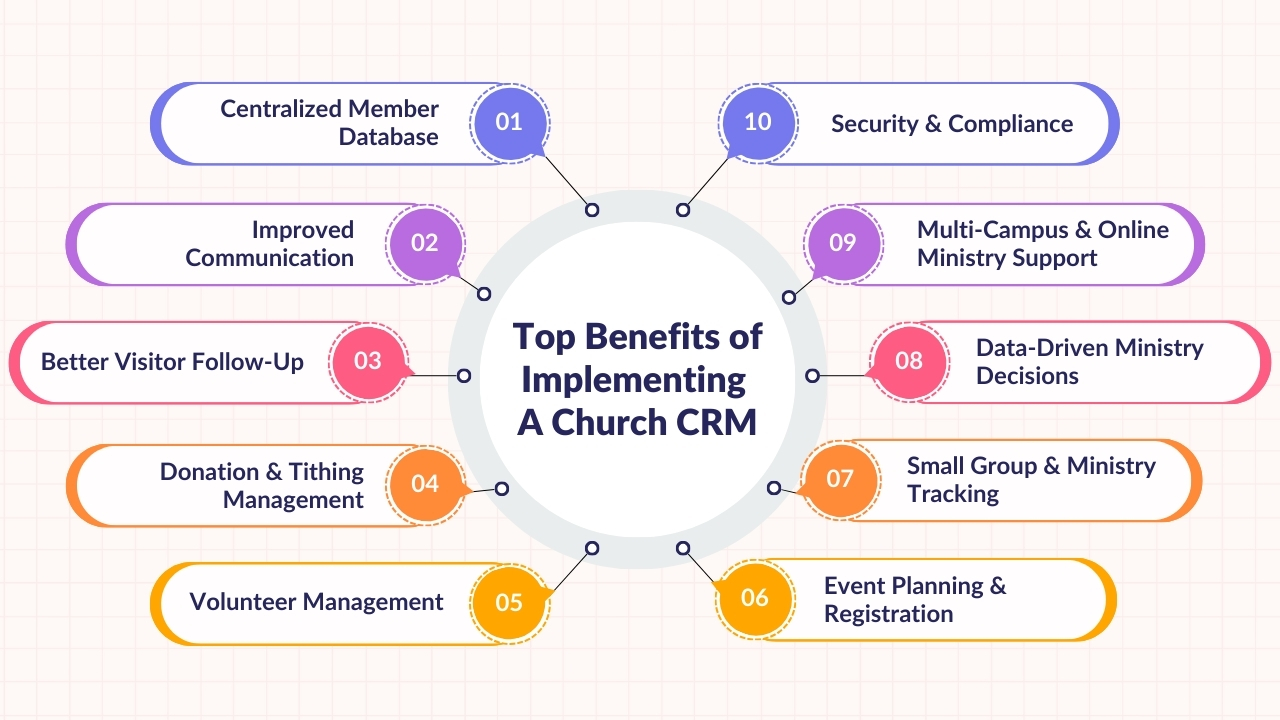
Top Benefits of Implementing a Church CRM
1. Centralized Member Database
One of the most valuable advantages of a Church CRM is the ability to keep all member information in one secure and organized location. Many churches depend on multiple spreadsheets, paper forms, isolated email lists, and separate giving platforms to manage their data.
Over time, when data is scattered across different systems or spreadsheets can often lead to confusion, duplicate records, and unnecessary administrative work.
A centralized system removes such challenges as it operates through a single, reliable database.
Unlike disconnected tools, a Church CRM provides:
- A unified member profile
- Accurate contact information
- Family relationships and household details
- Attendance history and engagement tracking
- Complete giving records
- Volunteer involvement history
- Small group participation details
When all this information is accessible in one place, church staff and ministry members gain a clear understanding of each member’s activities. It helps them to identify the members who are actively engaged, members who require follow-up, and how actively are individuals participating in church activities.
2. Improved Communication
For managing a ministry effectively, it is essential to communicate with members effectively. Sending clear and timely updates helps church members to remain informed, engaged, and connected to church activities.
Without having a centralized CRM, messages can become delayed, inconsistent, or general messages. A Church CRM helps to improve that by ensuring that the right message reaches the right people at the right time.
With a Church CRM, churches can use:
- Targeted email campaigns for specific ministries or groups
- SMS reminders for urgent updates or service times
- Event notifications for programs and outreach activities
- Volunteer updates for scheduling changes
- Personalized follow-ups for visitors or prayer requests
For instance, leaders can send welcome emails to first-time guests, send notifications to parents about youth schedule changes, or remind volunteers of service duties. Such strategic communication with members helps to strengthen relationships and also keeps members feeling informed and valued.
Also Read: 10 Powerful Thanks-Giving Sermons
3. Better Visitor Follow-Up
First impressions do matter in a church where new visitors are willing to create connection, belonging, and spiritual support. Many church members unintentionally lose members if there is no clear system for following up with first-time guests.
Paper visitor cards can often get lost, contact details may be forgotten, and follow-ups can get delayed for days. If there is no intentional, timely engagement with members, then first-time visitors may feel unnoticed, disconnected, and unimportant which often increases the chances of them leaving and not returning.
A Church CRM establishes a structured and reliable follow-up process with members. With the right system, churches can:
- Collect visitor information digitally through online forms or check-in tools.
- Send automated welcome emails instantly after a first-time visit
- Assign follow-up calls or messages to leaders or volunteers
- Track follow-up progress to ensure no guest is missed
- Schedule invitations to small groups, classes, or events.
When follow-up is both personalized and timely then it often increases retention and helps visitors to feel valued and connected to the church community.
4. Donation & Tithing Management
Managing donations manually can become complicated and risky. Paper records, scattered spreadsheets, and disconnected payment systems often result in errors, misplaced data, and compliance concerns.
Since churches are entrusted with financial stewardship, accuracy and transparency are essential. A Church CRM simplifies giving by centralizing and automating the entire donation process.
With a Church CRM, churches can manage:
- Online giving through secure digital platforms
- Recurring donations for steady tithes and offerings
- Accurate donation tracking for members and families
- Automated tax receipts for reporting
- Detailed financial reports and fund allocation tracking
The benefits include:
- Organized and accurate records
- Reduced administrative workload
- Simplified audits and compliance
- Transparent reporting
- Stronger donor confidence
Integrated mobile and online giving options make giving convenient and secure for members.
Also Read: How to Track Church Donations With Online Giving Tools
5. Volunteer Management
Volunteers are the foundation of church ministry, serving in roles from welcoming guests to leadership worship and organizing events. Without proper organization, scheduling can become confusing, leading to overlapping assignments, missed reminders, and volunteer frustration.
A Church CRM brings organized systems and clear scheduling tools that help churches coordinate volunteers smoothly, reduce confusion, and protect teams from burnout.
With a CRM, churches can:
- Track volunteer availability and preferred service times
- Assign clear service roles for weekly services and events
- Manage team rotations to avoid over-scheduling
- Send automated reminders for upcoming responsibilities
- Monitor participation history and engagement levels
Leaders can also identify:
- Consistent volunteers
- Those needing encouragement
- Future leadership potential
Organized volunteer management strengthens engagement, satisfaction, and long-term ministry commitment.
6. Event Planning & Registration
Churches organize many events such as conferences, youth camps, outreach programs, fundraisers, and small group gatherings. While these events build community and spiritual growth, managing them manually with paper forms and spreadsheets can become stressful and disorganized. A Church CRM simplifies event management by offering structured digital tools in one centralized system.
With a CRM, churches can manage:
- Online event registrations through digital sign-up forms
- Digital check-ins for smooth entry
- Attendance tracking for reporting and follow-up
- Payment processing for camps or ticketed events
- Automated reminders via email or SMS
This streamlined process reduces paperwork and saves administrative time. It also improves the attendee experience by making registration simple and communication clear. Leaders gain better insight into participation and engagement trends for future planning.
Also Read: Easy Christmas Fundraising Ideas You Can Start Today
7. Small Group & Ministry Tracking
Spiritual growth often happens in small groups and ministry gatherings where deeper relationships and accountability are formed. However, without proper tracking, it becomes difficult for leaders to track engagement or provide timely support.
A Church CRM brings structure by organizing ministry data in one accessible system.
With a CRM, churches can track:
- Group membership and participant lists
- Attendance records for each meeting
- Leadership roles and assignments
- Growth trends over time
- Prayer requests and follow-up needs
This visibility helps leaders understand ministry health. They can identify:
- Growing and thriving groups
- Areas where engagement is declining
- Members who need pastoral care
By using clear data insights, churches strengthen discipleship, improve accountability, and ensure that every member feels supported and connected.
8. Data-Driven Ministry Decisions
In today’s digital age, churches can gain real value from accurate data insights. While ministry is built on relationships and spiritual care, clear information helps leaders make wiser, more informed decisions.
A Church CRM provides organized reports that highlight patterns and trends, giving leadership a clearer view of church engagement, and growth across ministries.
Through a CRM, churches can access reports on:
- Attendance trends across services and campuses
- Giving patterns and donation consistency
- Volunteer participation and serving frequency
- Event engagement and registration outcomes
- Member retention and involvement levels
These insights help leaders take strategic action. With reliable data, church teams can:
- Plan services and programs more effectively
- Allocate financial and human resources wisely
- Identify growth opportunities and areas needing attention
- Strengthen community engagement through targeted outreach
Instead of relying on assumptions, data-driven insights provide clarity and direction while supporting responsible stewardship and meaningful ministry growth.
9. Multi-Campus & Online Ministry Support
As churches expand, they expand to multiple campuses and build strong online communities. Though this growth is a positive expansion, it also increases complexity.
It is essential for leaders to track engagement across locations, manage different groups, and establish consistent communication with members. Without a centralized system, offering online ministry can become difficult and members may feel disconnected.
A Church CRM supports multi-campus and online ministry by managing data on a centralized system and also allowing clear segmentation.
With a CRM, churches can:
- Segment members by campus or location
- Track campus-specific attendance and engagement
- Manage online attendees and digital participation
- Coordinate cross-campus communication and announcements
This structure helps leaders to monitor each campus while managing a single vision and mission. It ensures members stay connected and supports whether members stay connected and supported whether they attend in person or online while consistently and accomplish communication across all ministry branches.
10. Security & Compliance
Churches handle sensitive data such as member contact details, family records, and financial donations. Hence, keeping this data is not just a legal responsibility but also a trust concern.
Without having secure systems, churches may have risk data breaches, lost records, and compliance problems which can damage credibility and member confidence.
Modern Church CRMs are built with strong security features, including:
- Secure cloud storage to reduce data-loss risk
- Encrypted data protection for confidentiality
- Role-based access controls for authorized users only
- Automatic backups to prevent permanent loss
- Compliance tools for privacy and financial regulations
Such security features help churches to operate with transparency, accountability, and security. Investing in a secure CRM shows responsible stewardship and reinforces the commitment of the church towards integrity, care, and confidentiality.
How to Get Started with a Church CRM
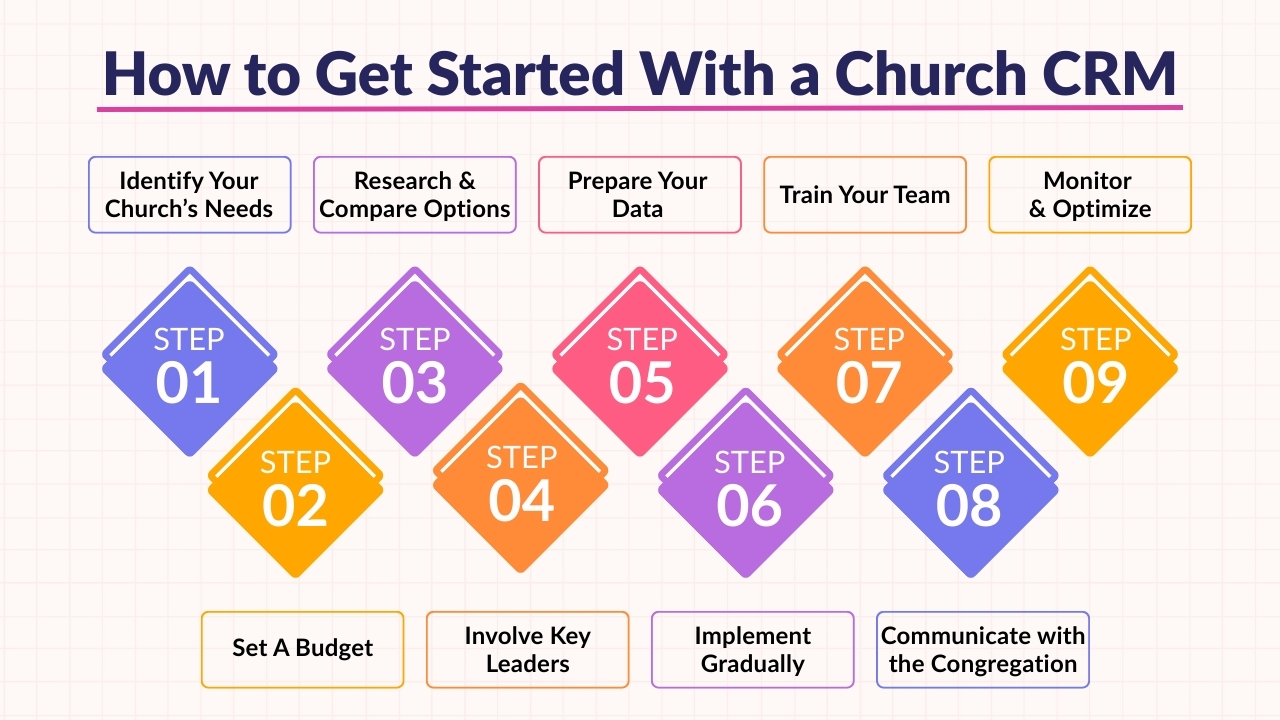
Getting started with a Church CRM begins with clarity. Before selecting any software, it is essential that your church understands the problems that you are trying to solve and the outcomes which you want to improve.
Every church is not the same, so it is essential that the right CRM matches your size, ministry structure, and day-to-day needs.
Step 1: Identify Your Church’s Needs
Begin by evaluating important areas of your church operations, like:
- Church size and number of active members
- Ministry complexity (small groups, multiple ministries, campuses, events)
- Budget for software and training
- Staff capacity and available time to manage the system
- Current challenges in communication, giving, volunteers, and follow-up
Next, ask honest, practical questions to identify where challenges exist.
- Are visitor or member follow-ups slipping through the cracks?
- Is donation and tithing tracking becoming complicated or time-consuming?
- Are volunteers feeling disorganized or over-scheduled?
- Is communication inconsistent across email, SMS, and social media platforms?
Clear answers will reveal the biggest operational gaps that you have.
Write down your ministry priorities in order of importance. This list of ministry priorities will guide your CRM decision and help you choose a system which supports your ministry goals instead of adding further complexity.
Also Read: Text-to-Give for Churches
Step 2: Set a Budget
Before selecting a Church CRM, it is essential that you establish a clear and realistic budget. Because though CRM pricing varies depending on church size and features, understanding the full cost helps to avoid unexpected expenses.
Investing in a Church CRM should not be considered as a burden, rather as a strategic investment which improves efficiency and supports long-term ministry growth.
When setting your budget, consider:
- Monthly subscription costs based on membership size or feature access
- Initial setup or onboarding fees
- Training costs for staff and volunteers
- Payment processing fees for online giving
By planning carefully, your church can select a CRM church platform which fits as per your budget while also delivering meaningful impact. Remember, only a well-implemented CRM saves time, reduces errors and also increases ministry effectiveness.
Step 3: Research & Compare Options
Once you understand the needs of your church and your budget, the next step is to research existing Church CRM options. Every Church CRM system does not offer the same features, pricing, or user experience.
By investing time to compare current Church CRM options carefully will help to avoid selecting a CRM system that does not completely support your ministry goals.
When evaluating different CRMs, look for:
- Customer reviews and testimonials from other churches
- Feature comparisons to ensure the system meets your requirements
- Free trials or test accounts to explore usability
- Customer support quality and responsiveness
It will be a smart decision to request live demos before making a final decision regarding the Church CRM platform. This helps teams to ask questions, understand workflows, and understand whether it feels intuitive and practical for everyday use.
Step 4: Involve Key Leaders
Implementing a Church CRM should not be a decision made by a single individual. Rather, it is essential that you involve important leaders early in the process, increase collaboration, build trust, and increase the chances of seamless adoption of church CRM.
When leaders feel that they are heard and included while selecting a Church CRM, then they are likely to support the new Church CRM system.
Be sure to include:
- Pastors, who understand ministry priorities and member care
- Administrative staff, who will manage daily data entry and communication
- Volunteer coordinators, who handle scheduling and team organization
- Finance team members, who oversee donations and reporting
Every group provides valuable insights about the operational requirements of the church. Their feedback helps to ensure that the CRM supports the challenges faced by ministry rather than adding more complexity.
When important leaders are included from the beginning encourages a feeling of ownership, and also leads to long-term success.
Step 5: Prepare Your Data
Before moving or implementing a new Church CRM, it is essential that you prepare your existing data carefully. Because if you migrate improper or outdated information then it can lead to confusion and also reduce the effectiveness of the new system.
It is essential that the ministry take time to organize and clean your data to ensure a smooth and accurate migration to the new system.
Before migration, make sure to:
- Clean up duplicate records to avoid confusion
- Update outdated contact information
- Organize existing spreadsheets and files
- Standardize data formats for names, phone numbers, and addresses
When your data is well-prepared it helps to prevent errors during import and also ensures that you begin your Church CRM with right information. A clean database not just improves efficiency but also allows church leaders to trust the reports and insights delivered by the new system from the first day.
Step 6: Implement Gradually
While introducing a Church CRM, it is a best practice that you do not activate every feature all at once. Rather a gradual implementation of Church CRM systems helps staff and volunteers to adjust with the system comfortably while reducing confusion.
Begin with essential features which allows your team to use those features confidently before expanding into more advanced tools.
Begin with core features such as:
- Member database management
Communication tools for email and SMS - Donation tracking and online giving
Once these systems are running smoothly, then you can further expand into additional features, including:
- Volunteer scheduling and team management
- Event registration and check-ins
- Advanced reporting and analytics
This gradual church CRM system approach helps to reduce struggle and increases chances of adoption. Gradual implementation of your Church CRM increases the benefits of such a system while maintaining stable and organized ministry operations.
Step 7: Train Your Team
Successful CRM implementation involves providing proper training to your system. Without offering proper training even the best Church CRM will not give results if your team does not know how to use Church CRM effectively.
Investing your time in staff training helps to ensure that staff and volunteers are confident and comfortable while using new CRM systems.
Investing time in staff training helps to ensure that staff and volunteers feel confident and comfortable while using new tools.
Provide structured support such as:
- Staff training sessions to cover daily workflows and responsibilities
- Volunteer walkthroughs for scheduling and communication tools
- Step-by-step guides for reference and troubleshooting
- Ongoing support to address questions as they arise
Ensure that you encourage open communication during staff training. Invite questions from staff, gather feedback from staff, and adjust training adjustments whenever necessary.
When your team feels supported and heard then adoption of Church CRM becomes seamless, and the CRM becomes an important ministry tool instead of a complex system.
Step 8: Communicate with the Congregation
While implementing a Church CRM, it is essential that you communicate with your church members with clarity. Because it is important that you make church members know why implementing a Church CRM is happening and how it will be beneficial for them.
Open communication helps to avoid any confusion and encourage member participation in new systems like online giving or event registration.
Be sure to explain:
- Why the church is implementing a CRM and what challenges it solves
- How it improves communication and keeps members better informed
- How to access online giving, event registration, or member portals
Establishing transparency helps to build trust. When members see that the goal is to improve organization, connection, and stewardship, then there are more chances that church members will support the transition. Clear communication with members ensures the CRM becomes a tool which makes the entire church community strong.
Step 9: Monitor & Optimize
Implementing a Church CRM is not the last step rather it is the beginning of a continuous improvement process. Once the system is in place, it is essential that you regularly monitor how it is being used and identify areas for improvement.
Continuous evaluation helps to ensure that the CRM remains effective and remains aligned with the ministry goals of your church.
After implementation, make sure to:
- Track system usage among staff and volunteers
- Review reports and data insights regularly
- Gather feedback from team members and ministry leaders
- Improve workflows based on real experience
By consistently tracking and refining processes, your church can maximize the value of the CRM. Adoption grows stronger over time when the system becomes fully integrated into daily ministry operations.
Conclusion
In today’s evolving ministry landscape, churches are called to serve both in-person and digital communities with clarity, care, and efficiency.
As responsibilities grow from managing members and volunteers to tracking donations and organizing events relying on scattered systems can slow down ministry impact. A Church CRM provides the structure needed to bring everything together in one secure, organized platform.
More than just software, a CRM is a ministry support tool. It strengthens communication, improves visitor follow-up, simplifies donation management, and helps leaders make informed decisions through meaningful data insights.
By centralizing information and automating key processes, churches can reduce administrative burdens and focus more on what truly matters: shepherding people and fostering spiritual growth.
Getting started requires thoughtful planning like identifying needs, setting a budget, training your team, and implementing gradually. But when done intentionally, the long-term benefits are significant.
Churches gain better organization, stronger engagement, increased transparency, and a clearer understanding of their community.
Ultimately, a Church CRM helps ensure that no member is overlooked, no opportunity for connection is missed, and no ministry effort is wasted. It empowers churches to lead with purpose, steward resources wisely, and build stronger, more connected faith communities for the future.
If you still have any query with why churches need a CRM and how to get started then you may book a free demo at SimplyGiv and we are more than happy to assist you.