
In today’s digital world, churches are rethinking about how they can implement convenient giving. As most people today use smartphones for everyday transactions, enabling text-to-give for churches is an effective and accessible way to support ministry growth.
Text-to-give is a type of mobile giving for churches which lets members donate by simply sending a text message. It allows donors to respond to a sermon, special appeal, or capital campaign without needing cash, cheques, or lengthy online forms.
This ease of use removes barriers and also encourages instant giving. By integrating church online giving tools like text-based donations, congregations can increase participation in giving from donors, make record-keeping smooth, and provide a smooth and effortless giving experience for all age groups.
As digital adoption continues to increase, churches that implement SMS giving for churches prepare themselves for long-term sustainability.
Whether it is supporting weekly tithes, missions, building funds, or emergency relief efforts, text-to-give gains immediate response from donors even during services, livestreams, and events.
With secure payment processing, automated receipts, and recurring donation options, improves transparency and trust. In this blog, we will explore what text-to-give is, how it works, and the step-by-step process to implement it successfully.
Also Read: Text-to-Give Vs Text-to-Donate
What Is Text-to-Give?
Text-to-give is a secure giving method that allows donors to donate conveniently by simply sending a text message. In an era when people use smartphones in everyday life, text-to-give aligns with the way people already communicate and manage their finances.
Instead of navigating to a website, logging to an account, or filling forms, members can complete a donation within seconds from their phones. This type of simplicity and ease removes barriers that often delay or prevent a donation.
Usually, text-to-give works in one of two primary formats. The first is keyword-based giving. In the keyword-based giving model, a donor texts a specific keyword like “Give”, “Tithe”, or “Missions” to a dedicated church phone number.The system then responds with a secure link that guides the donor through the donation process.
The second method is amount-based giving, where the donor texts a dollar amount like “50”, to the church’s designated number. Here the platform interprets the amount and the donation process will be initiated automatically.
If there are first-time users, the system sends a secure registration link where they enter basic information and payment details. Once this one-time setup is complete then the future donations become simple.
Donors can donate instantly in a few seconds by texting an amount or keywords, without re-entering payment information each time. By eliminating extra steps, text-to-give helps people to donate instantly as it lets immediate response during services or service appeals accessible anytime, anywhere.
Also Read: 50 Short Thank You Messages for Donations
Why Text-to-Give Matters for Churches
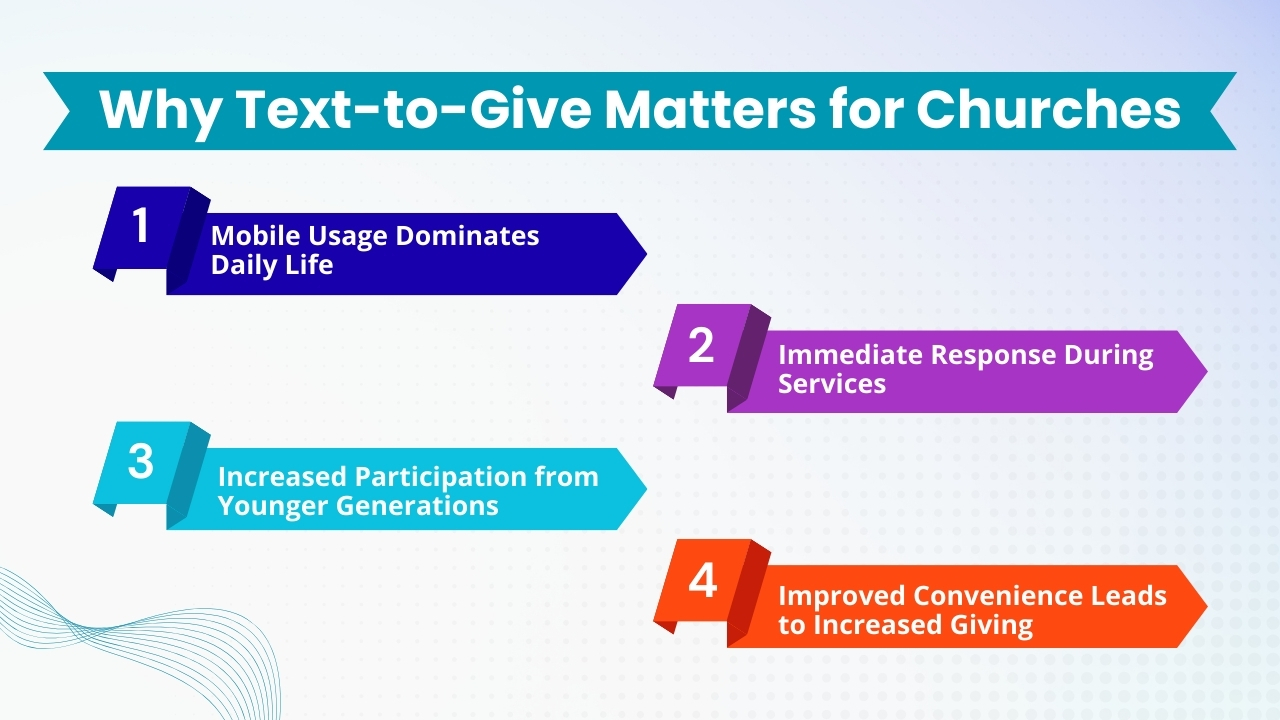
Text-to-give is not just a modern giving trend, instead it is a strategic way of giving that aligns with the way people live, communicate, and manage their finances today.
Churches that embrace mobile giving solutions prepare themselves to remove barriers, increase donor participation, and strengthen financial sustainability for the long-term.
Below are the key reasons why text-to-give matters for churches today.
1. Mobile Usage Dominates Daily Life
Smartphones have become an important part of everyday life. Please use smartphones to communicate, shop, pay bills, manage bank accounts, and interact on social media.
For many individuals, they use phones for handling financial transactions. As digital payments are continuously replacing traditional payments, fewer people carry cash or write cheques regularly. This shift directly impacts the way churches receive donations.
Offering text-to-give giving options, churches align with modern financial habits of donors. Rather than expecting members to adjust to outdated giving methods, churches adapt to the way people today manage their money.
Additionally, mobile giving supports flexibility in giving. Members can make donations while they attend services in person, watching a livestream, travelling.
Such accessibility for donors ensures that giving is not limited by location or circumstance. When churches embrace mobile-first solutions, embrace mobile-first giving, then they show awareness of changing lifestyles and make participation easier for every donor.
Also Read: Why Your Church Needs a Mobile Giving Solution
2. Immediate Response During Services
Momentum also plays an important role when it comes to donations. When a pastor delivers a compelling testimony, or a ministry vision, or invites the congregation to support a special cause, then people are encouraged to donate. However, without a simple way to respond, that momentum may reduce.
Text-to-give allows church members to act instantly. Rather than just intending to donate later and possibly forgetting, text-to-give allows donors to donate in real time.
A simple instruction displayed on the screen creates a clear and actionable step. Members when feel connected to the message then can make donations within seconds.
Such immediate response is essential for special offerings, mission updates, disaster relief efforts, or building campaigns. The ability to respond in the moment increases participation from donors as it closes the gap between inspiration and action.
Text-to-give has advantages for both hybrid and online services. As most churches livestream their gatherings, online digital tools ensure that not just attendees sitting in the church but also online attendees are able to participate. Offering a unified giving experience strengthens donor engagement across the entire congregation.
3. Increased Participation from Younger Generations
Today’s generation has grown up in a digital-first world. They are used to quick, intuitive interactions through apps, text messages, and online platforms.
For the younger generation, traditional giving methods may feel inconvenient or outdated but for them text-based systems might feel familiar.
Text-to-give aligns perfectly well with the communication style of the young generation. For them sending a text message feels effortless, and donating through a mobile payment link is part of their everyday routine.
When churches offer modern giving options, then they remove any barriers and create a welcoming approach for younger members. Younger donors also prefer recurring digital payments.
Among them, subscriptions for streaming services, memberships, and automated payments are common. Text-to-give platforms also implement recurring giving features, that makes it easier for younger members to set up consistent giving.
Importantly, while text-to-give is an attractive giving option for younger generations as it does not exclude older members. Many adults of all ages use texting so with simple instructions and minimal setup, adoption of text-to-give across all age groups becomes achievable.
By adopting text-to-give, churches show that they are adaptable and have forward-thinking. It encourages participation from younger generations but also indicates sustainability and relevance in an increasing digital culture.
4. Improved Convenience Leads to Increased Giving
Convenience directly influences giving. When the process of giving is complex, time-consuming, or unclear, then people are less likely to complete a donation. However, when giving is simple, fast, and secure then the donor participation naturally increases.
Text-to-give removes most challenges in traditional giving. Donors are not required to fill envelopes, write cheques, or go through complex donors. Because once a donor completes the initial setup, then future giving can be made instantly. Such simplicity while giving encourages consistent donation from donors.
Convenience offered also supports recurring giving. Most text-to-give systems allow donors to schedule their weekly or monthly giving. Recurring donations provide churches with predictable income, that help leaders to plan their budgets, fund ministries, and support outreach initiatives confidently.
Additionally, digital systems send instant donation confirmation and automated receipts. Donors appreciate knowing that their donations were received and recorded properly. Such transparency builds trust and creates more such positive giving experiences.
Text-to-give also reduces manual work like counting cash, entering data, and managing paper records. Automated reporting improves efficiency and accuracy giving more free time to staff to focus on ministry work rather than paperwork.
Ultimately, when churches remove friction from the giving process, then the donation becomes easier and more consistent. Improved convenience does not replace the intention to give rather it makes participation from donors more accessible. And when participation from donors increases, ministry impact also grows.
Also Read: 100 Best Thank You for Donation Quotes
How to Implement Text-to-Give
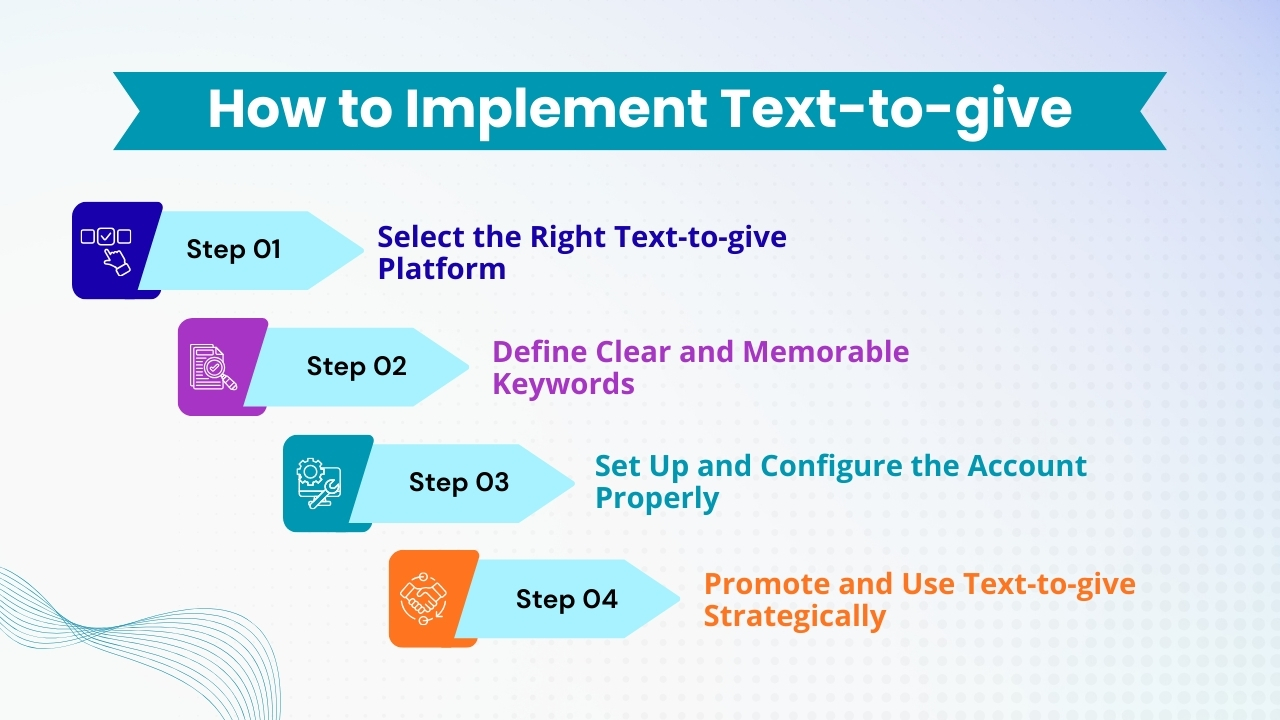
1. Select the Right Text-to-Give Platform
The first and important step while implementing text-to-give is to select reliable, church-focused platforms. Many provide platforms that are developed specifically for ministries and nonprofit organizations.
While selecting a platform, consider the following criteria:
1. Integration with Church Management Software (ChMS)
Your text-to-give platform should automatically sync with the church database. It ensures that every donation is recorded accurately under the donor’s profile without any manual data entry. Automating integration reduces administrative work and prevents errors.
2. Ease of Use for Members
As the giving process should be simple and intuitive. Ideally, members should only be required to text a keyword and follow a secure link to complete donation within seconds. Having fewer donation steps leads to higher participation from donors.
3. Security and Compliance
Choose a provider that is both PCI-compliant and uses encrypted transactions. Church members must feel confident that their financial information is secure.
4. Recurring Giving Options
A strong platform allows donors to set up recurring weekly or monthly gifts. It helps to stabilize church cash flow and supports long-term ministry planning.
5. Reporting and Financial Tools
Look for features like detailed reporting which helps your finance team to reconcile deposits, track fund allocation, and generate year-end statements. Choosing the right platform lays the foundation for a smooth and trustworthy digital giving experience.
Also Read: 10 Powerful Thanks Giving Sermons
2. Define Clear and Memorable Keywords
After selecting the platform, the next step is to set up keywords. Keywords are the simple works that members text to initiate a donation. The goal is to develop clarity and memorability.
Once you have selected your platform, the next step is setting up keywords. Keywords are the simple words members text to initiate their donation. The goal is clarity and memorability.
1. Keep Keywords Short and Familiar
Keep short and familiar keywords like “Tithe”, “Give”, or “Offering” that are easy to remember. Because complicated phrases can confuse members and reduce donor participation
2. Create Fund-Specific Keywords
To make donations more organized and intentional, assign specific keywords for different funds:
“Tithe” for general offerings
“Building” for construction campaigns
“Mission” for outreach projects
“Youth” for student ministries
This type of keyword structure helps donors to designate their contribution properly without confusion.
3. Avoid Similar or Overlapping Words
Ensure keywords are clearly unique from one another. For instance, avoid using both “Mission” and “Missions” as it may cause errors.
4. Maintain Consistency Across Communication
Use the same keywords consistently across slides, bulletins, website pages, emails, and social media posts. Because when keywords are used repeatedly then it reinforces memory.
5. Test Before Launch
Send test messages to ensure that the correct donation page loads and funds are properly categorized in the backend system. Well-chosen keywords remove friction. During a service, if the members feel encouraged to donate, then members should be able to act instantly without needing complex instructions.
3. Set Up and Configure the Account Properly
If you set up and configure the account properly then the text-to-give platforms will work smoothly from day one. These steps require detailed attention.
1. Customize the Donation Page
Design your donation page that aligns with your church’s identity, vision, and mission. Ensure that you use your logo, brand colors, and consistent styling so that the page feels trustworthy and familiar to donors. Add a warm message that explains how your donations support ministry and impact lives.
Ensure that you maintain clear fund categories so that it is easy for donors to choose, and include suggested donated amounts while also allowing custom donations. Enable recurring donation options so members get to donate on a weekly or monthly basis without any extra steps.
A clean, professional, mobile-friendly page builds confidence and encourages consistent donations.
2. Link Bank Accounts
Connect your church’s official bank account for secure deposits. Ensure that you double check routing and account numbers to prevent failed transfers. Confirm the deposit schedule either daily, weekly, or customized so your finance teams know when they will receive funds.
Ensure that your platform integrates with accounting tools which helps for smooth tracking and reporting. Having clear deposit timing and integrations make reconciliation easy and also improve transparency.
3. Set Up Automatic Receipts
Enable instant email or text receipts so donors receive instant confirmation about their donations. Confirmation receipts give assurance, transparency, and help donors with their year-end tax documentation.
Customize your receipt message with a thank-you note, impact statement, or short ministry update to make donations feel personal and not just transactional.
4. Conduct Internal Testing
Before launch, run multiple test donations across different amounts and fund categories. Confirm donations appear correctly in your ChMS, receipts are delivered instantly, and fund allocations are accurate.
By conducting testing you find issues early, prevents confusion, and builds confidence among staff and leadership.
5. Train Administrative Staff
Train finance and office teams to generate reports, reconcile deposits, process refunds if needed, and answer common donor questions. A knowledgeable team provides fast support and ensures a smooth rollout for your congregation.
Also Read: How to Start a Church Step By Step Guide for New Pastors
4. Promote and Use Text-to-Give Strategically
Implementing text-to-give is beyond technical setup. Because it requires clear communication, regular reminders, and strategic promotions to ensure that the members understand, trust, and regularly use the new giving option.
1. Announce During Services
Announce text-to-give during a worship service with a clear, simple explanation. Shortly explain about how text-to-give works: when members text a keyword to an assigned church number, then they may receive a secure link to complete their donation.
Explain to church members why the church is offering text-to-give to donors, highlighting its convenience and flexibility. Display the assigned number and keyword on the screen, and give a short live demonstration which will remove donor hesitation and encourage immediate participation from donors.
2. Include in Bulletins and Slides
Reinforce awareness by consistently displaying instructions like “Text Tithe to 12345 to give securely”. Add this message to offer slides, printed bulletins, and announcement screens. When members see the information repeatedly, it becomes familiar and easier to remember and increases long-term adoption.
3. Update Your Website
Ensure that text-to-give is easy for members to find on your website. Add a clear section for text-to-give on the homepage and also provide a detailed guide on the giving page.
Also include step-by-step instructions, simple visuals, and a short FAQ that includes security, receipts, recurring giving, and fund designations. Because when instructions are clear online then it reduces any confusion and also helps first-time users to donate without hesitation.
4. Send Email and Social Media Announcements
Send an informative email introducing digital giving, explaining its advantages and security features. Emphasize how your donations will support ministry growth and outreach efforts.
Post reminders on social media about your upcoming events or campaigns. Consistent communication ensures that text-to-give options remain in the minds of donors.
5. Use During Services and Special Events
Display text-to-give in real time during services, special events, fundraising or conferences. Show campaign-specific keywords for special initiatives and include the donation in livestream for online viewers. Immediate access to giving allows members to act when they feel encouraged.
6. Encourage Recurring Giving
Regularly remind members for donations so that they can schedule donations on a weekly or monthly basis. Recurring giving will stabilize church income, supports better budgeting, and enables long-term ministry planning confidently.
7. Share Impact Stories
Share testimonies, ministry updates, and campaign progress reports to donors to demonstrate the real impact of your donations. When members see how their donations are impacting lives, such transparency helps to build trust, engagement, and inspires continued support.
Key Benefits of Text-to-Give
1. Simplicity
Text-to-give is an effective giving option due to its simplicity. Donors are not required to do complex app downloads, long registration forms, or technical channels which might discourage participation from donors.
Members simply require to text a keyword to a designated number and receive a secure link to complete their donation. After the initial setup, future donations can be made in just a few taps.
2. Speed
Such systems are built for immediate response. Once donors complete their initial setup, giving takes only seconds. That speed is especially valuable during worship services or special appeals, when people feel inspired to give.
Enabling quick transactions reduces delays and increases follow-through donations, helping churches to maintain momentum even during important occasions.
3. Accessibility
Text-to-give is accessible anywhere as donors just need to have cellular phones.Members can donate during services, travelling, or even while watching a livestream from their home.
Such accessibility ensures that everyone can participate in giving, regardless of location, making donations more inclusive and convenient.
4. Integration with Church Systems
Modern platforms integrate directly with Church Management Software (ChMS), accounting tools, and donor reporting systems. It allows donations to be automatically recorded, categorized, and tracked reducing manual work and improving accuracy.
5. Automated Record-Keeping
Digital systems record detailed transaction records, generate instant receipts, and make year-end reporting simplify year-end reporting. Automating record-keeping saves time, offers transparency, and lets church leaders focus more on ministry instead of administration.
Types of Text-to-Give Systems
1. SMS Link-Based Giving (Most Common)
Donors text a keyword like Tithe or Give to your church’s giving number and instantly receive a secure link. They complete the donation on a mobile friendly page using a card or bank transfer.
This method is widely used because it is secure, flexible, and church-friendly. It supports multiple funds, recurring giving, and detailed donor records, making tracking and reporting easy for finance teams. The only drawback is that donors require an internet connection to complete the payment.
2. Carrier Billing (Less Common)
Carrier billing adds the donation directly to the donor’s mobile phone bill, which feels extremely simple and fast. However, it has major limits like donation amounts are often capped, fees are usually higher, and funds may take longer to reach the church.
It offers less support for fund designations, recurring gifts, and detailed reporting. Because churches require transparency and accurate records, so this option is generally not ideal long-term.
Best Practices for Promoting Text-to-Give
1. Keep Instructions Simple
Make text-to-give feel effortless. Use one clear line people can follow instantly like “Text Give to 12345 to donate instantly.” Avoid long explanations, multiple steps, or extra details during the giving moment. The easier it sounds, the more people will actually participate in donors, especially first-time givers and guests.
2. Use Visual Cues
Always show the key details on-screen and in print like the phone number, the keyword, and a short one-time explanation. Place it on offering slides, bulletins, lobby screens, and livestream overlays. Repeat it often as repetition builds familiarity and helps people remember it without thinking.
3. Share Stories, Not Just Instructions
Don’t promote a tool to just promote the mission. Instead connect giving to missions supported, families helped, lives changed, community outreach, and goals.
When people understand the impact that their donation accomplishes, they feel emotionally connected. Because people donate if they see the vision behind it and not systems.
4. Encourage Recurring Giving
Remind members that most platforms support giving on a weekly, bi-weekly, or on a monthly basis. Recurring giving ensures that donation is consistent, reduces seasonal highs and lows and helps your church plan budgets and expand ministry confidently. Regular donors remain more connected with the mission over time.
Conclusion
Text-to-give is not just a modern giving option, rather it is a ministry tool that aligns giving with today’s digital lifestyle. Mobile phones have become central for daily communication and transactions for all groups. Churches that adopt text-to-give remove barriers preventing donors from participation.
Rather than only using cash or cheques while giving, with text-to-give congregations can respond quickly during worship services, special campaigns or online events.
When text-to-give is implemented thoughtfully, it strengthens both convenience and stewardship. By choosing a secure church-focused platform, defining simple keywords, configuring accounts properly, and promoting the text-to-give option consistently, churches can create a smooth and trustworthy giving experience for donors.
Clear instructions, visual reminders, and real-life impact stories further encourage engagement and build confidence among members. Beyond convenience, text-to-give supports long-term ministry growth.
Recurring giving features provide predictable income, helping leadership plan budgets, expand outreach programs, and invest in future initiatives with confidence. Automated record-keeping simplifies administration, improves transparency, and ensures accurate reporting.
Ultimately, text-to-give empowers generosity anytime and anywhere. It allows churches to meet members where they are on their mobile devices while maintaining security, simplicity, and accountability.
When paired with strong communication and a clear vision, this tool becomes a powerful catalyst for sustained generosity and lasting ministry impact. If you still have any query with the implementation of text-to-give for churches, you may write to us at SimplyGiv and we are more than happy to assist you.