
With online giving, text-to-give activity, and social media continuously influencing donor behavior, it has become essential for nonprofits to track donor engagement for establishing stronger relationships with donors, improve retention which ensures consistent long-term growth for their mission.
To measure true impact, organizations cannot just track total donation amounts rather also track donor behavior, participation, and the consistency of their interactions over time.
They require to prioritize tracking donor engagement and donor behavior by analyzing how the donors connect with their mission across several channels.
Tracking donor engagement with donor interaction like online giving, recurring donations, email campaigns, text-to-give activity, event attendance, and volunteer participation offers insights regarding their commitment to your mission.
These insights help leaders to move from transaction-focused giving to intentional relationship-driven giving which achieves long-term donor support to your mission.
Modern tools like nonprofit CRM software, donor management systems, and church management software(ChMS) help such organizations to gather, organize, and analyze donor data that promotes smarter decision-making.
With the help of right fundraising analytics, churches and nonprofits can personalize outreach by segmenting donors, finding major gift prospects, and re-engaging disengaged donors that makes every interaction more intentional, impactful, and relevant.
For churches, engagement tracking supports ministry growth as it reveals active members, first-time donors, and those members who are most likely to become recurring donors.
In this blog, we will walk you through how nonprofits and churches effectively track donor engagement, track KPIs, and use actionable insights to establish lasting relationships and sustainable fundraising success.
Also Read: How to Increase Church Donations With Online Giving Solutions
What Is Donor Engagement?
Donor engagement is the continuing relationship between a supporter and your organization which is beyond a single donation. It shows how donors are connected, involved, and committed to your mission with time.
Donor engagement involves donor behaviors such as recurring donations, donor responses to email or text campaigns, event attendance, volunteer participation, social media interaction, and advocacy efforts.
Instead of measuring donor engagement only on the basis of total funds raised, instead it involves understanding the depth and consistency of donor involvement.
Tracking donor engagement helps nonprofits to understand whether donors feel emotionally connected to your mission, how frequently donors interact, and whether donor support is increasing or decreasing.
When nonprofits intentionally build connections with donors, they create lasting trust that leads to loyalty supporters, higher donor retention, greater lifetime giving, and a stable foundation for long-term ministry and fundraising growth.
Also Read: Top Benefits of Using Donation Kiosks for Non-Profits and Charities
Why Tracking Donor Engagement Matters
1. Improves Donor Retention
Acquiring a new donor is more expensive than tracking an existing donor. Tracking donor engagement metrics helps to know about giving frequency, email responses, and event participation that helps to find the donors who are becoming less active.
Early detection of less active donors helps nonprofits to personalize outreach, strengthen relationships, and re-engage donors before they disengage completely.
2. Increases Lifetime Value
Highly engaged donors consistently show their stronger commitment towards your mission, who will most likely increase overall support to your mission with time.
Such donors frequently increase donation amounts, set up recurring donations, participate in special fundraising campaigns, consider giving big donations, and even invite their family and friends to donate to your mission.
By tracking donor engagement metrics like donation frequency, campaign responsiveness, and communication activity, you may identify high-potential supporters early and nurture them into long term loyalty.
With personalized stewardship, meaningful appreciation, and strategic follow-up, you can strengthen donor relationships over time growing lifetime value while building a loyal, mission-driven community of advocates.
3. Strengthens Communication Strategy
Tracking donor engagement offers clear insights about the emails which were opened by donors, or social media posts that generate interaction from donors, and the fundraising campaigns that encourage donors to take action.
By analyzing response rates, click-throughs, and participation levels, from donors, non profits can refine their messaging and timing.
Rather than depending only on their assumption, through tracking donor engagement, leaders use donor data to communicate with them strategically, personalize outreach, and deliver content which donors can relate to and leads to impactful donor engagement.
4. Builds Accountability and Transparency
For churches and nonprofits trust is the foundation for establishing lasting relationships with donors. Tracking donor engagement ensures that non profits consistently follow up with supporters, send them thank-you messages on a regular basis.
By tracking communication and stewardship efforts, nonprofits display accountability and transparency. This proactive approach reassures donors that their contributions matter, strengthens donor credibility, and builds confidence in your leadership and mission over time.
Also Read: 100 Best Thank You for Donation Quotes
Key Donor Engagement Metrics to Track
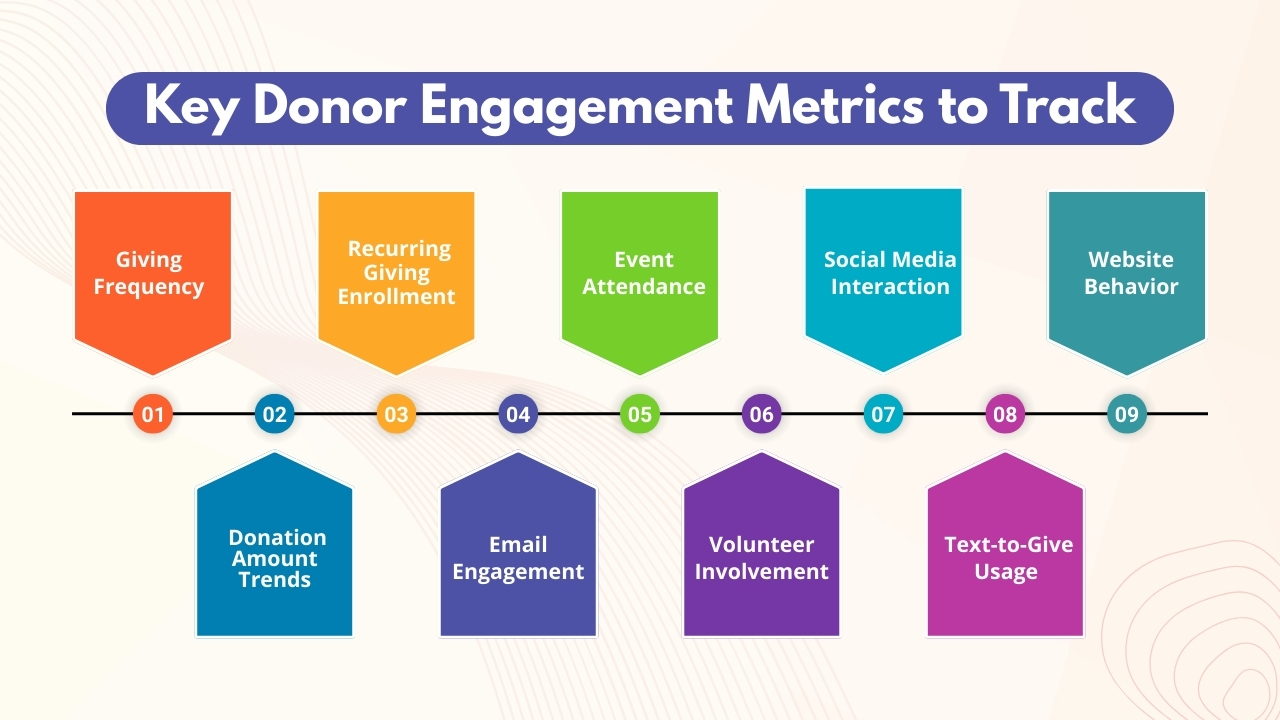
Tracking donor engagement involves tracking both financial and non-financial indicators. Donations reveal what supporters give, but donor’s actions reveal how they engage with your messages, attend events, volunteer, and advocates reveal how deeply they are connected to your mission.
When nonprofits and churches track the right metrics consistently, then they can increase donor retention, improve fundraising performance, and establish long-lasting relationships.
Below are important donor engagement metrics that every organization should track:
1. Giving Frequency
How often does a donor give?
Giving frequency is one of the important indicators of donor engagement. Because supporters who donate regularly are usually more connected to your mission than those donors who donate only once and disappear.
Track whether donors give:
- One-time
- Monthly recurring
- Quarterly
- Annually
Recurring donors often have stronger loyalty and higher lifetime value. Because a donor that donates small amounts monthly may contribute more over time than someone who gives a single large donation.
Tracking frequency of giving helps to identify regular donors, occasional donors, and those members who may be drifting away.
If an earlier consistent donor suddenly avoids donating in a month or year, then it may indicate disengagement. Early detection of disengaged donors lets you follow up with personalized communication before the relationship with those donors becomes weak.
2. Donation Amount Trends
It is not about how frequently donors give, but also about the total value of their contributions and how that giving grows over time. Tracking donation amount trends helps to know whether contributions are increasing, remaining stable, or gradually decreasing.
An upward trend may indicate growing trust and emotional investment. A stable giving pattern indicates satisfaction and stability. However, a sudden drop in giving amount may indicate financial strain, dissatisfaction, and disengagement.
Analyzing past donation data within your donor management system or nonprofit CRM, helps to identify donor patterns and proactively respond. For instance, donors who regularly increase their giving may be donors crucial for major giving.
Conversely, those reducing contributions may benefit from renewed communication or impact updates.
3. Recurring Giving Enrollment
Recurring donors are among the most engaged giving supporters. Monthly or scheduled giving indicates commitment, predictability, and long-term alignment with your mission.
Tracking the number of recurring giving enrollment helps measure:
- The percentage of donors enrolled in monthly giving
- Retention rates of recurring donors
- Average recurring donation amount
- Growth in recurring donor programs
For churches, recurring giving by donors shows their spiritual and community commitment to your mission. For nonprofits, it creates stable revenue and improves cash flow forecasting.
Because if your organization observes low recurring enrollment, then nonprofits and churches may require to promote monthly giving more clearly.
Engagement data can also show which communication channels most effectively encourage recurring giving signups.
4. Email Engagement
Email remains one of the most powerful communication tools for nonprofits and churches. Tracking email engagement provides valuable insight essential for tracking donor patterns.
Monitor key metrics like:
- Open rates
- Click-through rates
- Unsubscribe rates
- Campaign conversion rates.
High open and click rates suggest strong interest and trust. Rising unsubscribe rates may indicate message fatigue or irrelevant content. Because if donors stop opening emails consistently then it may indicate disengagement from donors.
Segmenting donors on the basis of email interaction helps you to personalize outreach.For instance, highly engaged readers may receive campaign invitations in advanced campaign invitations, while less responsive contacts may require re-engagement messaging.
Email engagement often reflects overall donor engagement. Donors who actively read and respond to email are more likely to donate and participate in giving.
5. Event Attendance
Participation in events from members reflects deeper involvement beyond financial giving. Track attendance at:
- Fundraising events
- Church services
- Volunteer days
- Conferences
- Community outreach programs
Event participation increases emotional connection and community belonging from donors. Donors who attend regularly often show higher donor retention and stronger loyalty.
Tracking event attendance helps to identify highly engaged individuals who could be ambassadors or volunteer leaders. Additionally, if event attendance reduces, it may indicate wider engagement challenges.Combining event data with giving behavior offers a complete picture of donor involvement.
6. Volunteer Involvement
Volunteers are frequently among the most committed supporters. Their investment of time often precedes or complements financial giving.
Track metrics like:
- Number of volunteer hours
- Frequency of participation
- Types of volunteer activities
- Conversion of volunteers into donors
Volunteers who serve consistently demonstrate deep emotional alignment with your mission. These individuals may be strong candidates for leadership roles, advocacy programs, or major gifts.
Monitoring volunteer engagement ensures you recognize and appreciate these contributors appropriately. When volunteers feel valued, their loyalty and giving potential increase significantly.
7. Social Media Interaction
Digital engagement plays a crucial role to maintain donor relationships. Social media through likes, shares, comments, and direct messages, social media creates consistent engagement opportunities that keeps your supporters connected to your mission between donations.
Monitor interactions like:
- Likes
- Comments
- Shares
- Direct messages
- Story interactions
Supporters who regularly interact with your content indicate keeping digital engagement even if they are not actively donating at that moment.
High engagement on impact stories or campaign posts may indicate that donors may have future giving potential from donors. On top of that, donors who share your contact serve as your advocates expanding your reach organically.
Tracking social media interaction helps to understand the messages that donors can relate to and how supporters engage publicly with your mission.
8. Text-to-Give Usage
For churches and nonprofits it is essential to use mobile fundraising tools, tracking text-to-give activity, and mobile giving patterns.
Monitor:
- Number of text-to-give transactions
- Repeat mobile donors
- Average mobile gift size
- Usage during services or special campaigns
Text-to-give activity often indicates convenience-based donor engagement. Donors who donate immediately during services or appeals are responding emotionally in real time.
Analyzing mobile giving trends helps you to improve service announcements, event fundraising strategies, and digital communication efforts. A strong increase in text-to-give activity may indicate donors are becoming more comfortable with digital donation tools.
9. Website Behavior
Your website works as a digital center for engagement. Tracking website behavior reveals how supporters interact with your content before giving.
Monitor metrics like:
- Giving page visits
- Time spent on donation pages
- Resource downloads
- Impact story views
- Blog readership
- Conversion rates
Tools like Google Analytics help to track such behavior. For instance, if many visitors reach the giving page but not complete a donation, then that indicates conflict in your donation process.
If there is high donor engagement with impact stories then it may indicate emotional connection while if supporters repeatedly visit volunteer pages may indicate growing donor interest in deeper involvement.
Website analytics provide actionable insight into donor decision-making journeys and help improve overall user experience.
Also Read: How to Increase Church Donations With Online Giving Tools
Tools for Tracking Donor Engagement
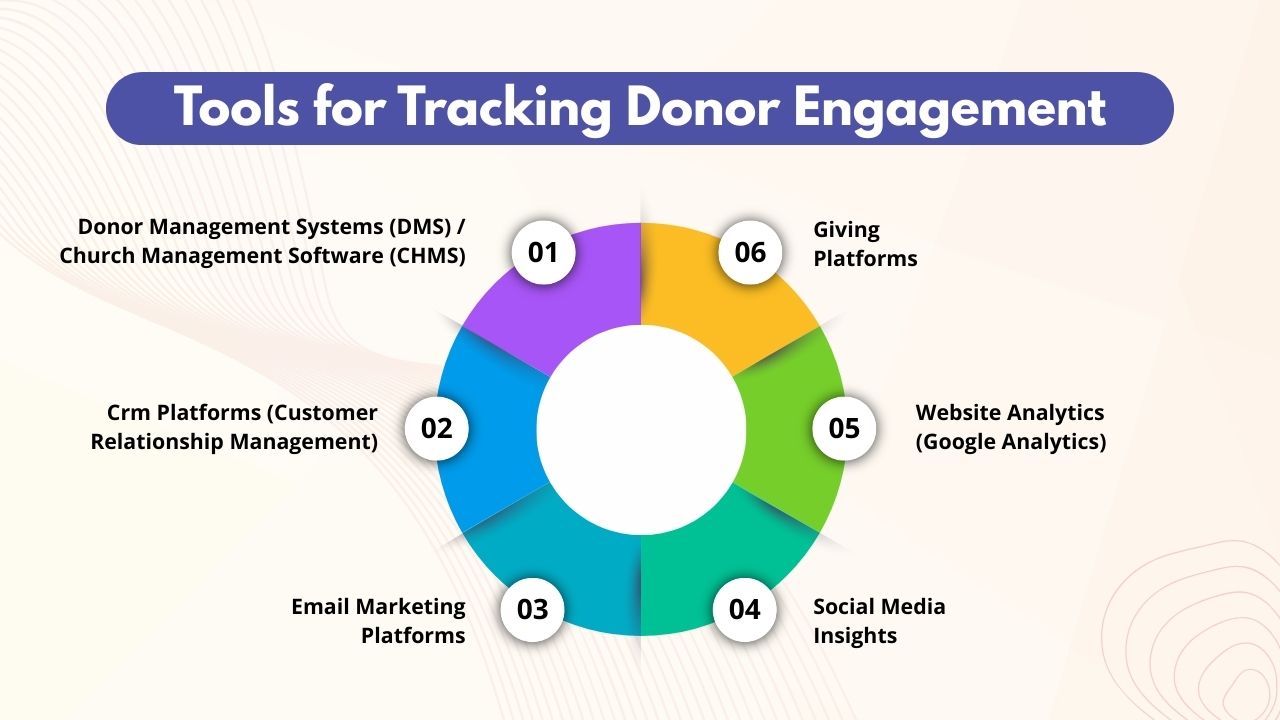
Effectively tracking donor engagement requires the right technology stack. Nonprofits and churches require integrated systems that collect, organize, and analyze supporter data.
From donation tracking, communication history, and digital engagement analytics, modern tools help organizations build a complete picture of donor behavior. Below are the essential tools for monitoring and improving donor engagement.
1. Donor Management Systems (DMS) / Church Management Software (ChMS)
These tools are the foundation for engagement tracking because they centralize donor records and reporting. Most modern systems include features like donation tracking, recurring enrollment, event registrations, volunteer records, pledge tracking, communication logs, and campaign reporting.
With every data centralized at one place, you can build donor engagement scores and segment donors as first-time, recurring, disengaged, major gift prospects for targeted follow-up.
2. CRM Platforms (Customer Relationship Management)
CRM platforms monitor relationship-building with donors above transactions. Such platforms help to record communication history, meetings, notes, follow-up tasks, campaign responses, pledge fulfillment, and major gift prospects.
Such platforms add depth to engagement tracking by capturing donor interests and preferences, ensuring continuity and accountability even if staff changes.
3. Email Marketing Platforms
Email marketing tools track important donor engagement details like open rates, click-through rates, bounces, unsubscribes, and campaign conversions.
Many platforms support donor segmentation and automation. When synced with your CRM or DMS, you can see which donors respond to impact stories and fundraising appeals.
4. Social Media Insights
Built-in dashboards on Facebook and Instagram track reach, likes, comments, shares, DMs, story views, and video watch time. These metrics indicate what content can donors relate to and identify donors who act as advocates by sharing your mission publicly.
5. Website Analytics (Google Analytics)
Website data reveals donor journeys like giving page visits, time on giving page, exits, conversions, downloads, and impact story views. Tḥis helps identify friction points and optimize donation pages and campaign landing pages. This helps identify friction points and optimize donation pages and campaign landing pages.
6. Giving Platforms
Digital giving tools provide reports on metrics like donor frequency, donor retention, recurring enrollment, campaign performance, average donation amount, text-to-give activity usage is highly valuable for churches during services and special appeals.
Also Read: Text-to-Give for Churches
Creating a Donor Engagement Scoring System
An effective way to track donor engagement is to develop a donor engagement scoring system. It involves assigning each point on the basis of supporter behaviors, that allows nonprofits and churches to track donor engagement levels and outreach strategically.
An effective donor engagement score model assigns point values to meaningful supporter actions. For instance, a monthly recurring donor may earn 20 points, attending an event 10 points, opening an email 5 points, clicking a campaign link 10 points, volunteering 15 points, and sharing a social media post 5 points.
Each donor behavior indicates a different level of donor commitment with recurring giving and volunteering showing donors deeply invested in your mission.
After calculating total points, donors can be categories as:
- 70+ points = Highly Engaged
- 40–69 points = Moderately Engaged
- Below 40 points = At Risk
This scoring system enables organizations to personalize communication. Highly engaged donors may be the right candidates for leadership roles or major gift conversions, while for at-risk donors re-engagement campaigns and impact updates are beneficial.
Prioritizing outreach on the basis of data, nonprofits and churches strengthen relationships and improve long-term donor retention.
Segmenting Donors Based on Engagement
Segmenting donors on the basis of donor engagement allows nonprofits to offer personalized messaging which helps supporters to resonate to your mission at different levels of your mission.
Rather than sending generic messages to all of your donors, segmentation helps to customize outreach strategies on the basis of donor engagement that increases relevance, stronger relationships, and improves donor retention.
When communication matches the engagement level of the donor, then the donor may feel messaging to be intentional and meaningful.
1. Highly Engaged Donors
Highly engaged donors are those donors who donate consistently, attend events, volunteer, and respond actively to communication. Such donors are emotionally invested in your mission and often are the donors with the highest lifetime value.
For highly engaged donors, send exclusive leadership updates and insights, invite them to VIP or appreciation events, encourage recurring upgrades or major giving opportunities, impact stories, and involve them as ambassadors.
Such donors should always feel valued, informed and included in your organization’s vision.
2. Moderately Engaged Donors
Moderately engaged donors are those donors who occasionally participate in giving but are not yet fully committed, while they are a valuable growth opportunity for ministry. Providing intentional communication, they can become highly engaged supporters.
For this group, share effective impact stories which highlight real outcomes, invite these donors to volunteer opportunities to make their involvement even stronger, encourage enrollment in recurring giving platforms, and provide targeted campaign invitations.
Strategic and consistent follow-up, and personalized messaging can gradually convert them into highly engaged donors over time.
3. At-Risk Donors
At-risk donors are those donors with declining donor engagement, less communication interaction, or reducing giving frequency. For this type of donors focus on personal, relationship-driven outreach.
Send them a warm check-in email, sincere thank-you messages, and offer clear impact updates which remind them that even their support matters. Also ask them to leave feedback to understand what changed and how you can improve their experience.
Tracking Engagement in Churches Specifically
Churches have unique engagement which extend beyond financial giving. Though donations remain important, spiritual involvement, community participation, and ministry activity provides deeper insights regarding member commitment to your mission.
Tracking these indicators help church leaders to strengthen discipleship, improve retention, and develop a flourishing faith community.
1. Service Attendance Trends
Regular service attendance clearly indicates church engagement. Tracking weekly or monthly attendance patterns and then comparing them with donation behavior can reveal important trends.
For instance, consistent attendees are the ones who donate regularly. A sudden difference in attendance may indicate disengagement or personal challenges where pastoral follow-up and care is required.
2. Ministry Participation
Involvement in ministry like small groups, youth programs, mission trips, worship teams, or outreach initiatives shows commitment on a deeper level.
Members who participate in church activities beyond Sunday services usually show stronger spiritual engagement with your mission. Tracking your ministry participation is essential which helps leaders to identify highly involved members and those ready for leadership development.
3. Text-to-Give and Mobile Giving Patterns
Modern churches mostly depend on digital giving tools. Tracking text-to-give activity and mobile giving patterns shows engagement trends on the basis of convenience.
Increase in recurring mobile donations may indicate that donors are increasingly comfortable with digital stewardship and consistent financial commitment.
4. Volunteer Ministry Roles
Volunteers often represent the core engagement members of a church. Tracking volunteer roles, frequency of service, and leadership responsibilities helps to identify highly committed members and also future ministry leaders.
Conclusion
Tracking donor engagement is no longer an option for nonprofits who want sustainable ministry growth. Donations indicate generosity, but donor engagement shows the donor’s commitment to your mission.
When organizations track giving frequency, recurring enrollment, communication response, event participation, volunteer involvement, and social media interaction, they get to know about the whole picture of supporter loyalty for a long-term.
Using different tools like donor management systems, CRM platforms, email marketing analytics, website insights, and giving platform reports, helps nonprofits to not just do guessing and use insights and make data-driven decisions.
Engagement scoring models and donor segmentation strategies allow leaders to customize communication, outreach, and nurture supporters on the basis of their level of involvement with ministry.
Such an approach increases donor retention, lifetime value, and establishes deeper relationships that revolve around trust and transparency.
For churches, engagement tracking supports spiritual growth, and community development. For nonprofits, engagement tracking helps to improve fundraising strategy and campaign effectiveness.
Tracking donor engagement helps nonprofits to shift from transaction fundraising to deeper relationship stewardship.
When organizations continuously track both financial and non-financial engagement metrics, they develop an intentional relationship with members.
The result of tracking donor engagement on a regular basis is stronger donor loyalty, predictable revenue, and a flourishing community of supporters who can deeply connect to your mission.
Tracking engagement strategically, nonprofits and churches can convert donor data into impactful action, and action into lasting impact.
If you still have any query with how to track donor engagement for nonprofits and churches, you may book a free demo at SimplyGiv and we are more than happy to assist you.