
Starting a church is a calling to guide people with wisdom and compassion while building a disciple-making community that reflects Christ’s love through clear direction and steady care.
If you are a new pastor or church planter wondering how to start a church, you are not alone. Because many church pastors or leaders feel encouraged to start a church but are burdened with where to start.
This step-by-step guide for new pastors helps pastors to turn their calling into starting a healthy church plant built with practical planning, wise leadership, and a strong foundation for long-term growth.
In this blog, you will learn the basic foundations of church planting. Begin with defining your church vision and mission statement. Identify the people you want to reach and understand your local culture through real community research.
You will also know how to build a strong core team, develop healthy leadership, and develop worship services which are welcoming, scripture-centered, and easy for newcomers to engage with.
Since starting a church requires both faith and practical preparations. We will walk you through the essentials for starting a church such as church registration, legal formation, financial accountability, budgeting, fundraising, and selecting the right location for starting a church whether home, school rented hall, or shared facility.
Once a church is established, then you must concentrate on church registration, legal structure, and financial planning. After starting a church, the focus is to build a church which is spiritually rooted, deeply connected, sustainably led for years to come.
You will find practical guidance on outreach and evangelism, discipleship pathways, small groups, volunteer systems, and communication strategies that help your church grow with integrity and authenticity.
So if your dream is to start a church in a city, suburb, or rural area. This blog will walk you through how to start a church with clarity, avoid common mistakes, and prioritize people over programs from the first day.
If you are ready to start a church from scratch and lead a flourishing church, then through this blog you get a clear roadmap with one faithful step at a time.
Also Read: Why Your Church Needs Mobile Giving Solution
How to Start a Church from Scratch
Starting a church involves seeking God’s direction through prayer, scripture, and wise counsel. This helps you to understand why you are starting a church, who you are willing to reach, and thereby forming a mission and vision that guide every decision while your church grows.
Then research the area and understand the community by listening to the needs of the people, and identifying the spiritual needs where your church can serve with purpose.
At the same time, gather a small team of committed believers who have the same vision are willing to serve faithfully and consistently. Church planting is a shared mission which has to be done in community with shared faith, support, and responsibility.
After establishing a strong foundation, focus on church registration, legal structure, and basic financial planning. Start your church in a simple and affordable space like a home, school, or rented hall and ensure that all people feel welcomed. Create worship services that are easy to understand, scripture-rooted, and have access to every person that attends.
Prioritize discipleship, outreach, and healthy leadership. Remember that starting a church is a journey where you require patience, humility, and faithfulness. When you build a church on prayer, clarity, and love for people, then you will build a strong and lasting spiritual community.
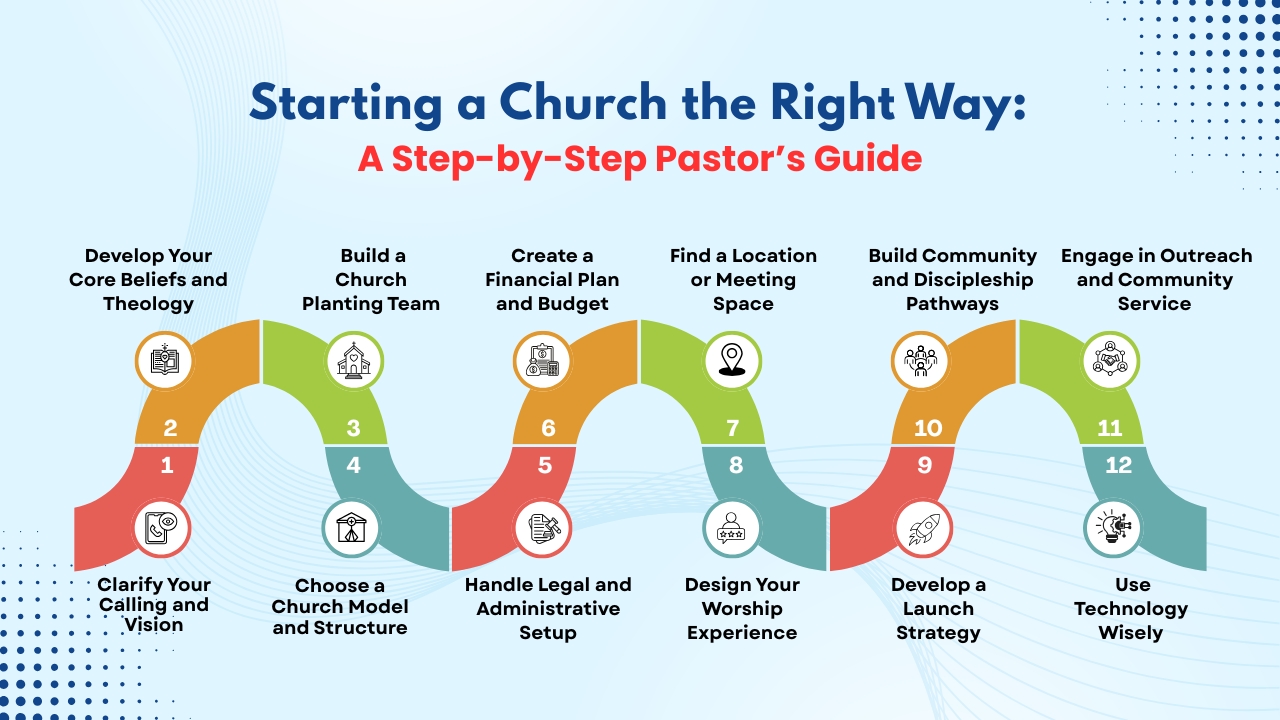
Starting a Church the Right Way: A Step-by-Step Pastor’s Guide
1. Clarify Your Calling and Vision
Before paperwork, team building, or choosing the location, the first and most essential step is seeking God for clear direction. Church planting starts long before your first service. It begins with prayerful understanding about why your church exists and who God is calling to serve, because without a clear calling and vision, even the best plans can lose direction.
Starting a church is not about filling the church full of people. Instead it’s about fulfilling a God-given mission. You must intentionally spend time praying, reflecting, and seeking wise counsel while you receive your calling.
It is essential that your desire is grounded in obedience, compassion, and long-term commitment, and not in comparison. Because if you receive clear calling from God then you will sustain through challenges and uncertainty.
As you reflect, consider key questions that shape your vision:
- What specific spiritual gap or unmet need in your community is God calling this church to address?
- Who is the primary community, demographic, or people group you feel led to reach and serve?
- Which core biblical values will shape your church’s culture, leadership, and decision-making?
- What will make this church spiritually distinct in the way it approaches worship, discipleship, and service?
Your vision statement should clearly describe the future God is calling you toward transformed lives, a strong community, and disciples living on mission.
Your mission statement should be practical and action-focused, describing how your church will pursue that vision each day through worship, teaching, community, and outreach.
When your vision and mission is clear then your leaders and people move in one direction, guide about priorities and decisions. It helps the church to remain faithful and allows them to grow in unity, purpose, and spirituality.
2. Develop Your Core Beliefs and Theology
Ensure you establish a clear theological foundation first instead of marketing. Define your church beliefs and how those convictions will direct your preaching, discipleship, and daily ministry decisions.
Once you define beliefs clearly then your preaching and ministries remain the same and all your members stay united around the church teachings and lives out everyday.
If you write your theology down early, you create a shared foundation that guides teaching, protects unity, and keeps the church steady through growth and change.
Start by documenting your core beliefs in a few important areas which will shape your church’s ministry. Clearly explain your view of Scripture and authority, including how the Bible is understood, interpreted , and used in teaching and leadership decisions.
Write out your beliefs about salvation and grace and repentance, faith, spiritual growth, and God’s transforming work and clearly explain how you view baptism and communion, including their meaning, purpose, and frequency.
Define your approach about church leadership and governance by clearly explaining about the way authority, accounting, and decisions are made within the church.
Ultimately, explain about your church’s commitment regarding community service and evangelism about how the church will live out faith with compassion, outreach, and sharing the gospel.
With clear theological beliefs you gain trust of new members by making them understand the importance and beliefs of the church.
They reduce confusion and conflict by providing the same references during any disagreements which will keep the future leaders are aligned so the church remains the same when it grows.
Many new pastors avoid this early and regret it later when growth brings competing expectations, but defining your core beliefs now strengthens unity, protects spiritual health, and builds a strong foundation for long-term ministry.
Also Read: 10 Powerful Thanks Giving Sermons
3. Build a Church Planting Team
Church planting is not to be done alone. Rather you need a strong core team that gives you accountability, encouragement, and practical support you need to move from vision to launch.
A strong launch team consists of people who will lead worship, handle administration and logistics, outreach and community engagement, commit to prayer, and financial stewards with integrity.
You don’t require a large team to start, instead you require the right people who are committed, dependable, and unified around your church’s mission.
Select team members who share the same vision and mission, are spiritual, and are willing to serve faithfully with humility instead of just gaining recognition.
Since starting a church requires patience, humility, and unity, choose people who know the challenges and will carry responsibility faithfully through both exciting and difficult seasons.
Ensure that you meet regularly as a team for praying and planning. Communicate openly and set clear roles and expectations early so that you build a culture of trust and teamwork which will be a strong foundation for both long-term growth and impact.
Also Read: Why Your Church Needs a Mobile Giving Solution
4. Choose a Church Model and Structure
Determine the type of church that you are willing to start. Because there is no single right model, choose the structure that matches with your calling, can serve your community well, and will use the resources which you already have.
The type of model that you choose for your church will define your meeting style, budget, outreach strategy, and the way you can grow sustainably.
Some common church models are a House Church, which is low-cost, small, and relational. A mobile church, where meetings are held in rented spaces like schools or theaters and are flexible as you expand.
A traditional Church, that has a fixed building and is comparatively more structured services. A digital or hybrid church is an online model but still offers in-person gatherings for worship and relationships.
Not just the church model, it is also essential to decide about the governance structure so that you have a clear leadership and accountability from the beginning.
Governance structures include pastor-led, elder-led, board-led, or congregational voting. Each structure affects your decision-making process, leader support, and the way accountability is maintained.
A clear structure prevents leadership confusion, reduces conflict, and provides a stable framework for wise decisions as the church grows and new leaders are developed.
5. Handle Legal and Administrative Setup
Starting a church means establishing real legal organization and not just holding weekly meetings. So handling administrative and legal setup early protects the ministry, builds trust, and creates a stable foundation for growth.
Even if your church begins small, it is essential to have clear documentation and proper systems that help to avoid any confusion and bigger problems later.
Some important early steps include registering your church as a nonprofit or religious organization on the basis of your local requirements. If applicable apply for tax-exempt status so that you receive donations properly and operate within the legal guidelines.
Write your governance down in clear bylaws that explain leadership roles, how decisions are made, membership expectations, and financial accountability.
Next, open a dedicated church bank account to keep ministry funds separate from personal finances, and use simple accounting to track donations, expenses, payroll, and your budget from day one.
These steps will protect your church from any legal and financial issues while building credibility with donors and the community, and consulting a legal or nonprofit professional early will help to do things accurately and avoid any costly mistakes.
6. Create a Financial Plan and Budget
Faith and finances must work together while starting a church. A clear financial plan is not unspiritual rather it’s wise stewardship. A realistic budget brings clarity and peace, helping your church stay financially stable and focused on ministry rather than constantly feeling pressured.
Begin with a simple, realistic budget that covers launch and ongoing expenses, especially space expenses like rent, deposits, utilities, cleaning, security, and weekly setup so you know the true cost of meeting consistently.
Be sure to budget for equipment like sound system, microphones, instruments, chairs, signage, and basic tech for streaming or presentations also for admin essentials like printing, communication tools, website hosting, insurance and software.
Assign funds for outreach and community programs, and even if your team is volunteer-based at first, but plan a budget for training, resources, and the support you will need as the church grows.
Then choose a sustainable funding plan through personal support or fundraising, core team giving, regular tithes and offerings, and, when available, grants or partnerships with other churches.
From day one, transparent stewardship which includes tracking every donation and expense builds trust and strengthens the church’s credibility, even when you’re still small.
Also Read: Church Donation Kiosks
7. Find a Location or Meeting Space
Choose a meeting space that matches with your model, budget, and target community. In the early stages, what you require is a consistent, welcoming place where people can gather and worship. This will make it easy for visitors to attend and allows your team to serve smoothly.
Depending on your size and resources, you have several options. Like many churches are launched in homes or small group spaces especially when you start as a house church or with a small core team.
You can also meet in community centers, schools, rented halls, or sharing space with another church. Choose the option that best balances cost, weekly setup needs, accessibility, and long-term stability.
When choosing a location, prioritize factors that support constant attendance of believers and also accessibility such as how easy it is for the believers to find, reach, and enter your church.
Consider parking and public transportation for families and newcomers, and also weigh visibility, affordability, and flexibility like storage, setup time, and how easily you can adjust schedules.
8. Design Your Worship Experience
Your worship service sets the spiritual tone of the church and is often the first experience new comers have, so make it warm, and centered around God from the moment they arrive.You need a consistent spirit-led gathering that communicates your values and helps people participate with ease.
Start by deciding the basic structure of your service. Choose a service length that fits your community and team capacity. Then define the format like welcome, worship, prayer, message, announcements, and closing.
Then, choose your music style whether traditional, contemporary or blended that fits your church culture. Focus not on impressing people but on leading them into sincere, authentic worship.
Also define your teaching style. Decide what preaching approach best fits your church whether expository(verse-by-verse), topical(theme-based), or more conversational and practical.
Define how prayer, communion, and congregational participation will fit into your service so it reflects biblical priorities and helps people connect deeply with God.
Consistency matters so aim for providing warmth, clarity, and spiritual health and rehearse your service with your team before starting to reduce stress, improve flow, and create a smoother experience for both leaders and guests.
9. Develop a Launch Strategy
A strong church launch does not happen instantly rather it happens through prayer, preparation and intentional outreach. A good launch strategy creates a clear path for people to discover your church, connect with your team, build early awareness, and return after the first service. The goal is not to create hype for one day, rather it’s to gather the right people and establish a healthy foundation for what comes next.
Before your first public service, begin by building anticipation with your personal network. Share your vision with friends, family, former ministry connections, and trusted community contacts. Invite people personally and not just through posts. A direct invitation by call, message, or conversation often makes a difference.
Ensuring you use simple digital tools like Social media, WhatsApp groups, email lists, and local community pages consistently that can help you spread awareness without any expenses. Keep your message clear about what your church stands for, where and when meetings will be held, and how people can connect.
Consider organizing preview services or interest meetings before starting the church to gather feedback, and help people feel connected early. These smaller gatherings help your team practice the flow, build relationships, and identify volunteer needs.
Most importantly, pray intentionally for your launch, pray for spiritual fruit, unity, and the people God will bring. If your goal is not a massive crowd. You will have a meaningful beginning if you start with the right people, right heart, and the right spirit.
10. Build Community and Discipleship Pathways
A church grows stronger through relationships and not by the count of people who attend your worship services or meetings. People may visit your church due to a service, but they stay and grow only when they find community, purpose, and spiritual direction.
That’s why it is essential for new churches to develop clear pathways which will convert first time guests into connected members. Start by creating simple pathways for connection like welcome teams, newcomer gatherings, after-service conversations, and short connection cards so you can follow up personally and help people feel seen.
Next, start small groups or discipleship circles where relationships can deepen as people study Scripture, pray together, and share life beyond Sunday.
Also create simple opportunities for people to serve in ministries. Serving builds ownership and belonging, and it strengthens the church’s ability to operate with excellence.
Offer clear roles based on gifts and availability like hospitality, worship support, kids ministry, outreach, media, setup, and prayer teams are common starting points. Discipleship should provide steps for spiritual growth like Bible teaching, mentorship, prayer rhythms, and leadership development with time.
Ultimately ensure people can receive pastoral care through counseling, prayer support, and spiritual guidance when they face challenges of life. Clear discipleship pathways transform your church from a weekly event into a spiritual family where people are cared for, and sent out to live their faith daily.
11. Engage in Outreach and Community Service
Churches thrive when they serve beyond their church walls. A church that only gathers on Sundays may find more and more people attending their services but only a church that serves the community grows in influence, trust, and spiritually.
Outreach is not just a program instead it is a way of showing Christ’s love through practical action and consistent presence. Start by looking for real needs in your local area. Talk to residents, schools, social workers, and community leaders to understand the actual needs of the people.
Then choose outreach efforts that match your church’s capacity and calling, remembering that simple, consistent service often makes a bigger difference than large, occasional events.
Some practical ways to engage include meeting local needs through food drives, school supply support, job help, or visits to the sick and elderly.
Partnering with community organizations like shelters, nonprofits, or local schools allows you to serve together. Consider supporting families, youth, or seniors through mentorship, tutoring, parenting support, or community gatherings that build connection.
Many churches offer counseling, prayer, or practical help during a crisis. Even small acts such as listening, praying, providing resources, or connecting people with support can lead to deeper ministry.
Authentic service builds trust and demonstrates faith in action. When a church serves with humility and consistency, the community begins to see the Gospel which is not only preached, but lived.
12. Use Technology Wisely
Even small churches can take advantage of simple technology in a meaningful way. Because the right tools help your church to stay organized, communicate early, and provide worship services even when your congregation begins to grow. Technology can support the mission when used wisely.
Start with tools that strengthen communication. Email lists, messaging apps, and basic scheduling tools can help you share updates, follow up with visitors, and keep volunteers informed.
Next, consider setting up online giving so people can give easily and consistently. This also supports financial transparency and helps your church plan responsibly.
Technology can also make services smoother through simple service planning tools for worship sets, sermon notes, volunteer rotations, and announcements.
Tracking the count of your members or a basic database will help you to keep contact information, record member attendance, and also to follow up with them with care, especially new members.
If your church reaches people online, consider livestreaming or recording sermons. Because even a simple phone or tripod can help people who are sick, travelling, or curious to connect with your church’s message.
Conclusion
Starting a church is a journey of faith and obedience that begins with clear calling and vision, and it grows through daily faithfulness—prayer, Scripture, wise planning, and genuine love for people.
As you plant a church, remember that your success is not measured by the count of people that attend your worship services or quick growth. Rather by spiritual fruit that transformed lives, healthy disciples, and a community that reflects Christ.
If you follow the steps provided in the blog with a clear mission, a strong team, clear theology, establishing legal and financial foundations. Then creating a welcoming worship experience and discipleship will be developing more than a church launch.
You will be building a stable ministry with the strength to endure and the flexibility to grow.
Though there will be challenges, delays, and unexpected lessons, you will not do it alone rather as a community. Stay accountable, seek counsel, and keep your heart rooted in God’s presence.
Make sure you serve your community with humility, engage in outreach consistently, and prioritize relationships over perfection.
Most importantly, keep Jesus Christ as your forever guide. When your church is built on prayer, trust, and love, it can become a lasting spiritual home where people get to experience God, grow in faith, and carry the mission forward for generations.
If you still have any query regarding the way to start a Church then you may write to us at simplygiv and we are more than happy to assist you.