

In today’s rapidly growing digital fundraising landscape, it is essential for nonprofits to offer donation options which are flexible, transparent, and easy-to-use to their donors.
Modern supporters look for convenience and clarity while donating for a cause. In order to set up an effective online giving strategy, nonprofit organizations require to know the process to set up multiple funds and Split Giving Online.
Setting up multiple funds in the online donation platforms allows organizations to guide donors towards different causes like the General Fund, Missions Fund, Building Fund, Youth Ministry, Community Outreach, or seasonal fundraising campaigns.
Rather than sending all donations into one generic account, multiple funds let donors send donations for specific funds, through which they have more control and confidence in their impact and increasing confidence in the impact that their funds would make, improving transparency, donor trust, and encouraging long-term generosity.
By enabling split giving helps donors to distribute a single donation across multiple funds at the same time. For instance, donors may send donations to support general ministry needs while also giving for a special outreach initiative, or mission-driven campaign.
This flexibility while making donations helps to remove barriers, make the donation process simple, and also increase the total donation amounts.
Successfully implementing multiple fund setup and split donation functionality requires the right donor management system, secure payment processing, and proper fund tracking and reporting.
When these systems are integrated accurately, it enables recurring donations, improves fund allocation management and overall fundraising performance.
Through this blog, you will learn how to create and organize multiple funds for different causes, set up split giving inside your ChMS or nonprofit CRM, and design a donation page which reduces any conflicts and increases conversion rates.
By applying these strategies, it helps your nonprofit organizations to build a scalable, transparent, and sustainable online giving platform which drives long-term growth.
Also Read: What is a Donation Kiosk
Understanding Multiple Funds in Online Giving
A fund is a specific allocation category within your online giving system that allows donors to send their donations for a specific cause or program.
Rather than sending donations into one generic account, churches and nonprofits can create unique giving categories for specific ministries, projects, and operational priorities that makes the donation purpose more clearer to supporters.
Such a structured list of funds gives more clarity, accountability, and financial management of donations.
Organizations usually create multiple funds like General Tithes or Operating Fund for supporting daily expenses, a Building Fund for improving facilities, a Mission Fund for outreach initiatives, or a Youth Ministry fund for investing in the next generation.
Some other donation categories are Community Outreach, Disaster Relief, Scholarship Programs, or special campaign and event funds which are short-term fundraising goals.
Offering multiple funds is essential for donors that help them to make donations for causes that matter them to the most. Being able to choose funds that they want to donate for increased transparency and trust among donors as they know exactly how their donations will be used.
When donors feel confident about the way their donations will be allocated, then they are more likely to participate in donations consistently which strengthen long-term engagement and sustainable growth.
Also Read: Top Benefits of Using Donation Kiosks for Non-profit charities
What Is Split Giving?
Split giving is an online giving feature which allows donors to split their one single donation across multiple funds in a single transaction.
Rather than choosing to donate only for a single cause, split giving allows donors to allocate certain amounts to different ministries, programs, or campaigns during a single transaction.
For instance, a supporter may give a total of $200 and split it as $100 to the General Fund, $50 to Missions, and $50 to the Youth Ministry.
This lets donors make multiple donations at once to different funds, making the donation process quick, easy, and more convenient for donors.
For churches and nonprofits, split giving is a powerful donation method that removes friction from the donation journey. When giving is simple, donors are more likely to give consistently through mobile devices.
It also encourages higher overall donation totals because supporters get to choose the causes that they care about most. They can support multiple causes like outreach, building projects, or community relief in a single transaction without extra steps.
Over time, enabling such flexibility while giving increases donor satisfaction, donor engagement, and healthier, more sustainable fundraising growth.
Also Read: Text-to-Give for Churches
Why Setting Up Multiple Funds Matters
Setting up multiple funds within your online giving system is more than an administrative enhancement, it is a strategic move which strengthens donor relationships, improves financial clarity, and supports long-term growth. Here is why it matters:
1. Increased Donor Control
Modern donors expect transparency and flexibility while giving online. They want to know exactly where their money is going and how their money will make an impact in other’s lives.
By offering multiple funds, you allow donors to make donations for specific causes, ministries, or campaigns that donors can relate to personally.
When donors are able to choose between donation options like a General Fund, Missions Fund, Building Project, or Community Outreach program, then they feel they have more control over donations that they make.
Such a feeling of having control increases donor trust and confidence as donors feel that their preferences are considered. As a result, donors are more likely to donate consistently and maintain engagement with your organization over time.
2. Higher Donation Amounts
It allows multiple funds especially when combined with split giving that often leads to increased total donations. Instead of forcing donors to make donations for only one cause, multiple funds allows donors to send donations for multiple funds in a single transaction.
For instance, a donor who wants to donate for both youth programs and global missions may increase their total donations in order to contribute to both donation funds. Such flexibility removes emotional barriers and encourages more donations.
When donors do not feel restricted, they tend to donate more freely and more frequently.
Also Read: How to Increase Church Donation With Online-Giving Tools
3. Clear Financial Tracking
Your donation page should be simple, intuitive, and easy to navigate for donors. A donation page that has a clean layout improves user experience and increases the chances that donors will complete their donation.
When donors feel the giving process is smooth and straightforward, then donors feel more confident and less are chances to abandon the transaction.
A recommended fund layout structure is a Donation Amount Field where donors can select preset donation amounts or enter a custom donation amount.
Next, include a Fund Selection Dropdown or Multi-Select List so donors can choose where their contribution will go.
Add an “Add Another Fund” Option to enable split giving. Include a Recurring Gift Toggle for monthly or scheduled donations, further with a secure payment option. Finish with a Summary Review Section so donors can confirm allocations before submitting donations.
Ensure that you provide every option simple. Avoid many dropdowns, lengthy descriptions, or hidden split options.Make split giving visible and easy to use for a seamless experience.
4. Stronger Donor Engagement
Donors who donate for a specific cause often feel a deeper connection to such funds. When someone makes donations for specific funds like for youth ministry or disaster relief, they feel emotionally connected to that outcome.
Such connection to funds, allows nonprofits for personalized messaging, targeted impact updates, and long-term stewardship. Over time, such a relationship-focused approach builds loyalty, increases retention, and converts occasional donors into committed, mission-driven advocates.
Also Read: Winter Fundraising Ideas That Actual Works
Step-by-Step Guide to Multi-Fund Setup and Split Giving for Nonprofits
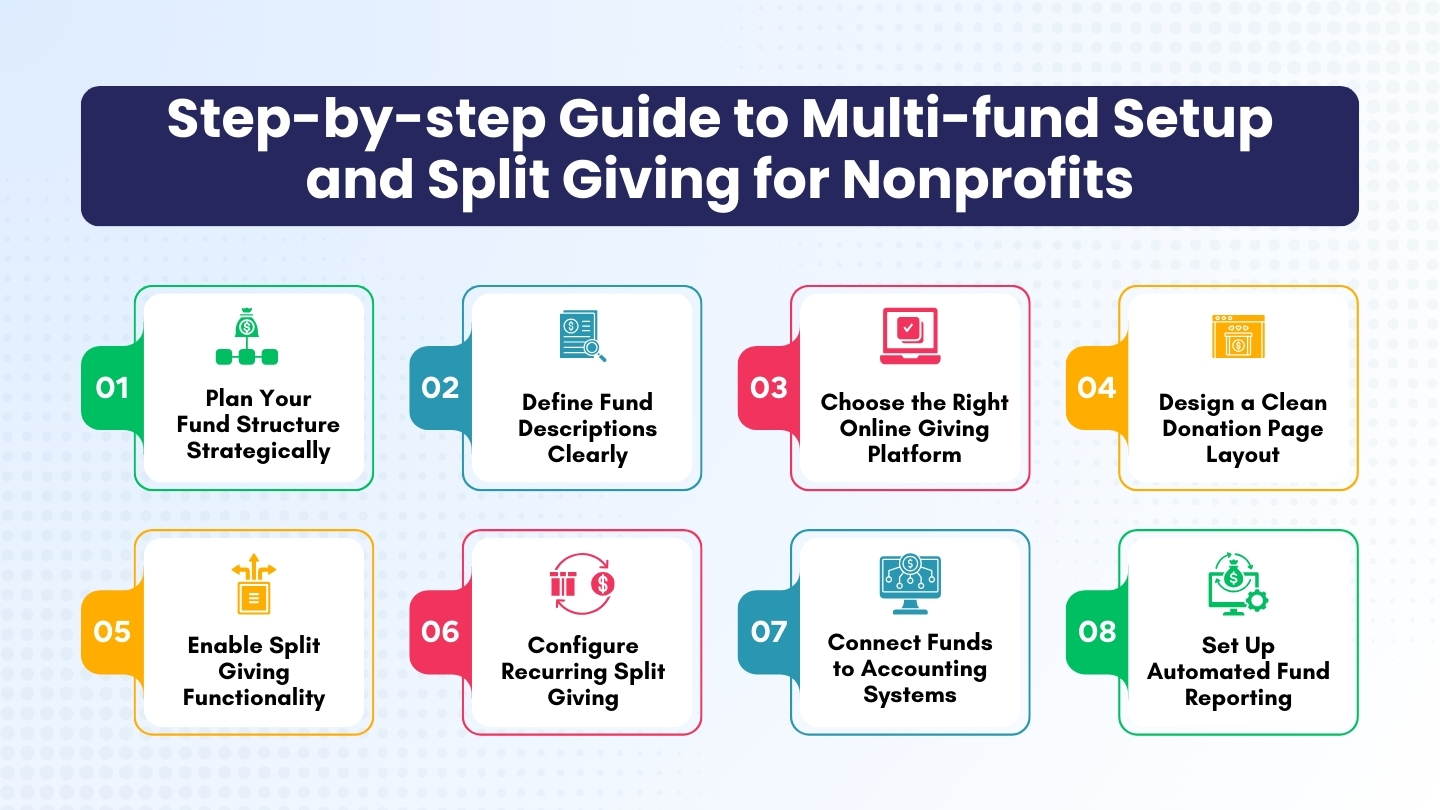
Step 1: Plan Your Fund Structure Strategically
Before you add multiple funds in your online giving system, take time to plan the structure of funds carefully. A clear, well-organized fund setup makes it easy for donors to donate confidently and also enables nonprofit organizations to track donations accurately.
One of the biggest mistakes that organizations make is adding too many funds. When donors see a long, cluttered list of giving options, then they can feel overwhelmed, which often leads to less conversion rates and causes people to abandon the donation process.
A strong best practice is to begin with 5 to 8 primary funds that include your most important needs.Add special campaign or seasonal funds only when necessary, and remove or archive them once the campaign ends to keep your donation page clean.
Next, organize your funds into simple categories so donors can quickly understand their options. Your list may include Core Funds(General Fund, Tithes & Offerings, Operating Expenses), Ministry Funds (Missions, Children’s Ministry, Youth Programs, Worship Ministry), Capital Funds (Building Fund, Renovation Fund, Equipment Fund), and Outreach Funds (Community Support, Disaster Relief, Benevolence).
Keep fund names short, simple, and descriptive to improve clarity and give confidence.
Step 2: Define Fund Descriptions Clearly
After adding your funds, the next step is to provide clear descriptions for each fund. Adding a short description regarding funds helps donors to understand how their funds will be used.
When supporters know the real purpose behind a fund, then they feel confident and are more likely to complete their donation.
For instance, a Building Fund might have a description: “Supports facility upgrades, maintenance, and expansion projects.” A Mission Fund might have a description: “Funds local outreach efforts and global mission initiatives.” These simple explanations about each fund helps to remove any uncertainty and clarity about its impact.
While describing funds avoid using long paragraphs or complex financial descriptions. Ensure you keep descriptions short, specific, and focused on outcomes. Rather than using generic statements highlight what the fund accomplishes and to whom this fund will benefit.
Clear fund descriptions help to remove confusion, reduce hesitation from donors and increase conversion rates. When donors are clear about the purpose of each fund, then they can make faster giving decisions and give with greater trust and confidence.
Step 3: Choose the Right Online Giving Platform
Selecting the right online giving platform is essential for successfully managing multiple funds and enabling split giving. Not all systems offer the flexibility needed to support designated donations, so it is important to choose a solution designed for churches and nonprofits.
Your platform should include multi-fund selection, allowing donors to select from different giving categories. It must also support split donation capability, so supporters can divide one gift across multiple funds in a single transaction.
Additional essential features include recurring donation support, detailed reporting by fund, automated tax-compliant receipts, and secure payment processing to protect donor information.
The system should allow donors to easily add multiple funds within one donation, assign custom amounts to each fund, and save their preferences for recurring gifts.
A user-friendly interface especially on mobile devices ensures a smooth experience. Choosing the right platform improves convenience, increases giving participation, and strengthens overall fundraising performance.
Also Read: Top Benefits of Using Donation Kiosks For Non Profit and Charities
Step 4: Design a Clean Donation Page Layout
Your donation page should be simple, intuitive, and easy to navigate. A clean layout improves user experience and increases the chances that donors will complete their gift.
When the giving process feels smooth and straightforward, supporters are more confident and less likely to abandon the transaction.
A recommended layout structure includes a Donation Amount Field where donors can select preset amounts or enter a custom value. Next, include a Fund Selection Dropdown or Multi-Select List so donors can choose where their contribution will go.
Add an “Add Another Fund” Option to enable split giving. Include a Recurring Gift Toggle for monthly or scheduled donations, followed by a secure Payment Information section. Finish with a Summary Review Section so donors can confirm allocations before submitting.
Keep everything simple. Avoid too many dropdown layers, lengthy descriptions, or hidden split options. Make split giving visible and easy to use for a seamless experience.
Step 5: Enable Split Giving Functionality
Once your funds are created, the next step is enabling split giving within your online donation platform. Most modern systems support this feature through different configuration methods.
Method A: Add Fund Button
In this setup, a donor selects a fund, enters an amount, and then clicks “Add Another Fund” to allocate part of their gift to additional categories. This method keeps the page clean while allowing flexibility.
Method B: Pre-Displayed Fund Fields
All available funds are shown on the page, and donors simply enter amounts next to each fund they wish to support. This approach makes options immediately visible.
Method C: Allocation Slider
The donor enters a total donation amount and then allocates percentages across funds using sliders.
The most effective option is manual amount allocation, as it is simple, transparent, and easy for donors to understand, increasing confidence and completion rates.
Step 6: Configure Recurring Split Giving
Recurring donors are essential for establishing a sustainable and predictable financial growth of the ministry. While enabling split giving, it is essential to ensure that your online giving platform supports recurring split donations.
Donors should be able to schedule giving on a monthly or bi-weekly basis and divide those donations across multiple funds.
Your system should enable supporters to save their fund preferences so they do not require re-enter fund allocation every time. The system should also provide an easy way for donors to modify or adjust fund allocations if their priorities change. Providing such flexibility increases long-term participation from donors.
For instance, a supporter may commit to a $500 monthly gift, allocating $300 to the General Fund, $100 to Missions, and $100 to Youth Ministry. This structured approach supports multiple programs consistently.
Recurring split giving leads to stable cash flow, improves budgeting accuracy, and increases donor loyalty by encouraging ongoing, diversified support across the key initiative of the organization.
Step 7: Connect Funds to Accounting Systems
Connecting your online giving funds to your accounting system is a crucial step and cannot be overlooked. Each fund must be mapped properly for accurate fund tracking and financial transparency.
Every designated fund should connect to separate ledger accounts, clearly defined budget categories, and appropriate bank tracking segments. This structure of funds helps your organization to track income accurately and avoids misallocation of donations that are restricted.
It is essential to coordinate with your accountant, bookkeeper, or financial administrator closely during this process. It helps to ensure that each fund is under the right category in your accounting software and also aligned with your financial reporting standards.
Proper mapping helps to make audits simple, improves tax reporting accuracy, and ensures compliance with nonprofit regulations.
When funds are mapped correctly, then leadership gets clearer financial insights, donors receive transparent reporting, and your organization maintains accountability thereby establishing long-term trust and financial stability.
Also Read: How to Track Donor Engagement for Non-Profits and Churches
Step 8: Set Up Automated Fund Reporting
After setting up multiple funds and split giving, configure automated reporting dashboards to track performance consistently. Your system should track important metrics like total donations per fund, recurring revenue by fund and split giving, and configure automated reporting dashboards to monitor performance continuously.
These insights let you know how each ministry, program, or campaign is performing over time.
Automated reporting removes errors due to manual tracking and saves valuable administrative data. With real-time data, leadership teams can quickly identify the campaigns that are gaining traction and identify the campaigns that require additional promotion.
This information supports better decision-making by adjusting messaging strategies, allocate resources effectively, and improve budgeting accuracy .
Consistent reporting helps organizations to predict future revenue, plan upcoming initiatives confidently, and respond proactively to giving trends. Data-driven fund management ultimately strengthens fundraising performance and long-term sustainability.
Best Practices for Split Giving Optimization
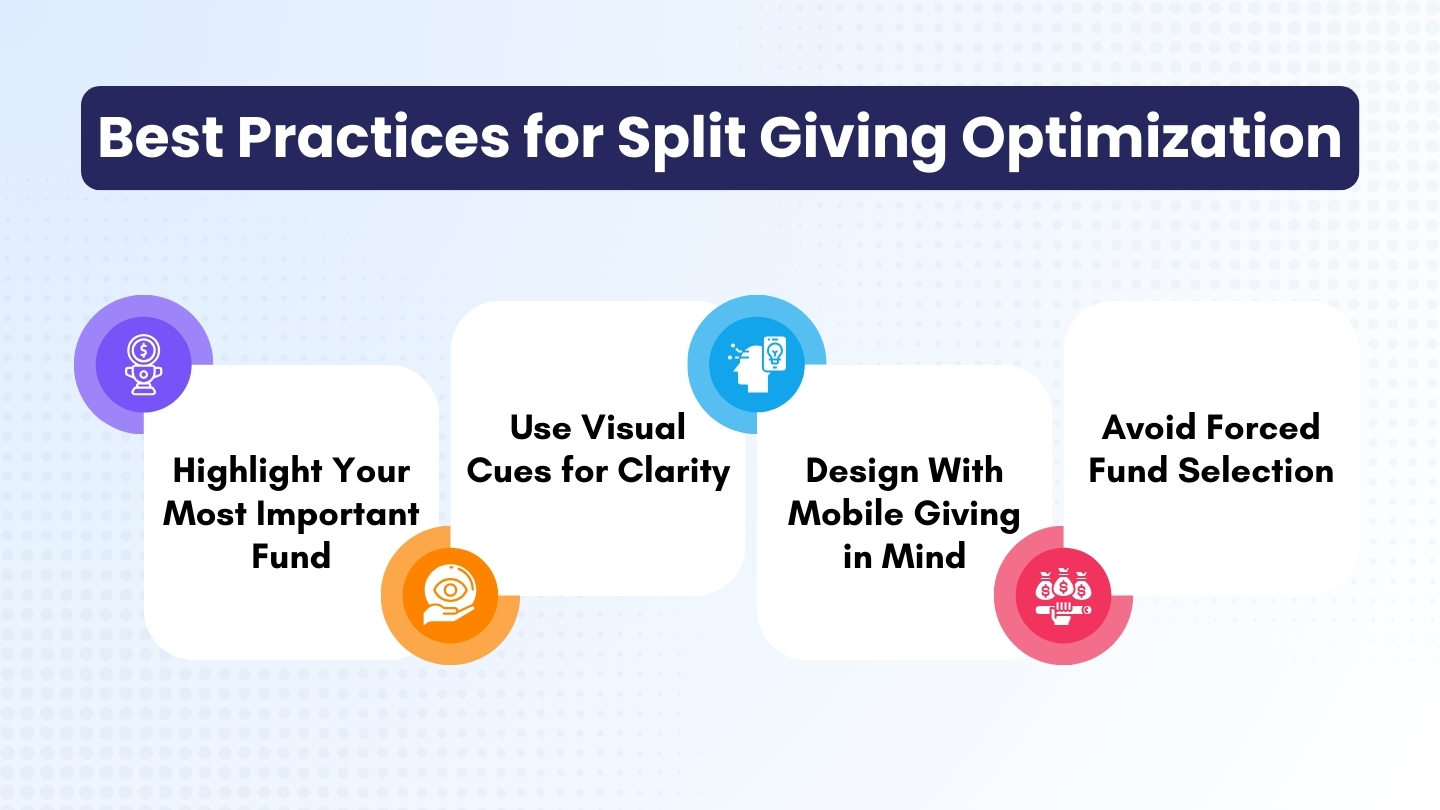
1. Highlight Your Most Important Fund
Always place your General Fund at the top of the fund list because it usually supports daily operations like payroll, utilities, and ministry expenses. When donors see the most important fund first, then they can quickly without confusion go through and support other funds. It helps to establish consistent financial stability for your organization.
2. Use Visual Cues for Clarity
Make fund selection easier for donors by including simple icons, labels, or short descriptions next to each fund. Providing visual cues help donors to quickly understand the purpose of each fund option without reading long text. For instance, a house icon for Building Fund or a globe icon for Missions Fund improves recognition and speeds up decision-making.
3. Design With Mobile Giving in Mind
Since most donors donate through mobile phones, your donation page must be mobile-friendly. Use large input fields, clear and tap-friendly buttons, smooth scrolling, and visible fund options. Avoid including hidden menus or complicated dropdowns which make the giving difficult on smaller screens.
4. Avoid Forced Fund Selection
Avoid forcing donors to choose a fund before continuing. Always offer a default option like the General Fund so supporters can donate quickly. This reduces any conflicts and improves conversion rates, mostly for first-time and impulse donors.
Also Read: 100 Best Thank You for Donation Quotes
Communicating Multiple Funds to Donors
Effectively communicating regarding your multiple fund options helps donors to understand how to donate confidently and intentionally. Educating and providing transparency helps donors to build trust and also encourage greater participation from donors.
1. Educate Supporters About Fund Options
Begin by clearly explaining the purpose of each fund. Making donors know how their contributions will be used and why multiple funds exist. When supporters understand the impact behind each fund option, then they feel more confident while directing their donations.
2. Announce From the Stage
During services or events, briefly explain how donors can split their gifts across multiple funds. Provide simple instances to demonstrate that the process is simple. A short walkthrough or live demonstration to donors can remove hesitation and increase participation.
3. Use Email Campaigns
Send emails that show practical examples of how donations can be divided. For example, illustrate how a single gift can support both Missions and Youth Ministry. Clear visuals and short impact descriptions make the process easy to understand.
4. Leverage Social Media
Regularly highlight specific funds and share real impact stories, photos, or updates. Transparency about results increases confidence, strengthens trust, and encourages consistent generosity.
How to Promote Split Giving Strategically
Promoting split giving effectively requires shifting how you communicate your fundraising message. Instead of asking donors to support just one cause such as “Please give to Missions” present giving as a flexible opportunity. A more strategic approach is to say, “You can support Missions and Youth Ministry in one gift.” This simple change in language highlights convenience and expands the donor’s sense of impact.
Providing specific examples makes the concept even clearer. For instance, show how a $150 donation can be divided into $75 for Missions, $50 for Youth Ministry, and $25 for the General Fund. Concrete breakdowns help donors visualize their contribution and make decisions quickly.
Use visuals in emails, social media posts, or on your donation page to demonstrate how split giving works. Clear examples reduce confusion and remove hesitation. When donors understand they don’t have to choose between causes, they are more likely to increase their total gift. Strategic messaging transforms flexibility into motivation, driving stronger participation and higher overall donations.
Conclusion
Setting up multiple funds and enabling split giving online is not just a technical upgrade for the ministry, instead it is a strategic move toward building stronger and sustainable fundraising.
By creating clearly defined funds, you give donors the control to direct their donations toward the causes that matter most to them. Such flexibility helps to build trust, transparency and strengthen long-term relationships.
Split giving removes the limitation of choosing just one initiative. When supporters can split their single donation across multiple funds, they feel empowered to make a larger impact with their donations. This feature often leads to higher total contributions, improved donor satisfaction, and increased recurring giving.
Success depends on thoughtful planning. Structuring funds strategically, keeping your donation page clean and intuitive, integrating with accounting systems, and setting up automated reporting all ensure financial clarity and compliance.
Clear communication through services, email campaigns, and social media also helps donors understand how to use split giving effectively.
When implemented correctly, multiple funds and split giving enhance donor engagement, improve budgeting accuracy, and provide predictable revenue growth.
Most importantly, they transform online giving into a flexible, transparent, and relationship-centered experience laying a strong foundation for long-term ministry and nonprofit success. If you still have any query with how to set up multiple funds and split giving online then you may book a free demo at SimplyGiv and we are more than happy to assist you.