
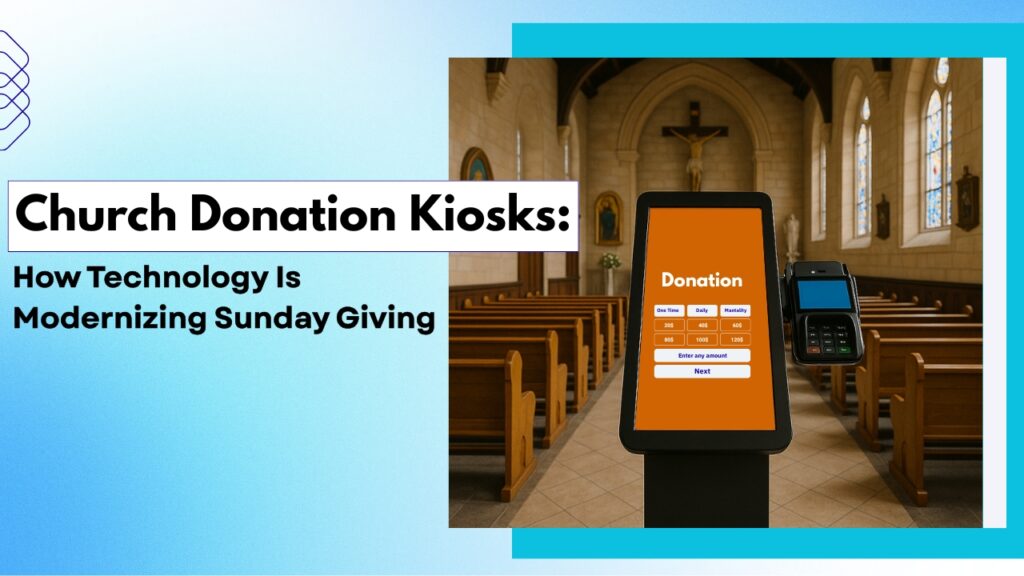
In today’s digital world, church donation kiosks are changing the way churchgoers donate, making Sunday giving faster, easier, and more secure than ever before.
As only few people carry cash or cheques, most churches are adopting digital giving kiosks which is essentially helping them to fill the gap between traditional giving and modern payment methods.
Such self-service giving stations allow worshippers to make cashless donations using either their debit or credit cards, mobile wallets, or contactless tap-to-pay options within seconds.
More than convenience, church giving kiosks have become an important part of modern ministry. Church donation kiosks provide a simple, intuitive interface where members get to select donation amounts, select specific funds whether tithes, missions, or youth programs and even set up recurring gifts.
The process is built to feel effortless, allowing church goers to donate with confidence while keeping their personal data secure through PCI-compliant payment processing.
For church administrators, such kiosks remove the burden of manually counting and depositing donations and thereby offering real-time reporting, automated receipts, and integration with church management systems. Due to which churches are able to be more transparent, accurate, and efficient in handling tithes and offerings.
Church donation kiosks are redefining generosity in the modern worship experience by improving donor engagement, supporting mobile and online giving strategies.
They strengthen congregations to support their ministries anytime before, during, or after service attracting both younger tech-savvy members and long-time attendees who are seeking convenience.
As technology continues to shape how people donate, so digital church kiosks are in the leading position helping ministries to grow, sustain, and also modernize their mission of faith through effortless, secure, and meaningful giving.
The Shift Away from Cash Is Global and It’s Permanent
The global move toward cashless payments is increasing and it’s here to stay. In the United States, recent reports suggest that contactless transactions increased by more than 150% between the years 2020 and 2023. While in Canada, over 60% of in-person purchases are now completed using tap-to-pay cards or mobile wallets like Apple Pay and Google Pay.
The United Kingdom has witnessed that cash usage dropped below 15% on all transactions, showing a clear, irreversible trend toward digital payments.
For churches and faith-based organizations, this shift presents a new challenge which is to how to sustain donations, tithes, and offerings in a world where few people carry cash.
The solution is not to accept fewer gifts rather it’s to adopt smarter giving options. Churches encourage their churchgoers to donate conveniently, securely by offering contactless and digital donation tools.
It helps faith communities to adopt technology while continuing to support their mission with modern generosity.
The Changing Landscape of Church Giving
1. A Shift in Donor Behaviour
Donor behavior has changed dramatically in recent years. Today’s churchgoers live in a fast-paced, digital-first world where convenience, security, and flexibility guide their finance habits.
Fewer people carry cash or write cheques, and many prefer to give using credit cards, debit cards, or mobile wallets like Apple Pay and Google Pay. This evolution poses both a challenge and an opportunity for churches.
By pairing the offering plate with contactless kiosks, mobile or online giving, and recurring options framed into the same prayers, thanksgiving and they preserve tradition while embracing modern payments.
Industry analyses are clear which is adopting church donation kiosks is not just an optional add-on rather is an essential tool for sustainable growth.
2. Why the Traditional Offering Plate Is No Longer Enough
Passing the plate or distributing envelopes has quite long been central to Sunday worship but such methods are increasingly limited. They assume members have cash or checks on hand and typically occur only during a service, missing spontaneous or post-service giving moments.
Manual counting and reconciliation are also time-consuming and error-prone, while traditional methods make it difficult to enable recurring or fund-specific donations.
Being in a world where people give anytime, anywhere, churches must provide complementary digital options and donation kiosks just do that.
3. What the Data Shows
Recent research confirms a clear trend where digital giving is transforming generosity in the church. The Church Giving Trends Report shows that non-cash donations are creating new opportunities for engagement and that congregations offer multiple giving methods including kiosks, mobile, and online options which tend to be more financially stable and resilient.
Many leading platforms report that recurring digital donors give more frequently and at higher amounts over time, providing churches with predictable income and stronger financial planning capabilities.
While the takeaway is simple where giving is evolving. As more and more churchgoers are shifting toward digital payment habits, ministries which adopt church giving kiosks, mobile apps, and online donation portals get to meet members where they are.
Such tools make donations simpler, faster, and more secure, bettering traditional offerings and ensuring that generosity flourishes and the mission of the church remains sustainable in a modern, cashless world.
What Is a Donation Kiosk for Churches?
A donation kiosk also known as a giving kiosk is basically a modern, self-service terminal that allows churchgoers and visitors to make contributions electronically.
Being placed in church lobbies, entrances, or community spaces, such kiosks simplify the donation process by allowing donors to donate using credit or debit cards, contactless tap-to-pay, mobile wallets, or QR codes removing the need for cash or cheques.
Donors get to easily select the type of gift they wish to make, whether a tithe, mission fund, building project, or outreach initiative, and complete their donation within seconds.
Key Features
A quality church giving kiosk offers simplicity, accessibility, and security.
- It includes a clear touchscreen interface with large buttons and intuitive navigation, ensuring that anyone irrespective of age or technology can use the kiosk easily.
- The payment terminal supports multiple payment options from chip, swipe, contactless and mobile payments.
- Internet connectivity, either wired or WiFi, ensures that the donation process happens in real time while syncing data directly to the church’s management software(ChMS) and accounting systems.
- Donors get to select specific funds or even set up recurring gifts due to which consistent support becomes effortless.
- Accessibility is crucial, while modern kiosks provide multi-language options, ADA-compliant designs and high-contrast displays for inclusive use.
Churches can also customize branding such as logos, colors, and messages to show their unique mission and identity.
Why It Matters
As experts note, a church giving kiosk improves convenience, accommodates cashless transactions, increases donation amounts, provides data insights, and projects a modern image.
Beyond technology, it fills the gap between tradition and innovation keeping the spirit of giving alive while adapting to how people prefer to pay today. In essence, such kiosks allow churches to create a smooth, secure, and modern giving experience which aligns with the needs of a digital-first congregation.
Comparing Church Giving Kiosks to Other Digital Giving Options
As churches explore digital giving tools, some common alternatives include such as online donations, mobile apps, and text-to-give. While each offers advantages, church giving kiosks fill gaps that these other methods cannot always cover.
1. Online Donations
The most convenient way is online donations where members are allowed to donate anytime from anywhere. It supports regular tithing, spontaneous giving, and donations from people who may not even attend in person.
However, online donations can’t match the physical visibility that kiosks provide inside the church. As a kiosk serves as an in-person reminder during worship services or events, often encouraging generosity in the moment. This visible presence can motivate more people to participate and maintain a consistent giving culture during Sunday gatherings.
2. Mobile Apps
Mobile giving apps are another popular option, where donors get quick access to donation tools from a smartphone. While the challenge is that everyone is not comfortable using apps, mostly older churchgoers who may struggle with downloads, logins, or using new technology.
A kiosk delivers a straightforward, walk-up option that feels intuitive and welcoming, making digital giving accessible to people across every age group.
3. Text-to-Give
Text-to-give works well for fast, event-driven campaigns, but still some donors worry about security or feel discouraged due to simplicity.
Kiosks offer a more secure, customizable, and transparent experience, allowing users to select specific funds, view options clearly, and donate confidently.
How Church Donation Kiosks Are Modernizing Sunday Giving
Church donation kiosks are transforming how churchgoers engage in generosity, by offering a secure, convenient, and efficient replacement to traditional cash or cheque offerings.
As more and more people are opting for cashless transactions, kiosks provide churches with a modern giving solution that matches with how people already pay for everyday expenses.
This shift towards donation kiosks not just supports current digital habits but also improves the overall giving experience for every member of the congregation.
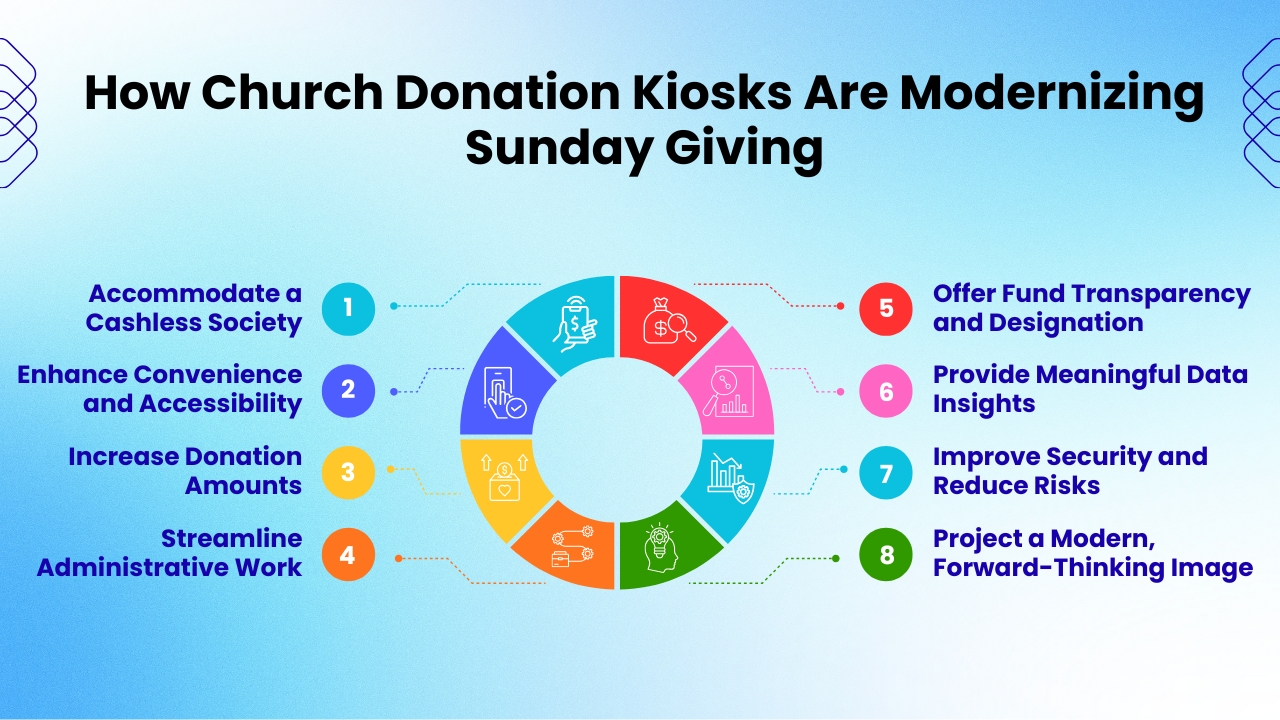
Below are 8 key ways church giving kiosks modernize Sunday giving and strengthen financial stewardship:
1. Accommodate a Cashless Society
With very few people carrying cash or cheques, many churchgoers struggle to participate in traditional offerings. Donation kiosks offer multiple digital payment options like credit or debit cards, contactless payments , and mobile wallets ensuring that every member can donate easily irrespective of how they choose to pay in their daily lives. Such inclusivity makes it easier for more people to donate regularly, without any unnecessary challenges.
2. Enhance Convenience and Accessibility
Kiosks allow people to donate anytime when the church is open, and not just during one part of the service. Their intuitive touchscreen interfaces make them easy for all age, gender, income, occupation, so that even older adults or for those even with mobility challenges.
Such flexibility encourages spontaneous and consistent giving.
3. Increase Donation Amounts
Digital giving naturally increases the number of contributions. Features such as preset donation amounts, recurring gift options, and fund selections encourage generosity and help donors feel more connected to the mission of the church. Such tools often motivate people to donate more than they might with cash.
4. Streamline Administrative Work
Kiosks automate payment processing, data entry, and record-keeping. It reduces manual tasks for staff and volunteers and thereby eliminating counting errors, and ensures every donation is securely tracked. Churches save valuable time while maintaining accurate and organized financial records.
5. Offer Fund Transparency and Designation
Members can select the exact ministry or project that they want to support like missions, youth programs, building funds, or emergency relief. This transparency strengthens trust and shows donors how their contributions directly impact church initiatives.
6. Provide Meaningful Data Insights
Kiosks collect analytics on donation trends, busy donation times, and fund popularity. Church leaders can use this data to plan budgets, improve campaigns, and understand the giving behavior of their congregation more clearly.
7. Improve Security and Reduce Risks
Digital transactions remove the risks associated with handling large amounts of cash. Encrypted processing and secure payment systems protect both the church and its donors ensuring contributions are transferred safely every time.
8. Project a Modern, Forward-Thinking Image
Adopting donation kiosks positions the church as initiative, relevant, and adaptable. This is attractive especially to tech-savvy generations such as millennials and Gen Z, helping the church remain inviting and accessible to future members.
Why Churches Need Donation Kiosks
Churches have always been places of community, generosity, and shared purpose. But as the world evolves, so do the ways people give. Today’s congregants live in a digital-first society where convenience, technology, and instant transactions are the norm.
With fewer people carrying cash and more depending on digital payments, traditional offering methods no longer meet the needs of the modern church member.
This is where giving kiosks for churches becomes a game-changing solution. A donation kiosk does not just replace the spiritual act of giving rather it enhances. It makes generosity easier, safer, and more accessible for everyone.
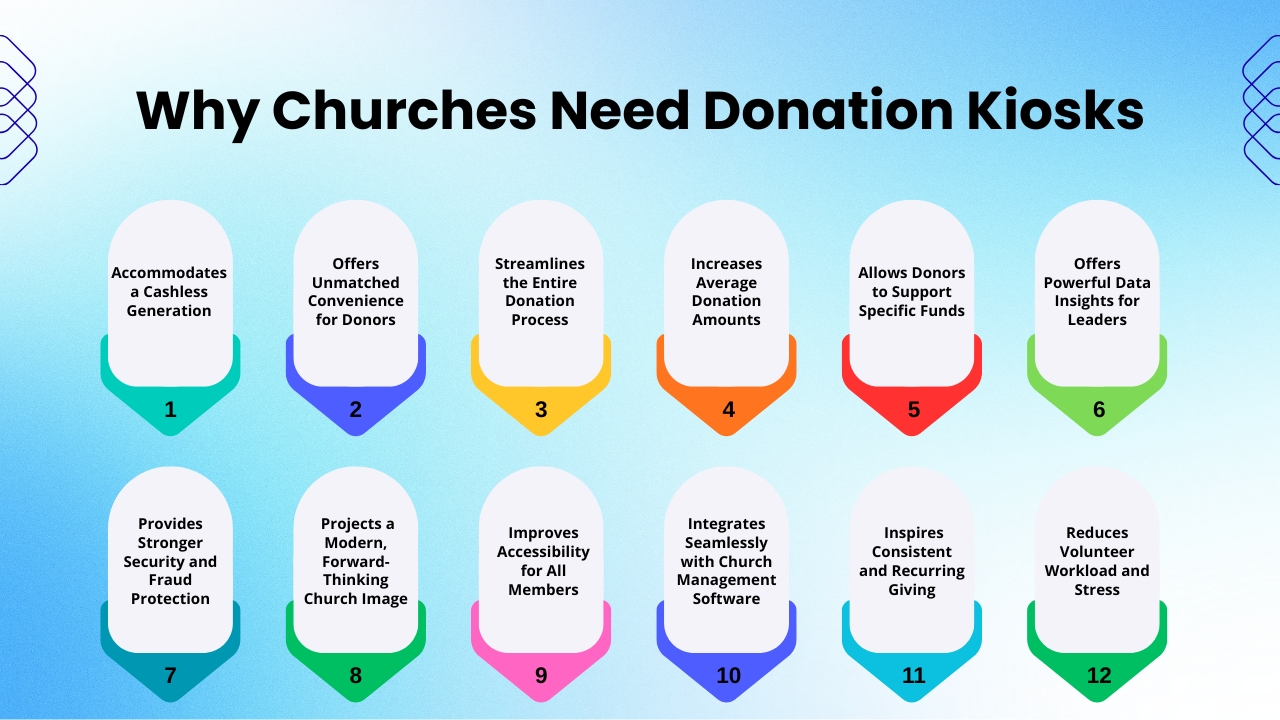
1. Accommodates a Cashless Generation
In today’s world, the majority of people simply do not carry cash or cheques. Whether grocery, paying bills, or donating to causes, digital payments have become the standard.
A church giving kiosk solves this challenge by offering multiple ways to give, including credit and debit cards, Tap-to-pay(NFC), Apple Pay and Google Pay Mobile Wallets, and QR-based payments.
It ensures that no one is excluded from participating in generosity just because they don’t have cash in their pocket. When the church provides flexible digital payment options, it aligns giving with how people already pay for everything else in their lives. A kiosk makes giving simple, modern, and universally accessible.
2. Offers Unmatched Convenience for Donors
Traditional offering times usually happen once during the service. But today’s congregants lead busy lives where parents arrive rushed, some split time between campuses, and many visitors simply prefer to give quietly on their own.
A giving kiosk for churches allows donations before service, after service, during midweek events, during community events, during community nights, and even when someone visits the church office.
This throughout the day accessibility removes barriers and encourages generosity whenever anyone is motivated to donate. When giving is convenient, more people participate leading to a healthier culture of consistent generosity.
3. Streamlines the Entire Donation Process
Manually counting envelopes, recording donation amounts, tracking cheques, and balancing totals might take time and easily lead to mistakes.
A self-service donation kiosk removes all of this manual work by automatically recording every transaction, syncing data securely which reduces the need for manual entry, offering instant receipts, and keeping financial records organized.
This gives churches cleaner, more accurate data and reduces much administrative time. Staff and volunteers can shift their efforts from paperwork to ministry work, where they make the biggest impact.
4. Increases Average Donation Amounts
Digital giving consistently leads to bigger contributions than traditional cash donations. As kiosks often show suggested donation amounts, recurring giving options, special project campaigns, and encouraging messages that encourage generosity.
So someone who is thinking of donating $10 in cash may instead select a suggested $25 or $50 amount on a kiosk simply just because the option is visible, easy, and compelling. A church donation kiosk removes friction while making donations quick and thoughtful that leads to increased donations.
5. Allows Donors to Support Specific Funds
Churches mostly manage several initiatives at the same time such as missions, youth ministries, building projects, benevolence efforts, and other ongoing programs.
Unlike traditional offering plates, a kiosk allows donors to decide clearly which fund or ministry that their gift will support. It drives greater transparency, higher trust, more intentional giving, stronger emotional connection to the mission of the church.
When people get to donate for what matters most to them, then they donate with greater passion and consistency.
6. Offers Powerful Data Insights for Leaders
A digital kiosk does not just collect money rather it collects meaningful data that helps church leaders make informed decisions. Kiosk analytics can show
peak donation days or time, most supported funds, donation patterns, average donation patterns, and donation sizes and trends in recurring donations.
With this information, churches get to launch better-targeted campaigns, improve their budgeting and forecasting, understand donor behavior, and make stewardship plans stronger. Real-time donation data is valuable for strategic planning and long-term financial health.
7. Provides Stronger Security and Fraud Protection
Handling cash has many risk factors such as loss, misplacement, theft, and even counting mistakes. Donation kiosks remove these issues by replacing physical money with secure, encrypted, and digital transactions.
Kiosks has many security features like PCI-compliant payment processing, encrypted data protection, secure cloud backups, and automatic digital receipts. It reduces stress for staff and ensures donors feel safe and protected while donating.
8. Projects a Modern, Forward-Thinking Church Image
Younger generations expect digital options everywhere from restaurants to banks to charities. When a church installs a giving kiosk, it sends a powerful message which is “We are a modern church that understands the needs of today’s world.”
It helps to attract young adults, or tech-savvy members, first-time visitors, or families who live in the digital world. A modern approach to donation reflects that your church is growing, adapting, and preparing for the future without negotiating its value or mission.
9. Improves Accessibility for All Members
Inclusivity is at the center of ministry. So donation kiosks are designed to be user-friendly and accessible for seniors, individuals with disabilities, non-English speakers, or people unfamiliar with digital devices.
Some important features include adjustable screen height, large, clear fonts, simple UI, and Multi-language support. No one should feel left out while wanting to donate and kiosks ensure everyone can participate equally and independently.
10. Integrates Seamlessly with Church Management Software
One of the most appreciated benefits of a kiosk is its ability to sync automatically with tools churches already use like planning center, Breeze, Rock RMS, Fellowship One, and Church Community Builder.
It eliminates manual data entry and ensures perfect alignment between in-person giving, online giving, and kiosk giving. And the result is accurate donor records, faster reporting, easier reconciliation, and more efficient administration. Integration keeps everything organized in one place, simplifying financial operations from start to finish.
11. Inspires Consistent and Recurring Giving
Recurring giving is essential to financial stability. Yet many members forget weekly or monthly offerings or simply get busy. A kiosk helps solve this by offering automated, recurring contributions.
Churchgoers also get to set their preferred frequency whether weekly, monthly, bi-weekly, custom schedules. It ensures predictable revenue that allows the church to plan confidently for missions, staffing, community outreach, building maintenance, and special projects.
12. Reduces Volunteer Workload and Stress
Volunteers are the backbone of a church, but counting offerings, recording data, and reconciling numbers each week can be overwhelming.A kiosk minimizes this burden by reducing cash handling, eliminating manual counting, automating record-keeping, and speeding up reconciliation.
This gives volunteers more time to serve in areas that matter most which is hospitality, youth ministry, worship support, and outreach activities. When giving is automated, volunteers experience less burnout and more fulfillment.
Tips for Effective Placement of Your Church Giving Kiosk
Where you place your church giving kiosk has a big impact on how often it’s used. Thoughtful placement of donation kiosks makes it feel natural, visible, and inviting for churchgoers.
Here are five practical tips to help you get the most from your kiosk:
1. Use High-Traffic Zones
Place the kiosk where people naturally pass by like near the main entrance, exit, lobby, coffee station, or fellowship hall. The more the number of people who see your donation kiosks then they are more likely to use it.
2. Keep It at Eye Level
Ensure that the screen is easy for users to see and reach for everyone including wheelchair users. So a height of around 45-50 inches from the floor to the center of the screen works well. While an adjustable screen angle is a big advantage.
3. Offer On-the-Spot Assistance
Especially in the early days, have a friendly volunteer or staff member nearby. A friendly question like, “Can I show you how it works?” helps ease uncertainty, encourages hesitant members to try the kiosk, and builds their confidence in using digital giving tools.
4. Choose a Visible, Secure Spot
Place the kiosk in a well-lit, open area which is easy to supervise. It promotes security and reassures users that their transactions are safe.
5. Highlight It During Special Events
For fundraisers, holiday services, or guest Sundays, move the kiosk to a highly prominent location. These are moments when people are already feeling generous and making giving as easy as possible.
How to Promote and Educate Your Congregation About the Kiosk
Introducing a new way to give can be exciting, but it’s crucial to help your congregation feel at ease and confident while using it. Below are four effective ways to promote and educate your church members about the donation kiosk.
1. Introduce the Kiosk During Services
Take a moment during Sunday services to announce the new kiosk and explain why it’s being included. Also share its advantages like convenience, accessibility, and digital payment options, and consider providing demos about how to complete a donation. When you provide a quick walkthrough helps to remove uncertainty and shows how simple the process is.
2. Highlight Security and Privacy
Many members may have questions regarding digital donations, especially around security. Ensure you explain the security features like encryption and secure payment processing of the kiosk.
Reassure the churchgoers that their information is secure and their donations remain private. Transparency helps to build trust and encourages more people to use donation kiosks for giving.
3. Offer Training and Hands-On Support
Provide short, friendly training sessions after services or during church events. Explain members step-by-step through the process and offer printed or digital guides which they can refer to later. Some people may need extra help so be patient and encourage users which will go a long way.
4. Encourage Feedback and Engagement
Make opportunities for members to share their thoughts through comment cards, a suggestion box, or an online survey. So that let them know that their feedback does matter.Use these insights to improve communication, placement, and user support as the congregation becomes more familiar with the kiosk.
Conclusion
Sunday giving has always been a spiritual act which is an expression of faith, gratitude, and community commitment. But the tools we use to give and receive that generosity are changing.
Donation kiosks don’t replace the center of worship, rather they improve it. They respect the tradition of offering while adapting to modern expectations of convenience, transparency, and connectivity.
For ministry leaders, deploying a donation kiosk is a forward thinking move which is the one that aligns with modern donor behavior, strengthens data and operational efficiency, and opens new streams of generosity.
It also shows that your church cares about accessibility, integrity, and relevance in the way it encourages people to give.
In 2025 and beyond, churches that integrate many innovative donation channels like kiosks, online portal, mobile apps will not just help to maintain financial stability but they will also make engagement deeper, grow recurring support, and make the generosity culture stronger which supports their mission.
So if you are exploring how to modernize your giving strategy, then start with a pilot kiosk. Measure the results, result to your churchgoers and iterate. While you step into the future of generosity, then you will experience that donations can be easy, meaningful, and abundant.
If you still have any query regarding how church donation kiosks are modernizing Sunday Giving then feel free to write to us at simplygiv and we are more than happy to assist you.