
Whenever Thanksgiving is near, pastors prepare themselves to walk alongside their congregations through a special season of gratitude, reflection, and renewed faith.
Thanksgiving is not just a national holiday; rather it is a sacred time for believers to pause from their busy lives and remember God’s goodness.
For both churches and ministries, thanksgiving is a special opportunity to preach strong , Bible scripture messages which touch hearts and make the sense of community more stronger.
A thoughtfully drafted Thanksgiving sermon helps pastors to connect more deeply with the congregation, inspire thankfulness, and direct everyone’s attention back to God as the ultimate giver of every blessing.
So even if your church gathers in a sanctuary, a small chapel, or through an online service, these Thanksgiving sermons will help you speak powerfully to the heart of the season.
Each message focuses on thanking God, His provision, and staying grateful in every situation.
From the Psalms of thanksgiving to Paul’s letters of encouragement, these passages remind us that gratitude is not just a response to abundance; rather it’s a lifestyle rooted in faith and trust in God.
Through this blog, we will explore 10 powerful Thanksgiving sermons that every pastor can preach this year. These sermon themes include thankfulness, generosity, contentment, worship, and God’s faithfulness which is all designed to help your church rediscover joy in gratitude.
Each sermon idea is supported by Scripture and practical insights you can adapt for your congregation, whether you are leading a traditional Thanksgiving service or a modern family gathering.
This thanksgiving, help your people look past the meals and focus on the Father’s heart. With these ten powerful messages, you can inspire genuine gratitude that lasts far beyond the holiday season transforming hearts, homes, and communities for the glory of God.
10 Powerful Thanksgiving Sermons
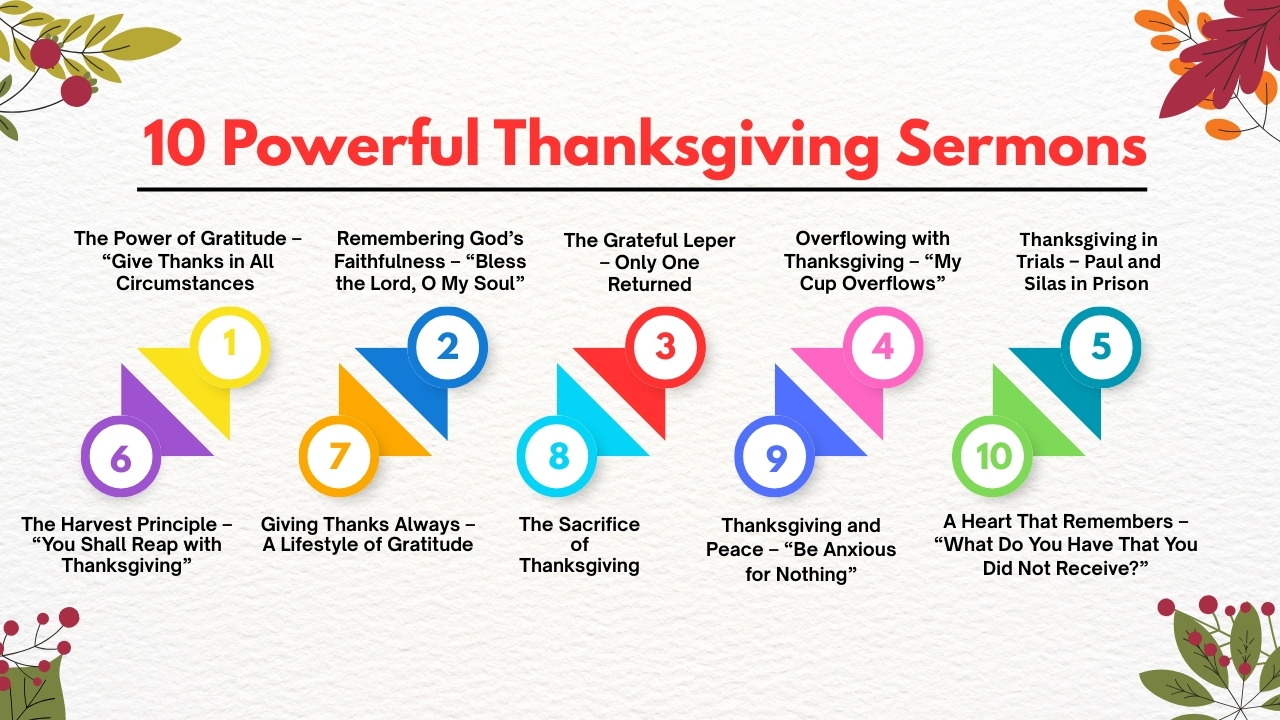
SERMON 1 The Power of Gratitude – “Give Thanks in All Circumstances
Many people want to feel thankful before they express thankfulness, but the Bible teaches us the opposite. Thankfulness is a strong spiritual behavior of each believer because it changes their focus, makes their heart stronger, and helps to see God’s goodness even during difficult times.
In 1 Thessalonians 516-18, Paul gives the early church a bold instruction “Give thanks in all circumstances.” Notice that Paul doesn’t command us to give thanks for everything, but to give thanks in everything.
Paul wrote these words to believers who were living under torture, facing hardship, and walking through deep uncertainty. His words remind us that being thankful does not depend on any situation; instead it is attached to God’s sovereignty, faithfulness, and unchanging character.
When we learn to live with a thankful heart, we discover a deeper spiritual strength and joy that circumstances cannot take away.
1. Gratitude Is a Choice Before It Becomes a Feeling
Many people wait to feel thankful before they express gratitude, but Scripture teaches the opposite. Gratitude begins with obedience and not emotion. When believers choose to thank God even when life feels confusing or painful then they align themselves with God’ truth instead of the instability of their circumstances.
Gratitude is an expression of trust that says, “God, I believe You are still good, still at work, and still in control.”
2. Gratitude Cultivates Joy
Paul connects rejoicing, prayer, and thanksgiving together because each one strengthens the others, and only a thankful heart will truly experience joy.
It means joy does not come from a perfect life rather true joy comes from knowing that God is present in each moment. By being thankful we keep ourselves spiritually open to the blessings which we may otherwise overlook. The more we practice thankfulness, the more we experience joy in our lives.
3. Gratitude Keeps Us in God’s Will
Most of the believers ask, “ What is God’s will for my life?”. Paul’s answer is simply that God’s will is that we live with a thankful health. When you are grateful then it brings your heart aligned with the purposes of God.
When we complain, we slowly drift away from God’s perspective, but when we choose to give thanks, our hearts realign with his truth and we begin walking more closely in step with his heart again.
Also Read: Text-to-Give Vs Text-to-Donate
SERMON 2 Remembering God’s Faithfulness – “Bless the Lord, O My Soul”
In Psalm 103, David does something powerful – he speaks directly to his own soul and says, “Bless the Lord.” He does not wait for his feelings to rise. He does not wait for circumstances to improve.
He commands his own heart to remember God’s goodness and respond in worship. It teaches us that thankfulness does not happen on its own but it’s something we choose on purpose.
True thanksgiving demands that we lead our own hearts instead of letting our feelings lead us. Sometimes you have to tell your soul what to do because emotions won’t take you there by themselves.
David knew how easily the human heart forgets but he must connect himself in truth by deliberately remembering who God is and what God has done.
1. Forget Not All His Benefits
David lists specific blessings to remind himself of God’s faithfulness
- Forgiveness – God removes our sin completely.
- Healing – God restores what is broken.
- Redemption – God rescues us from pits we cannot climb out of.
- Lovingkindness – God surrounds us with loyal, covenant love.
- Renewal – God revitalizes our strength like the eagle’s.
These are not small things as they are life-transforming gifts from a faithful God.
2. Gratitude Begins With Remembering
The enemy wants believers to concentrate on what is hurtful or what has not changed as per their will. But God calls us to focus on His goodness, His supplies, and His unchanging character.
When we purposefully remember God’s goodness, our mindset changes from feeling like we don’t have enough to seeing His abundance, and recalling His past faithfulness which makes our trust more stronger in what He will do in the future.
3. Gratitude Strengthens Worship
You worship more naturally when our hearts remember God’s goodness. The more we think about the benefits of the Lord, the more our spirits increase in praise.
When you are thankful you worship stronger and also remembering God’s goodness helps us to stay thankful. When you purposefully remember God’s goodness, worship becomes not just a duty but a joyful response.
Also Read: What is a Donation Kiosk
SERMON 3 The Grateful Leper – Only One Returned
In Luke 17, Jesus heals ten lepers which is an extraordinary miracle for men who had been rejected, isolated, and cut off from community. Yet after receiving this life-changing blessing, only one returned to give thanks.
The others went on with their lives, healed but unchanged in heart. This story reveals a powerful truth gratitude sets you apart. Many people receive God’s blessings, but only a few stop to thank the Giver.
The grateful leper reminds us that thanksgiving is more than polite manners which is a spiritual posture that leads us into deeper fellowship with Jesus.
1. Many Receive Blessings—Few Return to Thank the Giver
All ten lepers experienced the miracle, but only one sought out Jesus afterward. The nine enjoyed the gift but missed intimacy with the Giver.
This is a picture of how many people treat God’s blessings today when they celebrate answered prayers, provision, protection, and healing, but never return to express gratitude. God’s blessings are meant to pull us closer to Him, not push us farther away.
2. Gratitude Leads to Complete Restoration
When the one leper returned, Jesus said, “Your faith has made you whole.” The others were healed physically, but the thankful one received something extra which is spiritual wholeness.
Gratitude opens the door for deeper transformation in our hearts. When you consistently return to Jesus with thanksgiving, you don’t just experience blessings instead you experience restoration.
3. Gratitude Is Loud, Visible, and Humble
The grateful leper didn’t offer a silent or casual “thank You.” Scripture says he came back praising God with a loud voice and fell at Jesus’s feet. Genuine gratitude shows itself; it does not stay hidden.
Real gratitude is humble and willing to be seen. Gratitude does not stay silent; it becomes a testimony that honors God and builds faith.
SERMON 4 Overflowing with Thanksgiving – “My Cup Overflows”
In Psalm 235, David declares, “My cup overflows.” He is not describing a life of scarcity, struggle, or barely-enough provision. He is describing a spiritually rich life where God’s goodness is not merely enough but more than enough, it overflows.
David knew that when Lord is your shepherd, He will not stop filling your cup when it is half or even a full one instead He keeps pouring until it runs over. This overflowing cup is a metaphor for the richness of God’s presence, favor, mercy, and daily provision.
Thanksgiving begins when you know that God is never stingy with His blessings. God is generous, lavish, and excessive in the way He cares for and provides for us.
1. Gratitude Comes from Awareness of God’s Provision
We often ignore blessings from God because they appear ordinary. We often ignore daily mercies in our life like breath in our lungs, food on our table, the warmth of relationships which are the protection that we never saw and the right opportunities that came our way at just the right time.
Gratitude begins when we slow down long enough to notice the countless God’s hand is present in our everyday lives. When we start seeing these gifts, our hearts naturally overflow with thanksgiving.
2. Overflow Leads to Generosity
A heart that recognizes God’s abundance cannot help but give. When your cup overflows, generosity flows with it. You begin sharing encouragement, time, resources, forgiveness, and compassion.
You become generous because you have been given so much. True gratitude does not stay in your heart – it flows out through your hands in giving.
SERMON 5 Thanksgiving in Trials – Paul and Silas in Prison
Act 16 gives us one of the clearest and strongest examples of thanksgiving anywhere in the New Testament. Paul and Silas were not as usual in a church service with all their supportive believers around. Rather they were beaten, chained, and thrown into their inner prison, bleeding in the darkest part of the night. Yet the Bible says both Paul and Silas still prayed and sang hymns to God.
Their gratitude was not based on comfort rather it was rooted in confidence. Praise offered in hard places creates room for God to move in supernatural ways. Thanksgiving in trials is one of the clearest proofs of deep and unshakable faith.
1. Gratitude in Hard Places Changes the Atmosphere
When both Paul and Silas started to worship then the entire prison felt the impact. The whole earth shook, chains broke, and doors flew open. Gratitude changes the spiritual atmosphere. When you choose praise over despair, heaven begins to move.
2. Gratitude in Trials Demonstrates Deep Trust
Paul and Silas didn’t wait to be freed in order to start worship rather they chose to worship God before the progress happened. That kind of thankfulness says, “God, I trust you even here.” It reveals a faith which does not depend on any circumstances.
3. Gratitude Becomes a Testimony to Others
The prisoners listened. The jailer witnessed the miracle. Their gratitude turned a prison into a platform. When you praise God in your midnight hour, people notice – and God uses your worship to draw others to Himself.
Also Read: Church Donation Kiosks
SERMON 6 The Harvest Principle – “You Shall Reap with Thanksgiving”
In 2 Corinthians 9, Paul reveals a powerful spiritual principle thanksgiving, sowing, and reaping are deeply connected. God not only gives the seed but also multiplies it, producing a harvest that brings Him glory. Gratitude is the attitude that keeps this cycle going.
A thankful heart grows into a generous heart, and a generous heart becomes a blessed one; when believers give joyfully and receive gratefully, they step into God’s flow of provision, purpose, and increase.
1. God Supplies Seed and Increases It
Paul reminds us that God is the One who provides both the seed we plant and the harvest that follows. Nothing we have is by accident or just by self-effort alone. Gratitude begins when we recognize that every resource, opportunity, and blessing comes from His hand.
When we supply what He supplies, He promises to increase it – not just for our benefit, but for His kingdom’s impact.
2. Generosity Flows from a Grateful Heart
A heart without gratitude becomes closed, fearful, and protective. But a thankful heart opens wide, ready to give and bless others. Generosity is not forced rather it is the natural overflow of a grateful spirit. When we thank God for what we have, giving becomes joyful rather than burdensome.
3. Thanksgiving Amplifies the Blessing
Paul teaches that when we give, others begin to thank God. Our generosity becomes a testimony which directs people back to him. Your gift becomes someone else’s thanksgiving. In this way, gratitude multiplies, spreading from one life to another and glorifying God in the process.
SERMON 7 Giving Thanks Always – A Lifestyle of Gratitude
Gratitude was never meant to be limited to holidays, special services, or seasons of blessing. In Ephesians 520, Paul calls believers to “give thanks always for all things to God the Father in the name of our Lord Jesus Christ.”
This is not seasonal thanksgiving – it is a lifestyle. True gratitude is something we carry with us into every room, every day, and every circumstance. It becomes the tone of our hearts and the pattern of our daily lives.
1. Gratitude Flows Through Christ
Paul highlights that we give thanks to God through Jesus Christ. It teaches us that our reason and the source of thankfulness is Jesus Christ. Even if you feel that life is uncertain, one thing that remains constant is Jesus.
His sacrifice, His love, His grace, and His presence are more than enough for ourselves to keep our hearts to be continuously thankful. Thankfulness connected to Jesus Christ is unshakable because Jesus Christ is constant.
2. Gratitude Changes Relationships
Grateful people are able to love more as they complain less, are graceful, and build unity rather than dividing. Thankfulness slowly changes how we speak , become more patient, and allow us to become better spouses, friends, coworkers and Church members. A heart full of gratitude can never remain bitter.
SERMON 8 The Sacrifice of Thanksgiving
Most people associate thanksgiving with joy, blessings, and celebration. But the Bible mentions that there is also another side to thanksgiving. It says thanksgiving can sometimes be a sacrifice.
Psalm 5014 calls us to “offer to God a sacrifice of thanksgiving.” Hebrews 1315 echoes this truth, urging believers to continually offer a sacrifice of praise even when it costs something.
There are certain phases in our life when we naturally feel thankful but there are also other phases in our life when it is painful to feel thankful. And thanksgiving during difficult times in itself becomes worship in its purest form.
When you thank God through tears, disappointment, grief, or confusion, you are giving Him something precious and deeply honoring.
1. Sometimes Thankfulness Is Costly
It is easy to be thankful when you feel your life is good, prayers are answered and you are able to experience blessings.
It is easy to be thankful when you feel life is good, prayers are answered, and you can experience blessings. True spiritual maturity is seen when gratitude still comes from a heart that is hurting.
When you are tired, grieving, disappointed, or carrying a burden and you still choose to lift your hands in praise which is a sacrifice. It means you value God above your emotions
2. God Honors Sacrificial Gratitude
God is deeply moved by thanksgiving that costs us something. He says in Psalm 50 that this kind of gratitude “honors Me.” Anyone can praise God when you are on the mountaintop, but heaven notices when believers praise Him in the valley.Sacrificial gratitude says, “God, I trust You even when I don’t understand.”
SERMON 9 Thanksgiving and Peace – “Be Anxious for Nothing”
In Philippians 46-7, Paul offers one of the strongest remedies for anxiety bring your requests to God in prayer with thanksgiving. He teaches us that thankfulness is not just an addition to prayer rather it is the invisible force which brings peace.
Whenever anxiety increases, one naturally begins to worry, overthink, or try to fix things ourselves. But Paul teaches us believers towards a spiritual practice of the heart combining prayer with thankfulness.
By being thankful you shift the focus from the problem to the God who is greater than the problem. It reminds us that the One we pray to is faithful, and present. Thankfulness is not just a feeling rather it is a weapon against anxiety and fear.
1. Prayer with Thanksgiving Brings Peace
Paul acknowledges that you can pray and still feel anxious. But when you add thanksgiving, something changes. Gratitude turns desperate prayers into trusting prayers.
It helps you remember what God has already done – His faithfulness, His protection, His provision. When prayer is combined with thanksgiving, the heart settles, and peace begins to flow.
2. Peace Guards the Mind
Paul says the peace of God will “guard” your heart and mind. The Greek word used here refers to a military guard standing watch. God’s peace acts like a soldier at the gate of your mind, blocking fear, worry, and panic. Thanksgiving is the doorway which invites this supernatural peace to stand guard over your life.
Also Read: Top Benefits of Using Donation Kisoks for Non-Profit & Charities
SERMON 10 A Heart That Remembers – “What Do You Have That You Did Not Receive?”
In 1 Corinthians 47, Paul asks a piercing question “What do you have that you did not receive?” With one sentence, he tears down pride and reminds believers that everything – skills, opportunities, breath, health, relationships, salvation is a gift from God.
Pride forgets this truth and begins to claim worship. Gratitude remembers and gives glory back to the Giver. A thankful heart cannot be prideful and a prideful heartful cannot truly give thanks.
When we remember God as the source of every blessing, humility rises, worship flows, and stewardship grows. Gratitude becomes the anchor that keeps our hearts drifting into entitlement or self-reliance.
1. Gratitude Destroys Pride
Pride whispers, “I earned this” or “I did this myself.” But the Bible teaches us that every good thing comes from above. It is only by remembering God as the source of our gifts, talents, income, opportunities, and growth that keeps our hearts humble.
Gratitude is a spiritual posture that says, “Lord, without You, I have nothing.” It shatters the illusion that we are self-sufficient.
2. Gratitude Builds Worship
When we acknowledge God as the giver, worship becomes natural. Every blessing becomes a reason to praise. Every provision becomes a reminder of His kindness.
Gratitude redirects our eyes upward, turning ordinary moments into opportunities for worship. A grateful heart sees God’s fingerprints everywhere and responds in praise.
Conclusion
As Thanksgiving comes near, the church has a unique opportunity to slow down, understand , and know the blessings of God that we have in our lives every day.
These ten Thanksgiving sermons are designed to help pastors teach their congregation more deeply into thankfulness which is not just a holiday theme but also a spiritual path to be involved in our daily lives.
Each sermon shows a different aspect of thanksgiving gratitude in trials, remembering God’s faithfulness, worship as an act of trust, generosity as a response to blessing, and the continual call to give thanks in all circumstances.
Preaching these truths helps believers to shift their focus from what is lacking to what God has already provided. Gratitude strengthens faith, renews joy, and develops unity within the church.
It encourages spiritual maturity by teaching us to worship even when life feels heavy, to remember God’s past faithfulness, and to return thanks like the grateful leper who refused to forget to One who healed him. Thanksgiving becomes a way to re-anchor our hearts in God’s goodness.
More than a tradition, thanksgiving is a powerful spiritual weapon. It silences anxiety, breaks chains in midnight seasons, opens doors for miracles, and transforms how we see ourselves, our blessings, and our God.
When pastors lead their people into a deeper understanding of gratitude, entire families and communities are changed. This Thanksgiving season, may your sermons draw people closer to Jesus, open their eyes to His daily mercies, and ignite heartfelt worship.
As your congregation learns to cultivate a lifestyle of gratitude, they will not only celebrate God’s blessings – they will become living testimonies of His overflowing goodness all year long.
If you still have any query regarding Thanksgiving sermons feel free to write to us at simplygiv and we are more than happy to assist you.